Get notified by email when this case is updated.
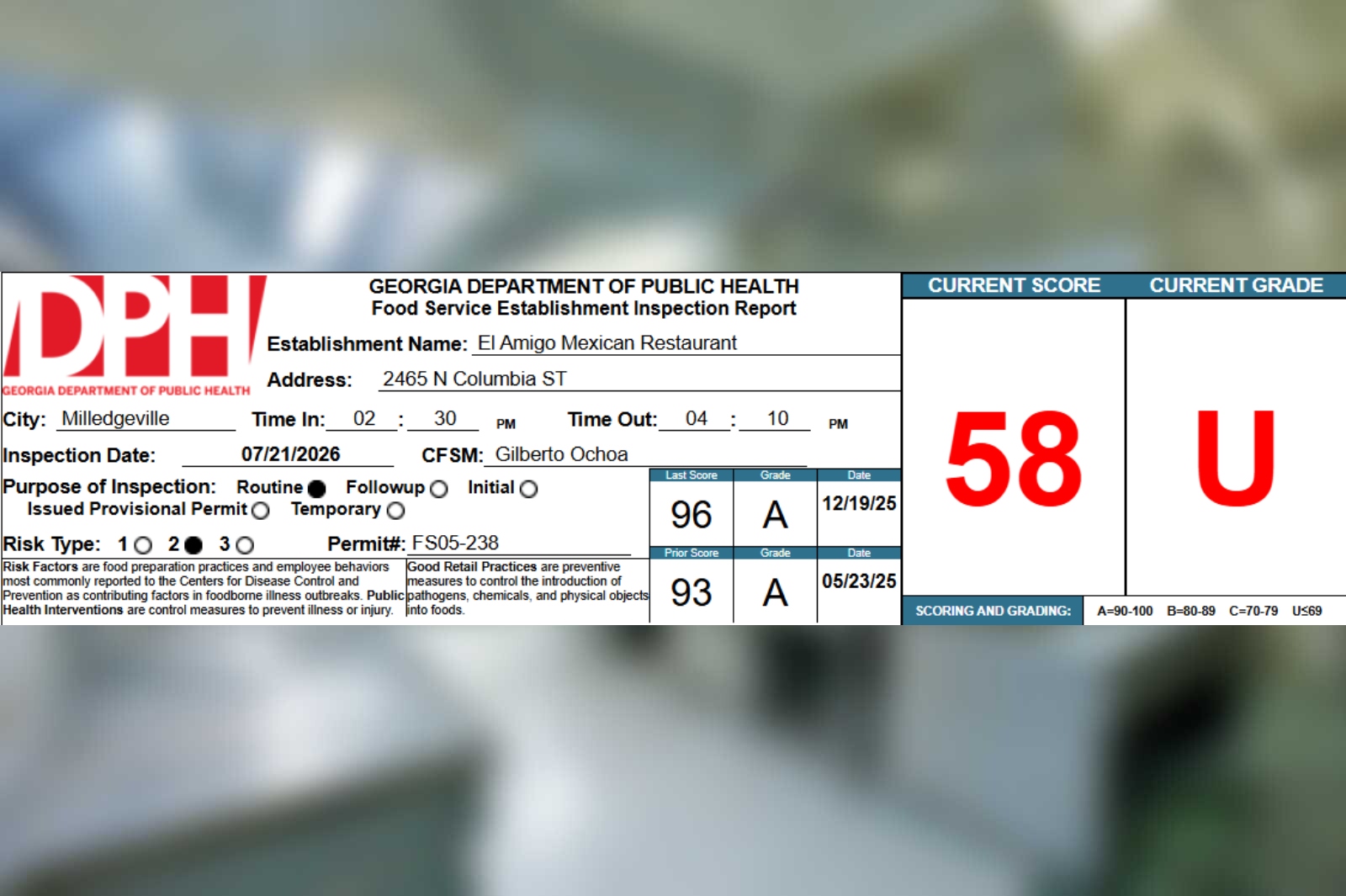
El Amigo Mexican Restaurant, located at 2465 N Columbia St, Milledgeville, GA 31061, received a score of 58 points out of a possible 100 points during their 07/21/2026 inspection by the Georgia Department of Public Health.
The violations noted by the inspector were:
Violation #1:
1-2A – pic present, demonstrates knowledge, performs duties
511-6-1.03(2)(a)-(n)(p),(q) – responsibility of pic (pf)
Points: 4
Corrected during inspection?: No
Repeat: No
Inspector Notes: Observed a person not employed at facility making drinks at the bar. 511-6-1.03(2)(a)-(n)(p),(q) – Responsibility of PIC (Pf) (a)Operations Not Conducted in Private Home. Food service establishment operations are not conducted in a private home or in a room used as living or sleeping quarters; Pf (b) Authorized Personnel Access. Persons unnecessary to the food service establishment operation are not allowed in the food preparation, food storage, or warewashing areas, except that brief visits and tours may be authorized by the person in charge if steps are taken to ensure that exposed food; clean equipment, utensils, and linens; and unwrapped single-service and single-use articles are protected from contamination; Pf (c) Authorized Persons Compliance. Employees and other persons such as delivery and maintenance persons and pesticide applicators entering the food preparation, food storage, and warewashing areas comply with this Chapter; Pf (d) Employee Handwashing. Employees are effectively cleaning their hands, by routinely monitoring the employees’ handwashing; Pf (e) Monitoring of Receiving. Employees are visibly observing and verifying delivered foods as they are received to determine that they are from approved sources and are placed into appropriate storage locations, as required by this Chapter, such that they are received and maintained at the required temperatures, protected from contamination, unadulterated, and accurately presented, by routinely monitoring the employees’ observations, maintaining receiving/corrective action records for deliveries during non-operating hours, and periodically evaluating foods upon their receipt as specified within DPH Rule 511-6-1-.04(3)(m);Pf (f) Monitoring of Receiving during Non-Operating Hours. Employees are verifying that foods delivered to the food service establishment during non-operating hours are from approved sources and are placed into appropriate storage locations such that they are maintained at the required temperatures, protected from contamination, unadulterated, accurately presented, by routinely monitoring the employees’ observations, maintaining receiving/corrective action records for deliveries during non-operating hours and periodically evaluating foods upon their receipt as specified within DPH Rule 511-6-1-.04(3)(m);Pf (g) Proper Cooking Techniques. Employees are properly cooking, cold/hot holding, and reheating for hot holding time/temperature control for safety food, being particularly careful in cooking, reheating, and holding those foods known to cause severe foodborne illness and death, such as eggs and comminuted meats, through daily oversight of the employees’ routine monitoring of the cooking, holding, and reheating for hot holding temperatures using appropriate temperature measuring devices properly scaled and calibrated;Pf (h) Proper Cooling Methods. Employees are using proper methods to rapidly cool time/temperature control for safety food, that are not held hot or are not for consumption within four hours, through daily oversight of the employees’ routine monitoring of food temperatures during cooling;Pf (i) Proper Thawing. Food employees are properly maintaining the temperature of Time/Temperature control for safety foods during thawing through daily oversight of the food employee’s routine monitoring of food temperatures;Pf (j) Consumer Food Safety. Consumers who order raw or partially cooked ready-to-eat foods of animal origin are informed that the food is not cooked sufficiently to ensure its safety;Pf (k) Proper Sanitizing. Employees are properly sanitizing cleaned multiuse equipment and utensils before they are reused, through routine monitoring of solution temperature and exposure time for hot water sanitizing, and chemical concentration, pH, temperature, and exposure time for chemical sanitizing;Pf (l) Clean Tableware. Consumers are notified that clean tableware is to be used when they return to self-service areas such as salad bars and buffets;Pf (m) Bare Hand Contact. Unless the conditions specified in DPH Rule 511-6-1-.04(4)(a)4. are met, employees are preventing cross-contamination of ready-to-eat food with bare hands by properly using suitable utensils such as deli tissue, spatulas, tongs, single-use gloves, or dispensing equipment;Pf (n) Food Safety Training. Employees are properly trained in food safety, including food allergy awareness, as it relates to their assigned duties. Food allergy awareness includes describing foods identified as major food allergens and the symptoms that a major food allergen could cause in a sensitive individual who has an allergic reaction;Pf (o) Reporting Responsibilities. Food employees and conditional employees are informed in a verifiable manner of their responsibility to report in accordance with the Chapter, to the person in charge, information about their health and activities as they relate to diseases that are transmissible through food;Pf (p) Imminent Health Hazard. If an imminent health hazard exists because of an emergency such as a fire, flood, interruption of electrical or water service for two or more hours, sewage malfunction, misuse of poisonous or toxic materials, onset of an apparent foodborne illness outbreak, gross unsanitary occurrence or condition, or other circumstances that may endanger public health, then operations are immediately discontinued and the Health Authority is notified. P However, establishments may continue to operate based upon emergency guidance provided by the Health Authority or under an emergency operation plan that has been approved by the Health Authority prior to the occurrence of such emergency events; Pf and (q) Procedures and Plans. Written procedures and plans, where specified by this Chapter and as developed by the food service establishment, are maintained and implemented as required. Pf PIC was notified. Education was provided.
Violation #2:
3-1C – food in good condition, safe, and unadulterated
511-6-1.04(1) – safe, unadulterated and honestly presented (p)
Points: 9
Corrected during inspection?: No
Repeat: No
Inspector Notes: Observed mold like substance on cheese and onions in WIC. 511-6-1.04(1) – Safe, unadulterated and Honestly Presented (P) (1) Condition. Food shall be safe, unadulterated, and honestly presented PIC was notified. Education was provided.
Violation #3:
4-1A – food separated and protected
511-6-1.04(4)(c)1(i)(ii)(iii)(v)(vi)(vii)(viii) – packaged & unpackaged food separation, packaging, and segregation (p, c)
Points: 9
Corrected during inspection?: No
Repeat: No
Inspector Notes: Observed tamale wraps stored with pest control devices and linens. 511-6-1.04(4)(c)1(i)(ii)(iii)(v)(vi)(vii)(viii) – Packaged & Unpackaged Food Separation, Packaging, and Segregation (P, C) (c) Packaged and Unpackaged Food – Separation, Packaging, and Segregation. 1. Food shall be protected from cross contamination by: (i) Except as specified in paragraph (i)(IV) of this subsection, separating raw animal foods during storage, preparation, holding, and display from: (I) Raw ready-to-eat food including other raw animal food such as fish for sushi or molluscan shellfish, or other raw ready-to-eat food such as fruits and vegetables, P and (II) Cooked ready-to-eat food; and P (III) Fruits and vegetables before they are washed; P (IV) Frozen, commercially processed and packaged raw animal food may be stored or displayed with or above frozen, commercially processed and packaged, ready-to-eat food. (ii) Except when combined as ingredients, separating types of raw animal foods from each other such as beef, fish, lamb, pork, and poultry during storage, preparation, holding, and display by: (I) Using separate equipment for each type, P or (II) Arranging each type of food in equipment so that cross contamination of one type with another is prevented, P and (III) Preparing each type of food at different times or in separate areas; P (iii) Cleaning and sanitizing equipment and utensils; (v) Cleaning hermetically sealed containers of food of visible soil before opening; (vi) Protecting food containers that are received packaged together in a case or overwrap from cuts when the case or overwrap is opened; (vii) Storing damaged, spoiled, or recalled food being held in the food service establishment separate from food, equipment, utensils, linens and single-service and single-use articles; or (viii) Separating fruits and vegetables, before they are washed from ready-to-eat food. PIC was notified. Education was provided.
Violation #4:
4-2A – food stored covered
511-6-1.04(4)(c)1(iv) – packaged & unpackaged food, food stored covered(c)
Points: 4
Corrected during inspection?: No
Repeat: No
Inspector Notes: observed tamales uncovered in RIF. 511-6-1.04(4)(c)1(iv) – Packaged & Unpackaged Food, food stored covered(C) (iv) Except as specified under paragraph 2. of this subsection and when cooling as specified in DPH Rule 511-6-1-.04(6)(e)2.(ii), storing the food in packages, covered containers, or wrappings, except for loosely covered or uncovered containers in which food is being cooled if protected from overhead contamination; PIC was notified. Education was provided.
Violation #5:
4-2B – food-contact surfaces: cleaned & sanitized
511-6-1.05(7)(b) – food contact surfaces and utensils – cleaning frequency (p, c)
Points: 4
Corrected during inspection?: No
Repeat: No
Inspector Notes: Observed a black mold like substance in ice machine. 1. Equipment food-contact surfaces and utensils shall be clean to sight and touch. PIC was notified. Education was provided.
Violation #6:
6-1A – proper cold holding temperatures
511-6-1.04(6)(f) – time/temperature control for safety; cold holding (p)
Points: 9
Corrected during inspection?: No
Repeat: No
Inspector Notes: Observed chicken at 48F and cheese stored at 49 and 48 in WIC. 511-6-1.04(6)(f) – Time/Temperature Control for Safety; Cold Holding (P) (f) Time/Temperature Control for Safety Food, Hot and Cold Holding. Except during preparation, cooking, or cooling, or when time is used as the public health control, time/temperature control for safety food shall be maintained at 41°F (5°C) or below or 135°F (57°C) or above, except that roasts cooked to a temperature and for a time specified in subsection (5)(a)2 of this Rule and reheated using the same temperature and time conditions as cooking may be held at a temperature of 130°F (54°C) or above. P PIC was notified. Education was provided.
Violation #7:
6-1A – proper cold holding temperatures
511-6-1.04(6)(f) – time/temperature control for safety; cold holding (p)
Points: 9
Corrected during inspection?: No
Repeat: No
Inspector Notes: Observed tomatoes at 64 and cooked chicken at 65 on counter in main kitchen. 511-6-1.04(6)(f) – Time/Temperature Control for Safety; Cold Holding (P) (f) Time/Temperature Control for Safety Food, Hot and Cold Holding. Except during preparation, cooking, or cooling, or when time is used as the public health control, time/temperature control for safety food shall be maintained at 41°F (5°C) or below or 135°F (57°C) or above, except that roasts cooked to a temperature and for a time specified in subsection (5)(a)2 of this Rule and reheated using the same temperature and time conditions as cooking may be held at a temperature of 130°F (54°C) or above. PIC was notified. Education was provided.
Violation #8:
6-2 – proper date marking and disposition
511-6-1.04(6)(g) – ready-to-eat time/temperature control for safety food, date marking (pf)
Points: 4
Corrected during inspection?: No
Repeat: No
Inspector Notes: Observed cooked chicken and cooked beef in WIC without a date. 511-6-1.04(6)(g) – Ready-To-Eat Time/Temperature Control for Safety Food, Date Marking (Pf) (g) Ready-to-Eat Time/Temperature Control for Safety Food, Date Marking 1. Except when packaging food using a reduced oxygen packaging method, and except as specified in paragraphs 5 and 6 of this subsection, refrigerated, ready-to-eat, time/temperature control for safety food prepared and held in a food establishment for more than 24 hours shall be clearly marked to indicate the date or day by which the food shall be consumed on the premises, sold, or discarded, when held at a temperature of 41°F (5°C) or below for a maximum of 7 days. The day of preparation shall be counted as Day 1. Pf 2. Except as specified in paragraphs 5 through 7 of this subsection, refrigerated, ready-to-eat, time/temperature control for safety food prepared and packaged by a food processing plant shall be clearly marked, at the time the original container is opened in a food service establishment and if the food is held for more than 24 hours, to indicate the date or day by which the food shall be consumed on the premises, sold, or discarded, when held at a temperature of 41°F (5°C) or below for a maximum of 7 days after the original container is opened. The day the original container is opened in the food service establishment shall be counted as Day 1, except, the day or date marked by the food service establishment may not exceed a manufacturer’s use by date if the manufacturer determined the use-by date based on food safety; Pf 3. A refrigerated, ready-to-eat, time/temperature control for safety food ingredient or a portion of a refrigerated, ready-to-eat, time/temperature control for safety food that is subsequently combined with additional ingredients or portions of food shall retain the date marking of the earliest-prepared or first-prepared ingredient. Pf 4. A date marking system that meets the criteria stated in paragraphs 1 and 2 of this subsection may include: (i) Using a method approved by the Health Authority for refrigerated, ready-to-eat time / temperature control for safety food that is frequently rewrapped, such as lunchmeat or a roast, or for which date marking is impractical, such as soft serve mix or milk in a dispensing machine; (ii) Marking the date or day of preparation, with a procedure to discard the food on or before the last date or day by which the food must be consumed on the premises, sold, or discarded; (iii) Marking the date or day the original container is opened in a food service establishment, with a procedure to discard the food on or before the last date or day by which the food must be consumed on the premises, sold, or discarded; or (iv) Using calendar dates, days of the week, color-coded marks, or other effective marking methods, provided that the marking system is disclosed to the Health Authority upon request. 5. The requirements in paragraphs 1 and 2 of this subsection do not apply to individual meal portions served or repackaged for sale from a bulk container upon a consumer’s request. 6. The requirements in paragraphs 1 and 2 of this subsection do not apply to shellstock. 7. The requirement in paragraph 2 of this subsection does not apply to the following foods prepared and packaged by a food processing plant inspected by a Health Authority: (i) Deli salads, such as ham salad, seafood salad, chicken salad, egg salad, pasta salad, potato salad, and macaroni salad, manufactured in accordance with 21 CFR 117 Current good manufacturing practice in manufacturing, packing, or holding human food; (ii) Hard cheeses containing not more than 39% moisture as defined in 21 CFR 133 Cheeses and related cheese products, such as cheddar, gruyere, parmesan and reggiano, and romano; (iii) Semi-soft cheeses containing more than 39% moisture, but not more than 50% moisture, as defined in 21 CFR 133 Cheeses and related cheese products, such as blue, edam, gorgonzola, gouda, and monterey jack; (iv) Cultured dairy products as defined in 21 CFR 131 Milk and cream, such as yogurt, sour cream, and buttermilk; (v) Preserved fish products, such as pickled herring and dried or salted cod, and other acidified fish products defined in 21 CFR 114 Acidified foods; (vi) Shelf stable, dry fermented sausages, such as pepperoni and Genoa salami; and (vii) Shelf stable salt-cured products, such as prosciutto and Parma ham. PIC was notified. Education was provided.
Violation #9:
18 – insects, rodents, and animals not present
511-6-1.07(5)(k) – controlling pests (pf, c)
Points: 3
Corrected during inspection?: No
Repeat: No
Inspector Notes: Observed several flies in the main kitchen area and in the back storage area.511-6-1.07(5)(k) – Controlling Pests (Pf, C) (k) Controlling Pests. The presence of insects, rodents, and other pests shall be controlled to minimize their presence on the premises by: 1. Routinely inspecting incoming shipments of food and supplies; 2. Routinely inspecting the premises for evidence of pests; 3. Using methods, if pests are found, such as trapping devices or other means of pest control as specified under subsections (6)(e), (6)(m), and (6)(n) of this Rule; Pf and 4. Eliminating harborage conditions. PIC was notified. Education was provided.
CLICK HERE to read the full report
