You're not signed in. Sign in to remove ads.

Sign in
Dark
Light
April 29, 2026
August 17, 2024

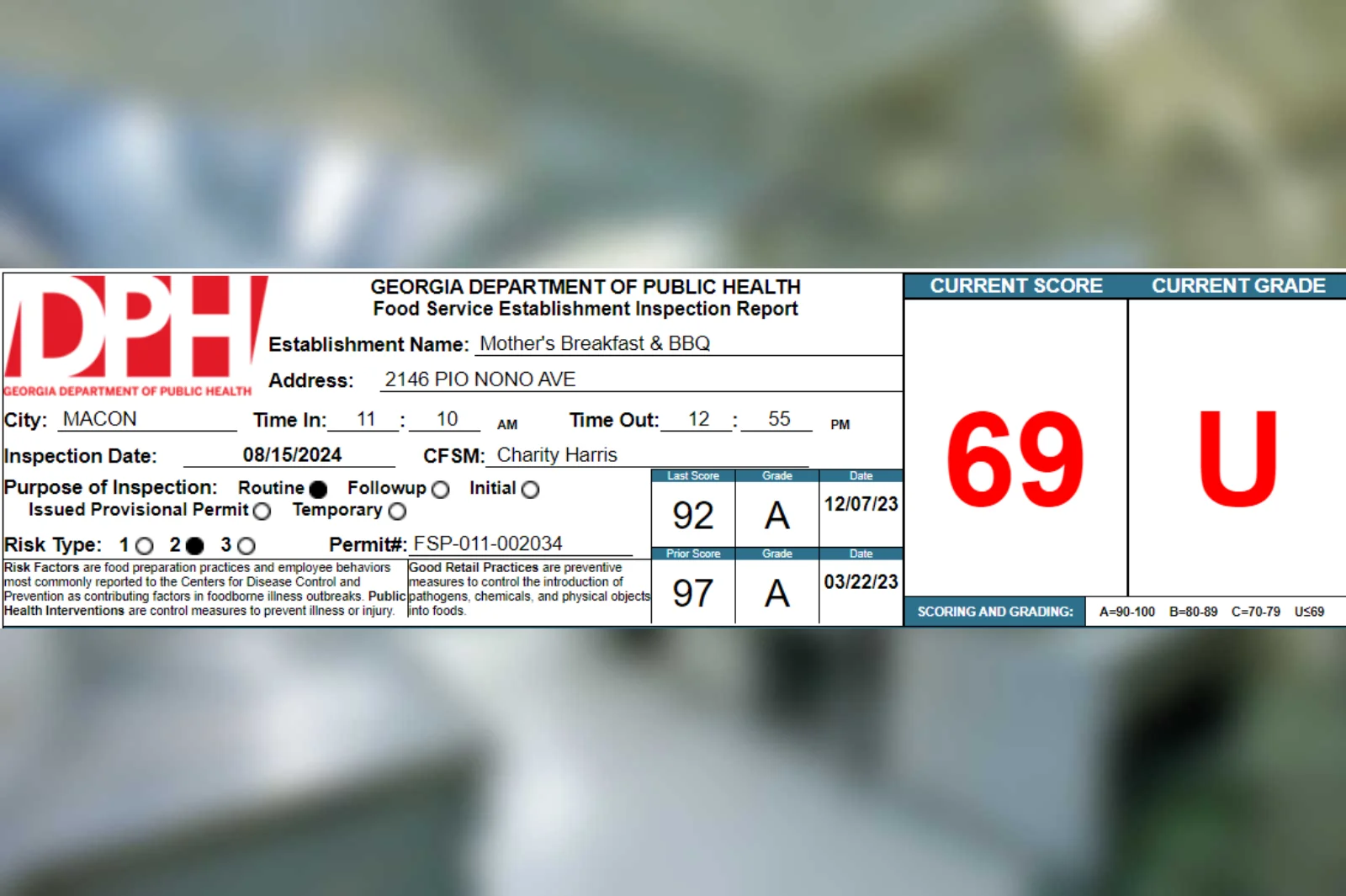
Mother’s Breakfast & BBQ in Macon receives a 69% on their recent health inspection

Follow This Case

Get notified by email when this case is updated.

Mother’s Breakfast & BBQ, located at 2146 Pio Nono Ave in Macon, received a score of 69 points out of a possible 100 points during their 08/15/2024 inspection by the Georgia Department of Public Health.

The violations noted by the inspector were:

Violation #1:
3-1C – food in good condition, safe, and unadulterated
511-6-1.04(1) – safe, unadulterated and honestly presented (p)
Points: 9
Corrected during inspection?: Yes
Repeat: No
Inspector Notes: Observed molded cheese cubes, lemons, and limes in the WIC. (1) Condition. Food shall be safe, unadulterated, and honestly presented. EHS informed the kitchen manager who then discarded the items.

Violation #2:
6-1B – proper hot holding temperatures
511-6-1.04(6)(f) – time/temperature control for safety; hot holding (p)
Points: 9
Corrected during inspection?: Yes
Repeat: No
Inspector Notes: Observed items that were hot holding on the line and warming cabinet that were not at the appropriate temperature. (f) Time/Temperature Control for Safety Food, Hot and Cold Holding. Except during preparation, cooking, or cooling, or when time is used as the public health control, time/temperature control for safety food shall be maintained at 41°F (5°C) or below or 135°F (57°C) or above. EHS informed PIC of the need to reheat items.

Violation #3:
6-2 – proper date marking and disposition
511-6-1.04(6)(g) – ready-to-eat time/temperature control for safety food, date marking (pf)
Points: 4
Corrected during inspection?: Yes
Repeat: No
Inspector Notes: Observed items that were made on yesterday with no form of date marking. (g) Ready-to-Eat Time/Temperature Control for Safety Food, Date Marking 1. Except when packaging food using a reduced oxygen packaging method, and except as specified in paragraphs 4 and 5 of this subsection, refrigerated, ready-to-eat, time/temperature control for safety food prepared and held in a food establishment for more than 24 hours shall be clearly marked to indicate the date or day by which the food shall be consumed on the premises, sold, or discarded, when held at a temperature of 41°F (5°C) or below for a maximum of 7 days. The day of preparation shall be counted as Day 1. Pf 2. Except as specified in paragraphs 4 through 6 of this subsection, refrigerated, ready-to-eat, time/temperature control for safety food prepared and packaged by a food processing plant shall be clearly marked, at the time the original container is opened in a food service establishment and if the food is held for more than 24 hours, to indicate the date or day by which the food shall be consumed on the premises, sold, or discarded, when held at a temperature of 41°F (5°C) or below for a maximum of 7 days after the original container is opened. The day the original container is opened in the food service establishment shall be counted as Day 1, except, the day or date marked by the food service establishment may not exceed a manufacturer’s use by date if the manufacturer determined the use-by date based on food safety; Pf 3. A refrigerated, ready-to-eat, time/temperature control for safety food ingredient or a portion of a refrigerated, ready-to-eat, time/temperature control for safety food that is subsequently combined with additional ingredients or portions of food shall retain the date marking of the earliest-prepared or first-prepared ingredient. Pf 4. A date marking system that meets the criteria stated in paragraphs 1 and 2 of this subsection may include: (i) Using a method approved by the Health Authority for refrigerated, ready-to-eat time / temperature control for safety food that is frequently rewrapped, such as lunchmeat or a roast, or for which date marking is impractical, such as soft serve mix or milk in a dispensing machine; (ii) Marking the date or day of preparation, with a procedure to discard the food on or before the last date or day by which the food must be consumed on the premises, sold, or discarded; (iii) Marking the date or day the original container is opened in a food service establishment, with a procedure to discard the food on or before the last date or day by which the food must be consumed on the premises, sold, or discarded; or (iv) Using calendar dates, days of the week, color-coded marks, or other effective marking methods, provided that the marking system is disclosed to the Health Authority upon request. 5. The requirements in paragraphs 1 and 2 of this subsection do not apply to individual meal portions served or repackaged for sale from a bulk container upon a consumer’s request. 6. The requirements in paragraphs 1 and 2 of this subsection do not apply to shellstock. 7. The requirement in paragraph 2 of this subsection does not apply to the following foods prepared and packaged by a food processing plant inspected by a Health Authority: (i) Deli salads, such as ham salad, seafood salad, chicken salad, egg salad, pasta salad, potato salad, and macaroni salad, manufactured in accordance with 21 CFR 110 Current good manufacturing practice in manufacturing, packing, or holding human food; (ii) Hard cheeses containing not more than 39% moisture as defined in 21 CFR 133 Cheeses and related cheese products, such as cheddar, gruyere, parmesan and reggiano, and romano; (iii) Semi-soft cheeses containing more than 39% moisture, but not more than 50% moisture, as defined in 21 CFR 133 Cheeses and related cheese products, such as blue, edam, gorgonzola, gouda, and monterey jack; (iv) Cultured dairy products as defined in 21 CFR 131 Milk and cream, such as yogurt, sour cream, and buttermilk; (v) Preserved fish products, such as pickled herring and dried or salted cod, and other acidified fish products defined in 21 CFR 114 Acidified foods; (vi) Shelf stable, dry fermented sausages, such as pepperoni and Genoa salami; and (vii) Shelf stable salt-cured products, such as prosciutto and Parma ham. EHS informed PIC of the need to assure all items are date marked.

Violation #4:
12B – personal cleanliness
511-6-1.03(5)(i) – hair restraints (c)
Points: 3
Corrected during inspection?: No
Repeat: No
Inspector Notes: Observed staff in need of hair restraints while working in the kitchen. (i) Hair Restraints. 1. Employees preparing or handling food shall use effective and clean, disposable or easily cleanable nets or other hair restraints approved by the Health Authority, worn properly to restrain loose hair including beards and mustaches longer than one half inch. EHS informed PIC of the need for staff to wear hair restraints while working with food and in the food prep area.

Violation #5:
12C – wiping cloths: properly used and stored
511-6-1.04(4)(m) – wiping cloths, use limitation (c)
Points: 3
Corrected during inspection?: Yes
Repeat: No
Inspector Notes: Observed used wiping cloths stored in various areas around the facility. (m) Wiping Cloths, Use Limitation. 1. Cloths in-use for wiping food spills from tableware and carry-out containers that occur as food is being served shall be: (i) Maintained dry; and (ii) Used for no other purpose. 2. Cloths in-use for wiping counters and other equipment surfaces shall be: (i) Held between uses in a chemical sanitizer solution at a concentration specified under DPH Rule 511-6-1-.05(6)(n); and (ii) Laundered daily. 3. Cloths in-use for wiping surfaces in contact with raw animal foods shall be kept separate from cloths used for other purposes. Staff removed wiping cloths before EHS could address.

Violation #6:
15A – food and nonfood-contact surfaces cleanable, properly designed, constructed, and used
511-6-1.05(6)(a) – good repair & proper adjustment (c)
Points: 1
Corrected during inspection?: No
Repeat: No
Inspector Notes: Observed excessive ice build up in the WIF. (6) Maintenance and Operation. (a) Good Repair and Proper Adjustment. 1. Equipment shall be maintained in a state of repair and condition. EHS informed the kitchen manager of the need to address the issue.

Violation #7:
15C – nonfood-contact surfaces clean
511-6-1.05(7)(a)2,3 – equipment, food/nonfood-contact surfaces, and utensils, food-contact surfaces of cooking equipment & nonfood-contact surfaces free of accumulations (c)
Points: 1
Corrected during inspection?: No
Repeat: No
Inspector Notes: Observed facility’s need to clean bulk containers routinely(inside and out). 2. The food-contact surfaces of cooking equipment and pans shall be kept free of encrusted grease deposits and other soil accumulations. 3. Nonfood-contact surfaces of equipment shall be kept free of an accumulation of dust, dirt, food residue, and other debris.EHS informed the kitchen manager.

Violation #8:
17C – physical facilities installed, maintained, and clean
511-6-1.07(5)(a),(b) – good repair, physical facilities maintained; cleaning, frequency & restrictions, cleaned often enough to keep them clean (c)
Points: 1
Corrected during inspection?: No
Repeat: Yes
Inspector Notes: Observed facility’s need to clean vents throughout the facility and ceiling tiles in the kitchen. (b) Cleaning, Frequency and Restrictions. 1. The physical facilities shall be cleaned as often as necessary to keep them clean and by methods that prevent contamination of food products. 2. Except for cleaning that is necessary due to a spill or other accident, cleaning shall be done during periods when the least amount of food is exposed, such as after closing. EHS informed PIC of the need to clean the noted areas.

Violation #9:
17C – physical facilities installed, maintained, and clean
511-6-1.07(5)(a),(b) – good repair, physical facilities maintained; cleaning, frequency & restrictions, cleaned often enough to keep them clean (c)
Points: 1
Corrected during inspection?: No
Repeat: Yes
Inspector Notes: Observed damaged floor tiles in the WIF. (5) Maintenance and Operation. (a) Good Repair. All physical facilities shall be maintained in good repair. EHS informed PIC of the need to address the issue as it is hasn’t been addressed for the past 3 inspections.

Violation #10:
17D – adequate ventilation and lighting; designated areas used
511-6-1.07(4)(b) – designated areas for employee activity, located to prevent contamination of food, equipment, utensils, linens, & single service articles (c)
Points: 1
Corrected during inspection?: Yes
Repeat: Yes
Inspector Notes: Observed keys, phone, and water bottle stored in the pass thru window and purse stored on dry storage rack with canned product. b) Designated Areas for Employee Activity. 1. Areas designated for employees to eat, drink, and use tobacco shall be located so that food, equipment, linens, and single-service and single-use articles are protected from contamination. 2. Lockers or other suitable facilities shall be located in a designated room or area where contamination of food, equipment, utensils, linens and single-service and single-use articles cannot occur. Kitchen manager stated that employee items are to be stored in the office or on the lower shelf behind the front counter.

Violation #11:
18 – insects, rodents, and animals not present
511-6-1.07(5)(k) – controlling pests (pf, c)
Points: 3
Corrected during inspection?: No
Repeat: No
Inspector Notes: Observed 2 dead roaches(lobby/employee restroom), flies, live roach near the back door, and dropping in aluminum pans used for holding seasoning containers. rodents, and other pests shall be controlled to minimize their presence on the premises by: 1. Routinely inspecting incoming shipments of food and supplies; 2. Routinely inspecting the premises for evidence of pests; 3. Using methods, if pests are found, such as trapping devices or other means of pest control as specified under subsections (6)(e), (6)(m), and (6)(n) of this Rule; Pf and 4. Eliminating harborage conditions. EHS informed PIC of the need to contact pest control and clean containers thoroughly as they are attracting pests.

Additional remarks:
Facility was unable to provide pest records for the new pest applicator. EHS informed management that if proper licensing can not be provided then they will need to find a licensed applicator.
Cooler had been open for awhile after receiving a delivery. (unit cooled from 54-46F during the inspection).

CLICK HERE to read the full report

Follow This Case

Get notified by email when this case is updated.