Read the full archive. Fewer ads, plus case alerts. Fewer ads, faster reading. Unlock the full archive. Independent local reporting. Read it all, with fewer ads.

Sign in Subscribe
Dark
Light
August 15, 2026
August 15, 2026

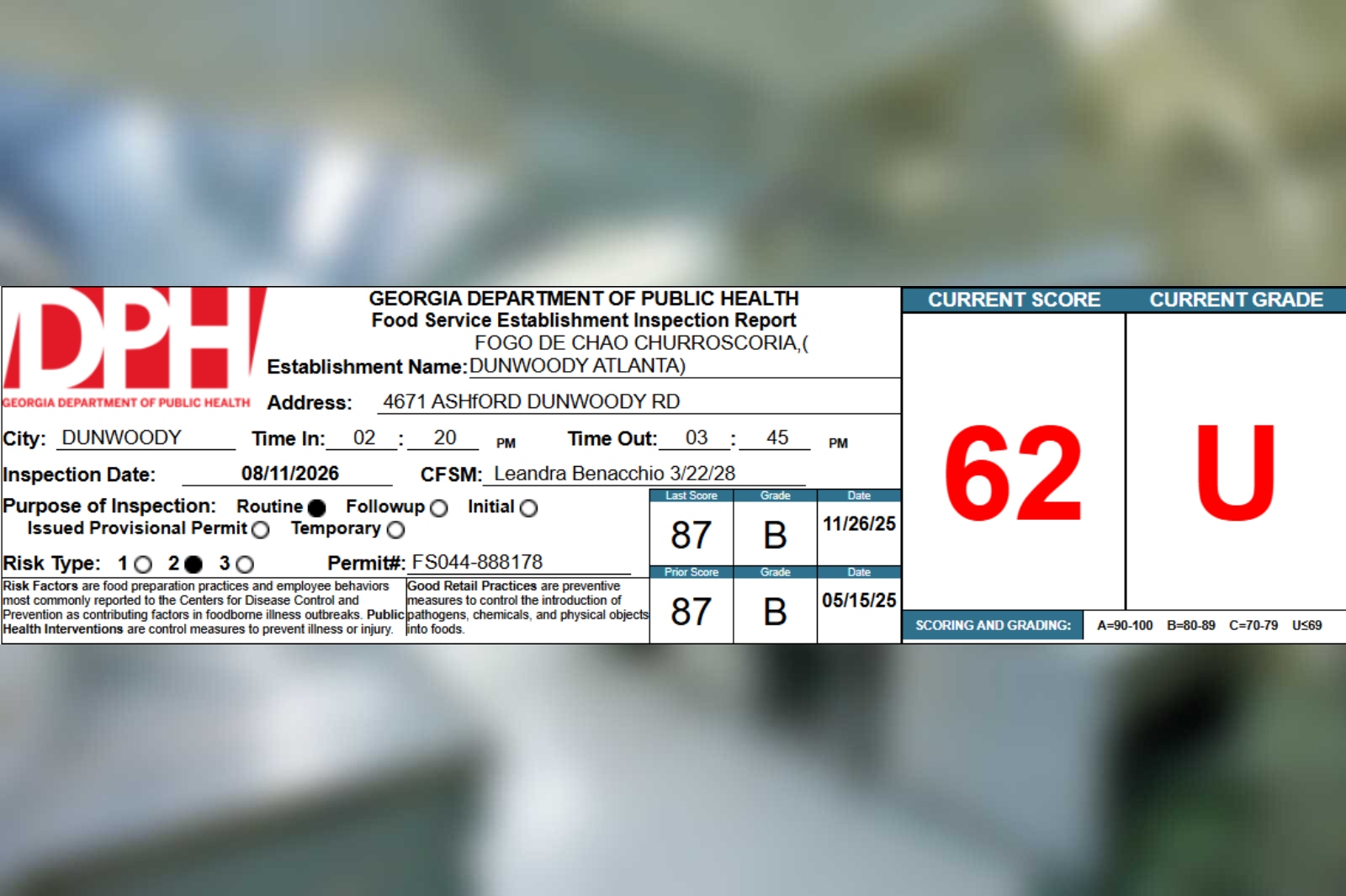
Fogo De Chao Churroscoria,(Dunwoody Atlanta) in Dunwoody receives a 62% on their recent health inspection

Follow Fogo De Chao Churroscoria,(Dunwoody Atlanta) in Dunwoody receives a 62% on their recent health inspection

Get notified by email when this case is updated.

Fogo De Chao Churroscoria,(Dunwoody Atlanta), located at 4671 Ashford Dunwoody Rd NE, Dunwoody, GA 30346, received a score of 62 points out of a possible 100 points during their 08/11/2026 inspection by the Georgia Department of Public Health.

The violations noted by the inspector were:

Violation #1:
2-1C – no bare hand contact with ready-to-eat foods or approved alternate method properly followed
511-6-1.04(4)(a)1,2,3,4(i) – preventing contamination from hands (p), (pf), (c)
Points: 9
Corrected during inspection?: Yes
Repeat: No
Inspector Notes: Observed PIC use the back of their bare hand to make direct contact with ready-to-eat cooked corn to determine whether the corn was still hot. CA: (4) Protection From Contamination After Receiving. (a) Preventing Contamination from Hands. 1. Food employees shall wash their hands as specified under DPH Rule 511-6-1-.03(5). 2. Except when washing fruits and vegetables or as specified under subsection (a)4, food employees shall not contact exposed, ready-to-eat food with their bare hands and shall use suitable utensils such as deli tissue, spatulas, tongs, single-use gloves, or dispensing equipment. P 3. Food employees shall minimize bare hand and arm contact with exposed food that is not in a ready- to-eat form. Pf 4. Paragraph (a)2. of this subsection does not apply to a food employee that contacts exposed, ready-to eat food with bare hands at the time the ready-to-eat food is being added as an ingredient to a food that: (i) contains a raw animal food and is to be cooked in the food service establishment to heat all parts of the food to at least the minimum time/temperatures specified in DPH Rule 511-6-1-.04(5)(a)1 and 2 and DPH Rule 511-6-1-.04(5)(b); P COS: PIC discarded the affected food items Employees shall not contact ready-to-eat foods with bare hands and must use suitable utensils, deli tissue, or single-use gloves.

Violation #2:
2-2B – proper eating, tasting, drinking, or tobacco use
511-6-1.04(4)(b) – preventing contamination when tasting (p)
Points: 4
Corrected during inspection?: Yes
Repeat: No
Inspector Notes: PIC was observed using their bare hand to remove a food item from a container of salt located in the food-preparation area and eating the item during the inspection. The salt is used to season food prepared and served to customers. CA: (b) Preventing Contamination When Tasting. A food employee may not use a utensil more than once to taste food that is to be sold or served. P COS: Affected food items was discarded

Violation #3:
4-1A – food separated and protected
511-6-1.04(4)(c)1(i)(ii)(iii)(v)(vi)(vii)(viii) – packaged & unpackaged food separation, packaging, and segregation (p, c)
Points: 9
Corrected during inspection?: Yes
Repeat: No
Inspector Notes: Observed raw beef and raw lobster stored next to ready-to-eat shrimp in the walk-in cooler. Raw fish was also stored next to tomatoes. In the reach-in cooler, observed raw burger patties stored above raw fish and next to pickled onions, with raw lobster and raw salmon stored next to cooked shrimp and cooked crab cake mixture. CA: (c) Packaged and Unpackaged Food – Separation, Packaging, and Segregation. 1. Food shall be protected from cross contamination by: (i) Except as specified in paragraph (i)(IV) of this subsection, separating raw animal foods during storage, preparation, holding, and display from: (I) Raw ready-to-eat food including other raw animal food such as fish for sushi or molluscan shellfish, or other raw ready-to-eat food such as fruits and vegetables, P and (II) Cooked ready-to-eat food; and P (III) Fruits and vegetables before they are washed; P (IV) Frozen, commercially processed and packaged raw animal food may be stored or displayed with or above frozen, commercially processed and packaged, ready-to-eat food. (ii) Except when combined as ingredients, separating types of raw animal foods from each other such as beef, fish, lamb, pork, and poultry during storage, preparation, holding, and display by: (I) Using separate equipment for each type, P or (II) Arranging each type of food in equipment so that cross contamination of one type with another is prevented, P and (III) Preparing each type of food at different times or in separate areas; P (iii) Cleaning and sanitizing equipment and utensils; (v) Cleaning hermetically sealed containers of food of visible soil before opening; (vi) Protecting food containers that are received packaged together in a case or overwrap from cuts when the case or overwrap is opened; (vii) Storing damaged, spoiled, or recalled food being held in the food service establishment separate from food, equipment, utensils, linens and single-service and single-use articles; or (viii) Separating fruits and vegetables, before they are washed from ready-to-eat food. COS: PIC rearranged the coolers by separating raw animal foods from ready-to-eat foods and storing raw animal foods according to their required minimum cooking temperatures.

Violation #4:
4-2B – food-contact surfaces: cleaned & sanitized
511-6-1.05(7)(a)1 – equipment, food-contact surfaces,& utensils (pf)
Points: 4
Corrected during inspection?: No
Repeat: No
Inspector Notes: Observed an accumulation of black organic growth on the interior components of the ice machine in the bar area, making direct contact with ice intended for use in customer beverages during the time of inspection. CA: (7) Cleaning of Equipment and Utensils. (a) Equipment, Food-Contact Surfaces, and Utensils. 1. Equipment food-contact surfaces and utensils shall be clean to sight and touch. Pf. Advisement: Discard the ice and clean and sanitize the interior of the ice machine according to the manufacturer’s instructions. Maintain the ice machine clean to sight and touch.

Violation #5:
6-1D – time as a public health control: procedures and records
511-6-1.04(6)(i) – time as a public health control (tphc) (p, pf, c)
Points: 9
Corrected during inspection?: No
Repeat: No
Inspector Notes: Observed no time stamps or other documentation demonstrating the use of Time as a Public Health Control for TCS food items placed on the buffet/self-service line during the current week. CA: (i) Time as a Public Health Control. 1. Except as specified under paragraph 4 of this subsection, if time without temperature control is used as the public health control for a working supply of time/temperature control for safety food before cooking, or for ready-to-eat time/temperature control for safety food that is displayed or held for sale or service, written procedures shall be prepared in advance, maintained in the food service establishment, and made available to the regulatory authority upon request that specify: Pf (i) Methods of compliance with paragraphs 2(i) – (iv) or 3(i) through (v) of this subsection; and (ii) Methods of compliance with the cooling of time/temperature control for safety food that is prepared, cooked, and refrigerated before time is used as a public health control. Pf 2. If time without temperature control is used as the public health control up to a maximum of 4 hours: (i) Except as specified in paragraph 2.(ii) of this subsection, the food shall have an initial temperature of 41°F (5°C) or less when removed from cold holding temperature control, or 135°F (57°C) or greater when removed from hot holding temperature control;P (ii) The food may have an initial temperature of 70°F (21°C) or less if; (I) It is a ready-to-eat fruit or vegetable that upon cutting is rendered a time/temperature control for safety food, or (II) It is a ready-to-eat hermetically sealed food that upon opening is rendered a time/temperature control for safety food, (III) The food temperature does not exceed 70°F (21°C) within a maximum time period of 4 hours from the time it was rendered a time/temperature control for safety food; and (IV) The food is marked or otherwise identified to indicate the time that is 4 hours past the point in time when the food is rendered a time/temperature control for safety food as specified in paragraph 2.(ii)(I) and (II). (iii) The food shall be marked or otherwise identified to indicate the time that is 4 hours past the point in time when the food is removed from temperature control;Pf (iv) The food shall be cooked and served, served at any temperature if ready-to-eat, or discarded, within 4 hours from the point in time when the food is removed from temperature control;P and (v) The food in unmarked containers or packages, or marked to exceed a 4-hour limit shall be discarded.P 3. If time without temperature control is used as the public health control up to a maximum of 6 hours: (i) The food shall have an initial temperature of 41°F (5°C) or less when removed from temperature control and the food temperature may not exceed 70°F (21°C) within a maximum time period of 6 hours; P (ii) The food shall be monitored to ensure the warmest portion of the food does not exceed 70°F (21°C) during the 6-hour period, unless an ambient air temperature is maintained that ensures the food does not exceed 70°F (21°C) during the 6-hour holding period; Pf (iii) The food shall be marked or otherwise identified to indicate: Pf (I) The time when the food is removed from 41°F (5°C) or less cold holding temperature control, Pf and (II) The time that is 6 hours past the point in time when the food is removed from cold holding temperature control; (iv) The food shall be: (I) Discarded if the temperature of the food exceeds 70°F (21°C), P or (II) Cooked and served, served at any temperature if ready-to-eat, or discarded within a maximum of 6 hours from the point in time when the food is removed from 41°F (5°C) or less cold holding temperature control; P and (v) The food in unmarked containers or packages, or marked with a time that exceeds the 6-hour limit shall be discarded. P 4. A food service establishment that serves a highly susceptible population may not use time as the public health control for raw eggs. PIC was advised to properly time-mark all applicable food items and maintain the required TPHC documentation.

Violation #6:
11C – approved thawing methods used
511-6-1.04(6)(c) – thawing (c)
Points: 3
Corrected during inspection?: No
Repeat: No
Inspector Notes: Observed bartender thawing packaged passion fruit drink mix inside the bar dishmachine during the time of inspection. CA: (c) Thawing. Except as specified in paragraph 4 of this subsection, time/temperature control for safety food shall be thawed: 1. Under refrigeration that maintains the food temperature at 41°F (5°C) or less; PF or 2. Completely submerged under running water: (i) At a water temperature of 70°F (21°C) or below, PF (ii) With sufficient water velocity to agitate and float off loose particles in an overflow PF, and (iii) For a period of time that does not allow thawed portions of ready-to-eat food to rise above 41°F (5°C), or (iv) For a period of time that does not allow thawed portions of a raw animal food requiring cooking to be above 41°F (5°C), for more than 4 hours including: (I) The time the food is exposed to the running water and the time needed for preparation for cooking PF, or (II) The time it takes under refrigeration to lower the food temperature to 41°F (5°C) PF; 3. As part of a cooking process if the food that is frozen is: (i) Cooked as specified under subsections (5)(a)1 or 2 or (5)(b) or 5(e) of this Rule PF, or (ii) Thawed in a microwave oven and immediately transferred to conventional cooking equipment, with no interruption in the process PF; or 4. Using any procedure if a portion of frozen ready-to-eat food is thawed and prepared for immediate service in response to an individual consumer’s order. 5. Reduced oxygen packaged fish that bears a label indicating that it is to be kept frozen until time of use shall be removed from the reduced oxygen environment: (i) Prior to its thawing under refrigeration that maintains the food temperature at 41°F (5°C) or less; or (ii) Prior to, or immediately upon completion of its thawing, using procedures to completely submerge in running water as specified in paragraph 2 of this subsection. Advisement: Do not thaw food or beverage products inside warewashing equipment or at room temperature.

Additional remarks:
Thermometers calibrated at previous facility 32F (Thermopop, thermapen, deltatrak)

Observed signed employee reporting agreement form and vomit/fecal

All frozen foods are frozen solid

Bar Dishmachine: 180F

Main Kitchen Dishmachine: 175F

Main Kitchen Sanitizer Bucket: 200 ppm quat

Accompanied by: William Patterson

511-6-1-.10 Compliance Procedures: (o) (1) Voluntary Closure. A food service establishment that is graded as a “U” and does not earn at least a grade “C” within ten (10) days of receiving the “U” will be requested to voluntarily close until all violations are corrected and/or have enforcement action taken to suspend or revoke the food service permit.

511-6-1-.10 Compliance Procedures: (o) (2) Voluntary Closure. A food service establishment that is graded as a “U” on two consecutive routine inspections will be asked to voluntarily close until all violations are corrected and/or have enforcement action taken to suspend or revoke the food service permit

CLICK HERE to read the full report

Premium feature
Keep scrolling, keep reading
Premium members never stop here - as they scroll, the next story in DeKalb County loads right below this one, post after post, all on one page and completely ad-free. Sign up and read the news the easy way.
Get Premium