Get notified by email when this case is updated.
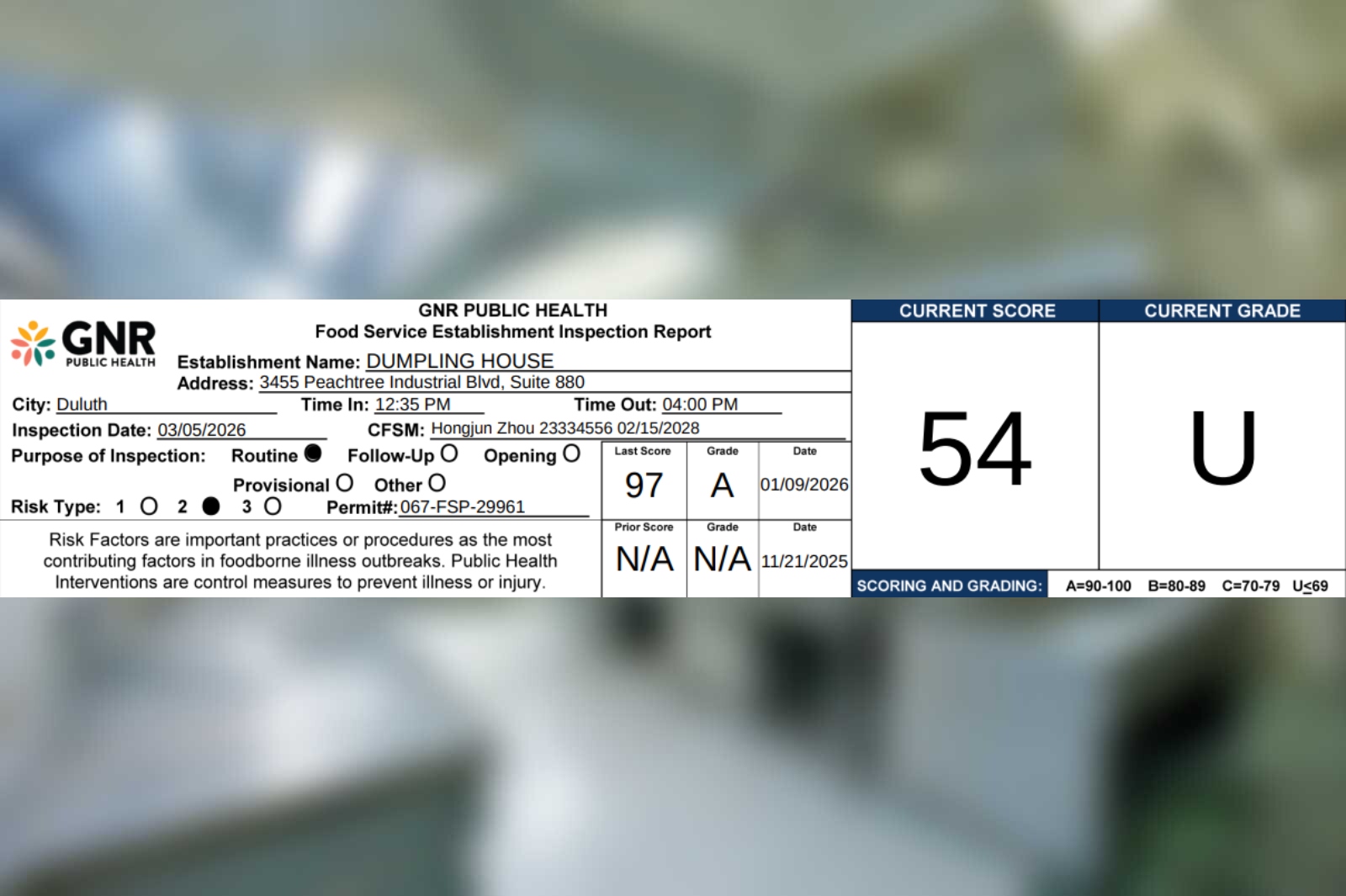
Dumpling House, located at 3455 Peachtree Industrial Blvd, Suite 880 in Duluth, received a score of 54 points out of a possible 100 points during their 03/05/2026 inspection by the Georgia Department of Public Health.
The violations noted by the inspector were:
Violation #1:
1-2A: .03(2)At the beginning of the inspection, there was no person-in-charge present. // There must be a person in charge on the premises of the food service establishment at all times. (Pf)
Corrective Actions: The person-in-charge arrived during the inspection. //
Violation #2:
1-2A: .03(2)(a)-(n),(p)Several violations occurred (including risk factors), resulting in an unsatisfactory score due to an overall lack of active managerial control. // It is the responsibility of the person in charge to ensure compliance with the food code by demonstrating active managerial control within their facility. (Pf)
Corrective Actions: Please ensure all violations are corrected and employees are trained. //
Violation #3:
2-1C: .04(4)(a)1,2,3Observed employee use bar hands to put a ready-to-eat egg roll in a to-go plate of chicken fried rice. // Except when washing fruits and vegetables, food employees shall not contact exposed, ready-to-eat food with their bare hands and shall use suitable utensils such as deli tissue, spatulas, tongs, single-use gloves, or dispensing equipment. (P)
Corrective Actions: The eggroll and fried rice were discarded. /.
Violation #4:
2-2A: .03(2)(o)The facility does not a verifiable method showing that employees have reviewed the employee health policy. They have one employee health verification form with two signatures of the four total employees. // Food employees and conditional employees shall be informed in a verifiable manner of their responsibility to report to the person in charge information about their health and activities as they relate to diseases that are transmissible through food. (Pf)
Corrective Actions: The policy was reviewed with all employees and they all signed the back of the form. //
Violation #5:
2-2B: .03(5)(k)1&21. Observed employee drinking from a multi-use beverage container in the prep area. 2. Observed the same container stored on top of food for the restaurant. // Employees shall consume food and drink only in approved designated areas separate from food preparation and serving areas, equipment or utensil areas and food storage areas (unless drinking from a single service beverage cup with a secure lid and straw that is handled to prevent contamination of the employee’s hands, the container, exposed food, clean equipment, utensils and linens, unwrapped single-service and single-use articles). (C)
Corrective Actions: The employees were educated, and the beverage was relocated. //
Violation #6:
2-2E: .03(6)The facility does not have written procedures for responding to a vomiting or diarrheal event. // A food establishment shall have written procedures for employees to follow when responding to vomiting or diarrheal events that involve the discharge of vomitus or fecal matter onto surfaces in the food service establishment. The procedures shall address the specific actions employees must take to minimize the spread of contamination and the exposure of employees, consumers, food, and surfaces to vomitus or fecal matter. (Pf)
Corrective Actions: Written procedures were emailed. Please print and keep on-site. //
Violation #7:
4-1A: .04(4)(c)1(i)(ii)(iii)(v) (vi)(vii)(viii)1. Observed raw beef being prepared on the drainboard of the three-compartment sink, where vegetables were being drained. 2. Observed raw beef stored in walk-in cooler over napa cabbage. // Food shall be protected from cross contamination during display, storage, and preparation. (P)
Corrective Actions: The beef was moved ot the walk-in cooler. The beef in the walk-in cooler was moved from over the napa cabbage. //
Violation #8:
4-1A: .04(4)(n)11. Observed employee blow into single-use gloves and put them on. 2. Observed employee continue to work with cooking utensils after picking up trash from the floor with gloved hands. // If used, single-use gloves shall be used for only one task such as working with ready-to-eat food or with raw animal food, used for no other purpose, and discarded when damaged or soiled, or when interruptions occur in the operation. (P)
Corrective Actions: The employees discarded gloves, washed hands, and put on new gloves. //
Violation #9:
6-1A: .04(6)(f)Observed several foods requiring refrigeration for safety in the walk-in cooler being held above 41°F. // Time/temperature control for safety food shall be maintained at 41°F (5°C) or below. (P)
Corrective Actions: The foods were discarded. //
Violation #10:
6-1D: .04(6)(i)1. Observed a bowl of hot and sour soup and eggrolls being held under time as a public health control (TPHC) without any time labeling. 2. Observed written procedures for TPHC not listing the hot and sour soup, egg drop soup, or egg rolls. // When using time without temperature control (Time Control, TPHC) for a maximum of 4 hours: 1) hot foods shall start at 135°F (57°C) or above and cold foods shall start at 41°F (5°C) or below when removed from temperature control; (P) 2) the food items shall be marked or otherwise identified to indicate the time that is 4 hours past the point in time the food was removed from temperature control; (Pf) 3) foods not cooked and served or consumed within 4 hours of being removed from time control shall be discarded; (P) 4) food in unmarked containers or packages, or marked to exceed a 4-hour limit shall be discarded; (P) 5) written procedures for TPHC (including methods of compliance with cooling foods is prepared, cooked, and refrigerated) shall be created in advance, kept in the food service establishment, and made available upon the Health Authorities request. (Pf)
Corrective Actions: The food was discarded and the written procedures were updated. //
Violation #11:
11C: .04(6)(c)1. Observed frozen raw shrimp thawing on the drainboard of the three-compartment sink (no water). 2. Observed frozen raw beef thawing in a container of standing water. // Time/temperature control for safety food shall be thawed: 1) under refrigeration that keeps the food at 41°F or less; 2) completely submerged in running water with the temperature of the water at 70°F or less, has sufficient flow to agitate and float off loose particles in an overflow, and that no part of the food exceeds 41°F; 3) as a part of the cooking process. (C)
Corrective Actions: The shrimp was placed in a container and placed under cold flowing water. The beef was moved to the walk-in cooler. //
Violation #12:
12A: .04(4)(q)Observed several boxes of food stored directly under the leaking condenser unit in the walk-in freezer. // Food shall be protected from contamination by storing the food: 1) in a clean dry location; (C) 2) where it is not exposed to splash, dust, or other contamination; (C) and 3) at least 6 inches (15 cm) above the floor. (C)
Corrective Actions: Please relocate the boxes of food and place a container on the top shelf to catch and discharge. //
Violation #13:
12C: .04(4)(m)Observed 2x wet wiping cloth buckets where cloths were stored in a chlorine sanitizer of an inadequate concentration. // Cloths in-use for wiping counters and other equipment surfaces shall be stored in sanitizer of the appropriate concentration in-between uses and laundered daily. (C)
Corrective Actions: The solutions were remade to the appropriate concentration. //
Violation #14:
14A: .04(4)(k)Observed 2x containers of in-use utensils stored in room temperature, non-flowing water. // During pauses in food preparation or dispensing, food preparation and dispensing utensils shall be stored: 1. in the food with their handles above the top of the food and the container; 2. In food that is not time / temperature control for safety food with their handles above the top of the food within containers or equipment that can be closed; 3. On a clean portion of the food preparation table or cooking equipment only if the in-use utensil and the food-contact surface of the food preparation table or cooking equipment are cleaned and sanitized at a frequency; 4. in running water of sufficient velocity to flush particulates to the drain, if used with moist food such as ice cream or mashed potatoes; 5. in a clean, dry container; or 6. in a container of water if the water is maintained at a temperature of at least 135°F (57°C) and the container is cleaned at the required frequency. (C)
Corrective Actions: The utensils were placed in the dirty dish area. New utensils were obtained and stored in a clean, dry container to be changed every four hours. //
Violation #15:
14B: .05(10)(e) 1,2,4Observed a multicompartment tray of flatware stored exposed on a cart in the dining room. // Cleaned equipment and utensils, laundered linens, and single-service and single-use articles shall be stored: (i) in a clean, dry location; (ii) where they are not exposed to splash, dust, or other contamination; and (iii) at least 6 inches above the floor. (C)
Corrective Actions: The tray was covered to protect the flatware. //
Violation #16:
15A: .05(6)(a)1. Observed leaks in the walk-in freezer around the condenser unit. 2. Observed an ambient air temperature of 57°F in the walk-in cooler. // Equipment shall be maintained in a state of repair and condition that meets the requirements specified under subsections .05(1) and .05(2) . (C)
Corrective Actions: Please have the unit repaired. //
Violation #17:
18: .07(2)(m)1. Observed the front door completely open at the beginning of the inspection. No screen door or air curtain present. 2. Observed both the back screen door and the solid doors in the kitchen completely open, leading to the back corridor, while the corridor door was also open. // Outer openings of a food service establishment shall be protected against the entry of insects and rodents by: 1) filling or closing holes and other gaps along floors, walls, and ceilings; (C) 2) closed, tight-fitting windows; (C) and 3) solid self-closing, tight-fitting doors. (C) When windows or doors of a food service establishment are kept open for ventilation, the openings shall be protected against the entry of insects and rodents by: 1) 16 mesh to 1 inch screens; (C) 2) a properly designed and installed air curtain; (C) or 3) other effective means. (C)
Corrective Actions: The front door was closed. The screen doorw as closed. //
Additional remarks:
NOTE: All food temperatures were in compliance during today’s inspection unless marked with an asterisk (*).
NOTE: Ensure chemicals are properly stored. Observed 1x fluid lighter stored on shelf above prep cooler.
NOTE: Ensure employee food is stored away from food for the restaurant. Observed a bag of lemongrass stored with cooked foods in the upright freezer.
NOTE: Ensure all gaps around the front doors and the kitchen screen door (including the hole where the lock should be) are sealed.
NOTE: Failure to correct violations not corrected during the inspection may result in a permit suspension.
NOTE: A follow-up inspection will occur within the next 10 days.
NOTE: A required additional routine inspection will occur within the next 12 months.
NOTE: Consecutive unsatisfactory scores on inspections will result in permit suspension.
CLICK HERE to read the full report
Get notified by email when this case is updated.