Get notified by email when this case is updated.
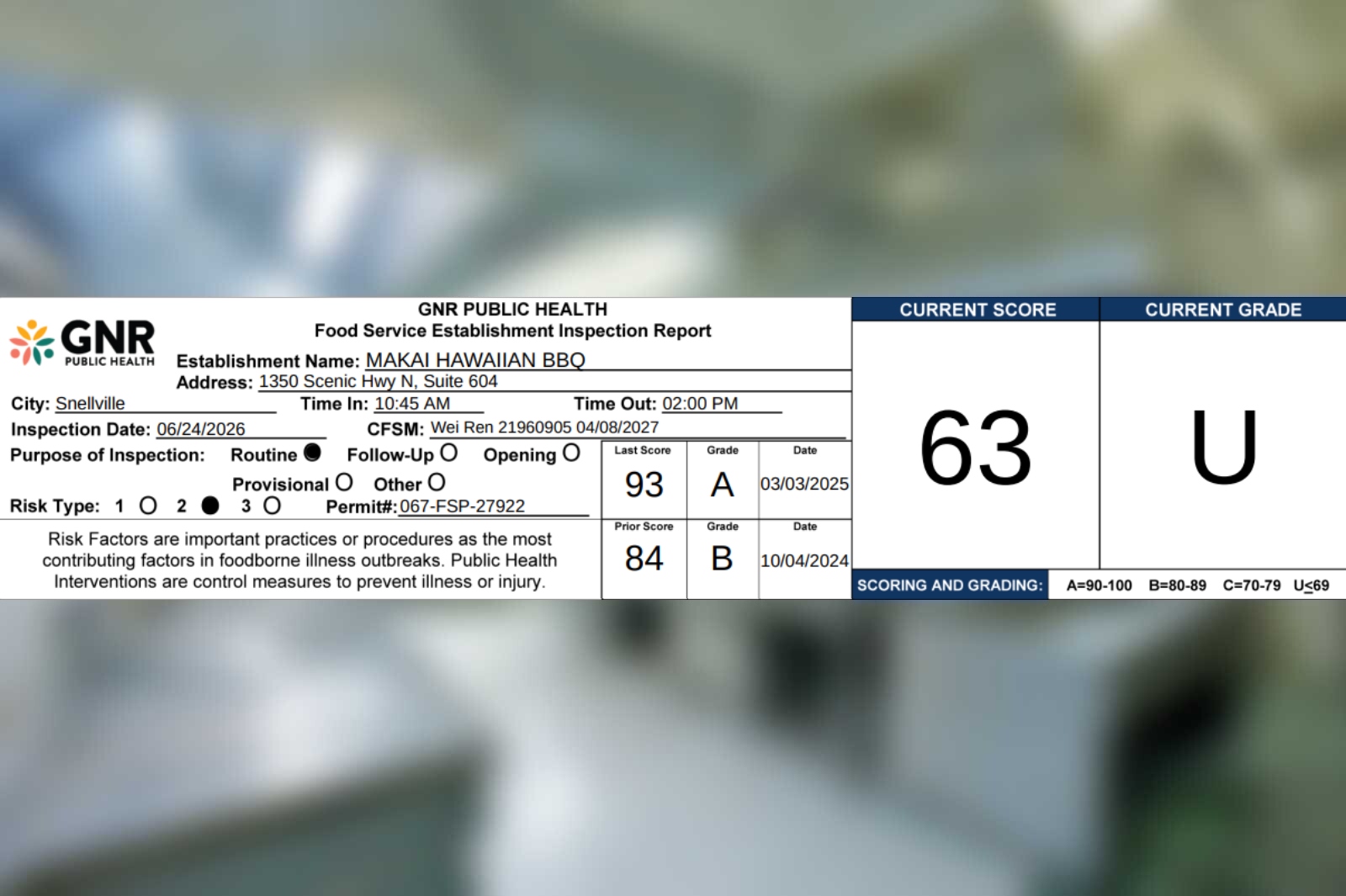
Makai Hawaiian BBQ, located at 1350 Scenic Hwy N Ste 604, Snellville, GA 30078, received a score of 63 points out of a possible 100 points during their 06/24/2026 inspection by the Georgia Department of Public Health.
The violations noted by the inspector were:
Violation #1:
1-2A: .03(2)(a)-(n),(p)Several risk factor violations were observed during today’s inspection resulting in an unsatisfactory score as a result of an overall lack of active managerial control. It is the responsibility of the person in charge to ensure compliance with the food code by demonstrating active managerial control within their facility. (Pf)
Violation #2:
2-1B: .03(5)(c)Observed a food employee touch raw chicken and then touch clean utensils to cut ready-to-eat food. Employees must wash hands and exposed portions of arms immediately before engaging in food preparation including working with exposed food, clean equipment and utensils, and unwrapped single-service articles, and: 1) after touching exposed body parts; 2) after using the toilet room; 3) After caring for or handling service animals or aquatic animals; 4)after coughing, sneezing, using tobacco, eating, or drinking; 5) after handling soiled equipment or utensils; 6) during food preparation, as often as needed to remove soil and contamination and to prevent cross contamination when changing tasks; 7) when switching between working with raw food and working with ready-to-eat food; 8) before putting on gloves; 9) after engaging in other activities that contaminate hands; 10) a second time when entering the kitchen from using the restroom. (P)
Corrective Actions: Food employee washed their hands and changed gloves. The utensils were placed in the warewashing sink to be washed, rinsed, and sanitized.
Violation #3:
2-2A: .03(1)(c)2,3,17The person-in-charge (PIC) does not have any knowledge and awareness of the employee health policy. Person in charge shall explain their responsibility for preventing the transmission of foodborne disease by a food employee who has a disease or medical condition that may cause foodborne disease and can describe the symptoms associated with the diseases that are transmissible through food. They also shall be able to explain how food employees and conditional employees comply with reporting responsibilities and exclusion or restriction of food employees. (Pf)
Violation #4:
2-2A: .03(2)(o)No employee health policies on site or signed. Food employees and conditional employees shall be informed in a verifiable manner of their responsibility to report to the person in charge information about their health and activities as they relate to diseases that are transmissible through food. (Pf)
Violation #5:
2-2D: .06(2)(o)Observed pots and pans being stored in the 2nd handsink in the kitchen. A handwashing sink shall be maintained so that it is accessible at all times for employee use and not used for purposes other than handwashing. An automatic handwashing facility shall be used in accordance with manufacturer’s instructions. (Pf)
Corrective Actions: Pots and pans were removed from the handsink.
Violation #6:
2-2E: .03(6)The facility does not have an adequate disinfectant for vomit and diarrheal events. On-site bleach is not listed on EPA list G. A food establishment shall have written procedures for employees to follow when responding to vomiting or diarrheal events that involve the discharge of vomitus or fecal matter onto surfaces in the food service establishment. The procedures shall address the specific actions employees must take to minimize the spread of contamination and the exposure of employees, consumers, food, and surfaces to vomitus or fecal matter. (Pf)
Violation #7:
4-1A: .04(4)(c)1(i)(ii)(iii)(v) (vi)(vii)(viii)Observed raw chicken stored over cooked sauces, and cooked pork in the prep cooler. Observed raw chicken stored over raw beef and raw pork in the reach-in cooler, cooler under the grill, and the walk-in cooler. Observed unwashed vegetables stored over cooled macaroni pasta and raw eggs over cooked sauces in the walk-in cooler. Food shall be protected from cross contamination by: (i) Except as specified in paragraph (i)(IV) of below, separating raw animal foods during storage, preparation, holding, and display from: (I) Raw ready-to-eat food including other raw animal food such as fish for sushi or molluscan shellfish, or other raw ready-to-eat food such as fruits and vegetables, (P) and (II) Cooked ready-to-eat food; and (P) (III) Fruits and vegetables before they are washed; (P) (IV) Frozen, commercially processed and packaged raw animal food may be stored or displayed with or above frozen, commercially processed and packaged, ready-to-eat food. (ii) Except when combined as ingredients, separating types of raw animal foods from each other such as beef, fish, lamb, pork, and poultry during storage, preparation, holding, and display by: (I) Using separate equipment for each type, (P) or (II) Arranging each type of food in equipment so that cross contamination of one type with another is prevented, (P) and (III) Preparing each type of food at different times or in separate areas; (P) (iii) Cleaning and sanitizing equipment and utensils; (v) Cleaning hermetically sealed containers of food of visible soil before opening; (vi) Protecting food containers that are received packaged together in a case or overwrap from cuts when the case or overwrap is opened; (vii) Storing damaged, spoiled, or recalled food being held in the food service establishment separate from food, equipment, utensils, linens and single-service and single-use articles; or (viii) Separating fruits and vegetables, before they are washed from ready-to-eat food.
Corrective Actions: Food items were rearranged in the appropriate order.
Violation #8:
4-1A: .04(4)(n)1Observed the person in charge (PIC) take off a wrist support wrap with gloves on, then touch clean utensils used to flip food on the grill, then wash gloves with water. If used, single-use gloves shall be used for only one task such as working with ready-to-eat food or with raw animal food, used for no other purpose, and discarded when damaged or soiled, or when interruptions occur in the operation. (P)
Corrective Actions: Utensils were washed, rinsed, and sanitized. PIC threw the gloves away and washed his hands.
Violation #9:
8-2B: .07(6)(e)Observed 2 cans of Raid in the facility. Poisonous or toxic materials shall be used according to: (i) Law and this Chapter; (ii) Manufacturer’s use directions included in labeling, and, for a pesticide, manufacturer’s label instructions that state that use is allowed in a food service establishment, (P) (iii) The conditions of certification, if certification is required, for use of the pest control materials, (P) and (iv) Additional conditions that may be established by the Health Authority.
Corrective Actions: Raid was removed from the facility.
Violation #10:
8-2B: .07(6)(g)Observed chlorine sanitizer with a concentration above 200ppm. Chemical sanitizers, including chemical sanitizing solutions generated on-site, and other chemical antimicrobials used on food contact surfaces shall not exceed stated concentrations as listed on the EPA-registered label, in 40 CFR 180.940 and 40 CFR 180.2020, (100 ppm for chlorine and 400 ppm for quaternary ammonia). (P)
Corrective Actions: Chlorine sanitizer was remade to an appropriate concentration.
Violation #11:
12A: .04(4)(q)Observed 5 barrels of sauce stored on the floor in the walk-in cooler. Food shall be protected from contamination by storing the food: 1) in a clean dry location; (C) 2) where it is not exposed to splash, dust, or other contamination; (C) and 3) at least 6 inches (15 cm) above the floor. (C)
Violation #12:
12C: .04(4)(m)Observed multiple wet wiping cloths stored on prep surfaces throughout the kitchen. Cloths in-use for wiping counters and other equipment surfaces shall be stored in sanitizer of the appropriate concentration in-between uses and laundered daily. (C)
Corrective Actions: Wiping cloths were moved to a bucket of sanitizer.
Violation #13:
12C: .04(4)(m)Observed sanitizer buckets stored on the floor. Wet wiping sanitizer containers shall be stored off the floor and used in a manner that prevents contamination of food, equipment, utensils, linens, single-service, or single-use articles. (C)
Corrective Actions: Sanitizer buckets were moved to a bottom shelf.
Violation #14:
14A: .04(4)(k)Observed an old can being used as a scoop for rice. During pauses in food preparation or dispensing, food preparation and dispensing utensils shall be stored: 1. in the food with their handles above the top of the food and the container; 2. In food that is not time / temperature control for safety food with their handles above the top of the food within containers or equipment that can be closed; 3. On a clean portion of the food preparation table or cooking equipment only if the in-use utensil and the food-contact surface of the food preparation table or cooking equipment are cleaned and sanitized at a frequency; 4. in running water of sufficient velocity to flush particulates to the drain, if used with moist food such as ice cream or mashed potatoes; 5. in a clean, dry container; or 6. in a container of water if the water is maintained at a temperature of at least 135°F (57°C) and the container is cleaned at the required frequency. (C)
Corrective Actions: Old can was removed.
Violation #15:
14A: .04(4)(k)Observed a scoop and tongs sitting in room-temperature water beside the hot holding unit. See temperature log. During pauses in food preparation or dispensing, food preparation and dispensing utensils shall be stored: 1. in the food with their handles above the top of the food and the container; 2. In food that is not time / temperature control for safety food with their handles above the top of the food within containers or equipment that can be closed; 3. On a clean portion of the food preparation table or cooking equipment only if the in-use utensil and the food-contact surface of the food preparation table or cooking equipment are cleaned and sanitized at a frequency; 4. in running water of sufficient velocity to flush particulates to the drain, if used with moist food such as ice cream or mashed potatoes; 5. in a clean, dry container; or 6. in a container of water if the water is maintained at a temperature of at least 135°F (57°C) and the container is cleaned at the required frequency. (C)
Corrective Actions: Utensils were washed, rinsed, and sanitized.
Violation #16:
14B: .05(10)(e) 1,2,4Observed multiple dishes in the facility that were stacked wet. Clean equipment and utensils shall be stored in a self-draining position that allows air drying and covered or inverted. (C)
Corrective Actions: Dishes were placed in a self-drying position.
Violation #17:
14C: .05(10)(e)1&3Observed multiple boxes of single-use items stored on the floor outside the bathrooms. Single-service and single-use articles shall be stored: 1) in a clean, dry location; 2)where they are not exposed to splash, dust or other contamination; and 3) at least 6 inches above the floor. Single-service and single-use articles shall be kept in the original protective package or stored by using other means that afford protection from contamination until used. (C)
Violation #18:
15A: .05(1)(a)Observed cardboard being used as lining for multiple shelves throughout the facility. Utensils and food-contact surfaces of equipment shall be made of materials that do not allow the migration of deleterious substances or impart colors, odors, or tastes to food and under normal use conditions, and shall be: (P) safe (P), durable, corrosion-resistant, and nonabsorbent. In addition, materials shall be sufficient in weight and thickness to withstand repeated warewashing and shall be finished to have a smooth, easily cleanable surface. Materials shall be resistant to pitting, chipping, crazing, scratching, scoring, distortion and decomposition. (C)
Violation #19:
17D: .07(4)(b)Observed multiple phones and a speaker on prep surfaces throughout the kitchen. Lockers or other suitable facilities shall be located in a designated room or area where contamination of food, equipment, utensils, linens and single-service and single-use articles cannot occur. (C)
Corrective Actions: Items were moved to the employee area
Additional remarks:
NOTE: All cold holding temperatures were in compliance unless otherwise noted.
NOTE: No additives are used at this facility.
NOTE: No hot-holding observed during today’s inspection.
NOTE: REPEAT VIOLATIONS WILL RESULT IN PERMIT SUSPENSION.
NOTE: A follow up will be conducted within 10 days. Correct any uncorrected violations or permit may be suspended. Two consecutive unsatisfactory scores will result in permit suspension.
NOTE: A required additional routine will be conducted within 12 months.
CLICK HERE to read the full report
