You're not signed in. Sign in to remove ads.

Sign in
Dark
Light
May 30, 2026
May 28, 2026

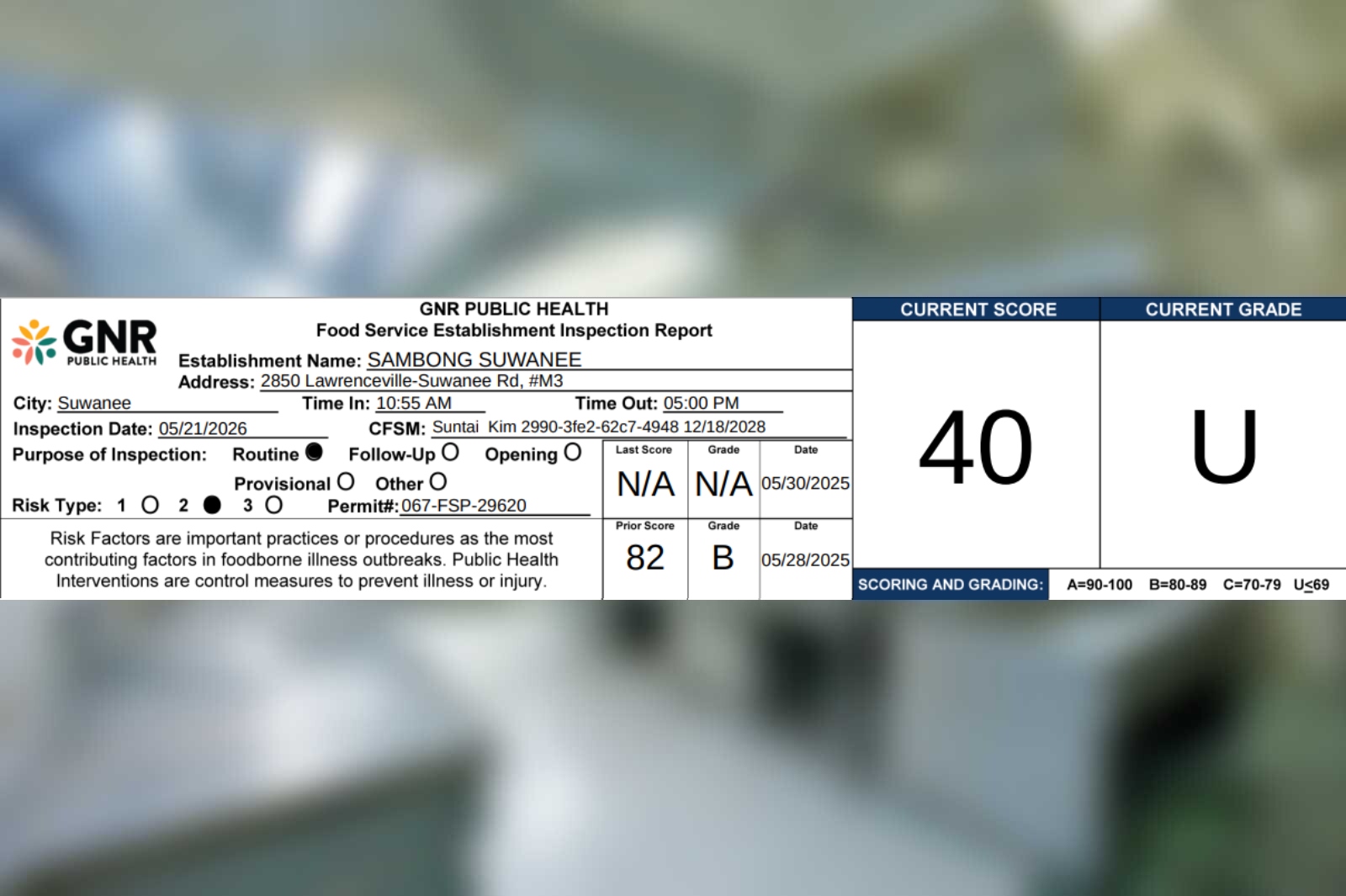
Sambong Suwanee in Suwanee receives a 40% on their recent health inspection

Follow This Case

Get notified by email when this case is updated.

Sambong Suwanee, located at 2850 Lawrenceville-Suwanee Rd, #M3 in Suwanee, received a score of 40 points out of a possible 100 points during their 05/21/2026 inspection by the Georgia Department of Public Health.

The violations noted by the inspector were:

Violation #1:
1-2A: .03(2)(a)-(n),(p)Several violations of risk factors due to lack of active managerial control. It is the responsibility of the person in charge to ensure compliance with the food code by demonstrating active managerial control within their facility. (Pf)

Violation #2:
2-2A: .03(2)(o)Person-in-charge (PIC) could not demonstrate in a verifiable manner that food employees were informed and are aware of the reporting responsibilities for symptoms and diseases. Food employees and conditional employees shall be informed in a verifiable manner of their responsibility to report to the person in charge information about their health and activities as they relate to diseases that are transmissible through food. (Pf)

Violation #3:
2-2B: .03(5)(k)1&2Observed several employee beverage containers stored improperly (on a prep table near food, on shelving above customer food, in a server area). Containers were not disposable and did not have straws. Employees shall consume food and drink only in approved designated areas separate from food preparation and serving areas, equipment or utensil areas and food storage areas (unless drinking from a single service beverage cup with a secure lid and straw that is handled to prevent contamination of the employee’s hands, the container, exposed food, clean equipment, utensils and linens, unwrapped single-service and single-use articles). (C)
Corrective Actions: Beverage containers were relocated to designated employee areas.

Violation #4:
2-2D: .06(2)(o)Observed an employee use the handwash sink to mix a bucket of sanitizer. A handwashing sink shall be maintained so that it is accessible at all times for employee use and not used for purposes other than handwashing. An automatic handwashing facility shall be used in accordance with manufacturer’s instructions. (Pf)
Corrective Actions: Employee removed bucket from the handwash sink.

Violation #5:
2-2D: .03(5)(d)Observed an employee rinse hands at the warewashing sink with the sprayer rather than wash at the handwash sink when gloves were soiled. Food employees shall clean their hands in a handwashing sink or approved automatic handwashing facility and may not clean their hands in a sink used for food preparation or warewashing, or in a service sink or curbed cleaning facility used for the disposal of mop water and similar liquid waste. (Pf)
Corrective Actions: Employee washed hands a the handwash sink.

Violation #6:
3-1D: .04(5)(f)PIC was not able to provide a letter of parasite destruction for Skate fish that is served undercooked in the facility . Before service or sale in ready-to-eat form, raw, raw-marinated, partially cooked, or marinated-partially cooked fish shall be: 1) Frozen and stored at a temperature of -4°F (-20°C) or below for a minimum of 7 days (168 hours) in a freezer; (P) 2) Frozen at -31°F (-35°C) or below until solid and stored at -31°F (-35°C) or below for a minimum of 15 hours; (P) or 3) Frozen at -31°F (-35°C) or below until solid and stored at -4°F (-20°C) or below for a minimum of 24 hours. (P)
Corrective Actions: PIC obtained a letter from the supplier of the skate fish.

Violation #7:
4-1A: .04(4)(c)1(i)(ii)(iii)(v) (vi)(vii)(viii)Observed unwashed produce stored on top of a bucket of washed lettuce. Observed ready-to-eat (RTE) food (Kimchi) stored with raw beef on a shelf in the walk-in cooler. Observed unwashed pears stored above RTE foods (peeled onions, cooked rice). Observed RTE kimchi stored under raw beef on a prep table. Food shall be protected from cross contamination by: (i) Except as specified in paragraph (i)(IV) of below, separating raw animal foods during storage, preparation, holding, and display from: (I) Raw ready-to-eat food including other raw animal food such as fish for sushi or molluscan shellfish, or other raw ready-to-eat food such as fruits and vegetables, (P) and (II) Cooked ready-to-eat food; and (P) (III) Fruits and vegetables before they are washed; (P) (IV) Frozen, commercially processed and packaged raw animal food may be stored or displayed with or above frozen, commercially processed and packaged, ready-to-eat food. (ii) Except when combined as ingredients, separating types of raw animal foods from each other such as beef, fish, lamb, pork, and poultry during storage, preparation, holding, and display by: (I) Using separate equipment for each type, (P) or (II) Arranging each type of food in equipment so that cross contamination of one type with another is prevented, (P) and (III) Preparing each type of food at different times or in separate areas; (P) (iii) Cleaning and sanitizing equipment and utensils; (v) Cleaning hermetically sealed containers of food of visible soil before opening; (vi) Protecting food containers that are received packaged together in a case or overwrap from cuts when the case or overwrap is opened; (vii) Storing damaged, spoiled, or recalled food being held in the food service establishment separate from food, equipment, utensils, linens and single-service and single-use articles; or (viii) Separating fruits and vegetables, before they are washed from ready-to-eat food.
Corrective Actions: Food storage was re-arrange in the walk-in cooler according to cook temperature. Kimchi and beef were moved so that kimchi was no longer stored under raw meats.

Violation #8:
4-2B: .05(7)(a)1Observed a black mold-like build up and hair in an ice machine behind the front service counter. Observed black, mold-like build-up in a second ice machine in the rear of the facility near dry storage. Equipment food-contact surfaces and utensils shall be clean to sight and touch. (Pf)

Violation #9:
6-1C: .04(6)(d)Observed bean sprouts in a prep cooler that did not have a adequate rate of cooling. Observed Kimchi cooling in a large container greater than 3 in. deep in the walk-in cooler with an inadequate rate of cooling (discarded). Observed cooked noodles cooling in the prep cooler that did not have an adequate rate of cooling. See temperature log. TCS foods being cooled from 135°F to 70°F in 2 hours MUST cool 0.54°F per minute (roughly 32.5°F per hour). TCS foods being cooled from 70°F to 41°F MUST cool 7.25°F per hour (0.121°F per min or 29°F in 4 hours).
Corrective Actions: Sprouts were moved to the walk-in cooler. Kimchi and noodle discarded.

Violation #10:
6-2: .04(6)(g)Observed Time/Temperature control for safety (TCS) foods in the walk-in cooler that were prepared greater than 24 hours prior that were not date marked. Refrigerated, ready-to-eat, time/temperature control for safety foods prepared and held in a food establishment for more than 24-hours shall be clearly marked to indicate the date of prep or the date by with the food shall be consumed, sold, or discarded when held at 41°F (5°C) or below for a maximum of 7 days. The day of preparation shall be counted as Day 1. (Pf)
Corrective Actions: Foods were date marked with the date of preparation.

Violation #11:
6-2: .04(6)(h)Observed multiple containers of TCS foods (beef soup sauce, ox bone soup) in the walk-in cooler that were held past 7 days after preparation. Observed foods that were previously in the freezer that were not marked with preparation, freeze and thaw dates or that were frozen greater than 7 days after preparation. A food that requires datemarking shall be discarded if it exceeds 7 days, not including the time that the product is frozen. (P)
Corrective Actions: Foods were discarded.

Violation #12:
8-2B: .07(6)(g)Observed chlorine sanitizer that was made at a concentration greater than 200 ppm. Chemical sanitizers, including chemical sanitizing solutions generated on-site, and other chemical antimicrobials used on food contact surfaces shall not exceed stated concentrations as listed on the EPA-registered label, in 40 CFR 180.940 and 40 CFR 180.2020, (100 ppm for chlorine and 400 ppm for quaternary ammonia). (P)
Corrective Actions: Water added to bucket until an appropriate concentration was reached for chlorine.

Violation #13:
8-2B: .07(6)(b)Observed a working bottle of sanitizer solution (bleach) that was not labeled. Working containers used for storing poisonous or toxic materials such as cleaners and sanitizers taken from bulk supplies shall be clearly and individually identified with the common name of the material. (Pf)
Corrective Actions: Bottle was labeled.

Violation #14:
8-2B: .07(6)(c)Observed several containers of chemicals (bleach, Lysol, cleaners) that were located on a shelf above a pallet holding several bags of dry food. Poisonous or toxic materials shall be stored so they cannot contaminate food, equipment, utensils, linens, and single-service and single-use articles by: 1. Separating the poisonous or toxic materials by spacing or partitioning; (P) and 2. Locating the poisonous or toxic materials in an area that is not above food, equipment, utensils, linens, and single-service or single-use articles. (P)
Corrective Actions: Chemicals were relocated to a bottom shelf below food.

Violation #15:
10D: .04(4)(d)Observed several containers of squeeze bottles throughout the kitchen and a container of spice that were not labeled with the common name of the sauces that they contained. Except for containers holding food that can be readily and unmistakably recognized, such as dry pasta, working containers holding food or food ingredients that are removed from their original packages for use in the food establishment, such as cooking oils, flour, herbs, potato flakes, salt, spices, and sugar shall be clearly and legibly identified, in English, with the common name of the food. (C)
Corrective Actions: Bottles were labeled.

Violation #16:
10D: .04(7)(d)Observed that the posted allergen disclosure statement did not list all the major food allergens served in the facility. Skate fish served but not listed on the allergen disclosure. 1. If required by law, consumer warnings shall be provided. (C) 2. Food service establishment or manufacturers’ dating information on foods may not be concealed or altered. (C) 3. The permit holder shall notify consumers by written notification of the presence of major food allergens as an ingredient in unpackaged food items that are served or sold to the consumer. (C)

Violation #17:
11A: .04(6)(e)Observed bean sprouts cooling in a prep cooler that did not have an adequate rate of cooling. Kimchi stored first out in the kitchen tied in plastic bags then in the walk-in cooler in deep plastic containers. Noodles stored covered with plastic during cooling. Foods shall be cooled using one or more methods approved by the health authority (e.g., smaller batches, thinner portions, using rapid cooling equipment, stirring food in containers placed in an ice water bath, using containers that facilitate heat transfer and ice as an ingredient; placing items in the walk-in cooler or walk-in freezer partially or completely uncovered as long as the food is protected from overhead contamination). (Pf, C)
Corrective Actions: Discussed with PIC proper cooling methods including moving foods to coolers that are set at a lower temperature and dividing foods into smaller containers.

Violation #18:
11C: .04(6)(c)Observed pigs’ feet thawing in a prep sink in standing water. Time/temperature control for safety food shall be thawed: 1) under refrigeration that keeps the food at 41°F or less; 2) completely submerged in running water with the temperature of the water at 70°F or less, has sufficient flow to agitate and float off loose particles in an overflow, and that no part of the food exceeds 41°F; 3) as a part of the cooking process. (C)
Corrective Actions: Feet were moved to a large pot and placed under running water that overflowed the sides of the pot.

Violation #19:
12C: .04(4)(m)Observed wet wiping cloths that were not stored in sanitizer and not completely submerged in sanitizer solution. Cloths in-use for wiping counters and other equipment surfaces shall be stored in sanitizer of the appropriate concentration in-between uses and laundered daily. (C)
Corrective Actions: Cloths were placed in buckets with enough sanitizer for cloths to be fully submerged.

Violation #20:
14A: .04(4)(k)Observed a silver bowl stored in a bulk container of food. Observed measuring cups stored in food containers with handle not stored above the food. During pauses in food preparation or dispensing, food preparation and dispensing utensils shall be stored: 1. in the food with their handles above the top of the food and the container; 2. In food that is not time / temperature control for safety food with their handles above the top of the food within containers or equipment that can be closed; 3. On a clean portion of the food preparation table or cooking equipment only if the in-use utensil and the food-contact surface of the food preparation table or cooking equipment are cleaned and sanitized at a frequency; 4. in running water of sufficient velocity to flush particulates to the drain, if used with moist food such as ice cream or mashed potatoes; 5. in a clean, dry container; or 6. in a container of water if the water is maintained at a temperature of at least 135°F (57°C) and the container is cleaned at the required frequency. (C)
Corrective Actions: Bowl and measuring cups were removed from the food containers.

Violation #21:
14B: .05(10)(a)Observed metal and plastic food storage containers that were stacked wet. After cleaning and sanitizing, equipment and utensils: 1. Shall be air-dried or used after adequate draining before contact with food; (C) and 2. May not be cloth dried except that utensils that have been air-dried may be polished with cloths that are maintained clean and dry. (C)
Corrective Actions: Containers were moved to warewashing to be re-cleaned.

Violation #22:
15A: .05(6)(q)1&3Observed food stored in a container with a cracked and broken lid. Utensils shall be maintained in a state of repair or condition that complies with the requirements specified under subsections .05(1) and .05(2) or shall be discarded. (C) Ambient air temperature, water pressure, and water temperature measuring devices shall be maintained in good repair and be accurate within the intended range of use.
Corrective Actions: Lid discarded.

Violation #23:
17D: .07(4)(b)Observed employee beverage containers stored above boxes of customer sodas. Observed employee personal items (bag, open beverage in plastic bottle) stored above customer food. Observed keys sitting on a food scale on a prep table. Observed a cell phone sitting on a service counter. Areas designated for employees to eat, drink, and use tobacco shall be located so that food, equipment, linens, and single-service and single-use articles are protected from contamination. (C)
Corrective Actions: Employee items were relocated to designated areas.

Additional remarks:
Note: All cold holding temperatures are in compliance unless otherwise noted.

Note: All hot holding temperatures are in compliance

Note: Cooked pork moved to warmer. Unable to get a second temperature.

Note: No additives used at this facility.

Note: Thermometers calibrated today (see temp log).

Note: A required additional routine will be conducted within 12 months.

Note: A follow up will be conducted within 10 days. Please correct any uncorrected violations or permit may be suspended.

Note: Two consecutive unsatisfactory (U) scores will result in permit suspension.

Note: Three consecutive violations on routine inspections will result in permit suspensions.

Joint inspection with DMG.

CLICK HERE to read the full report

Follow This Case

Get notified by email when this case is updated.