Get notified by email when this case is updated.
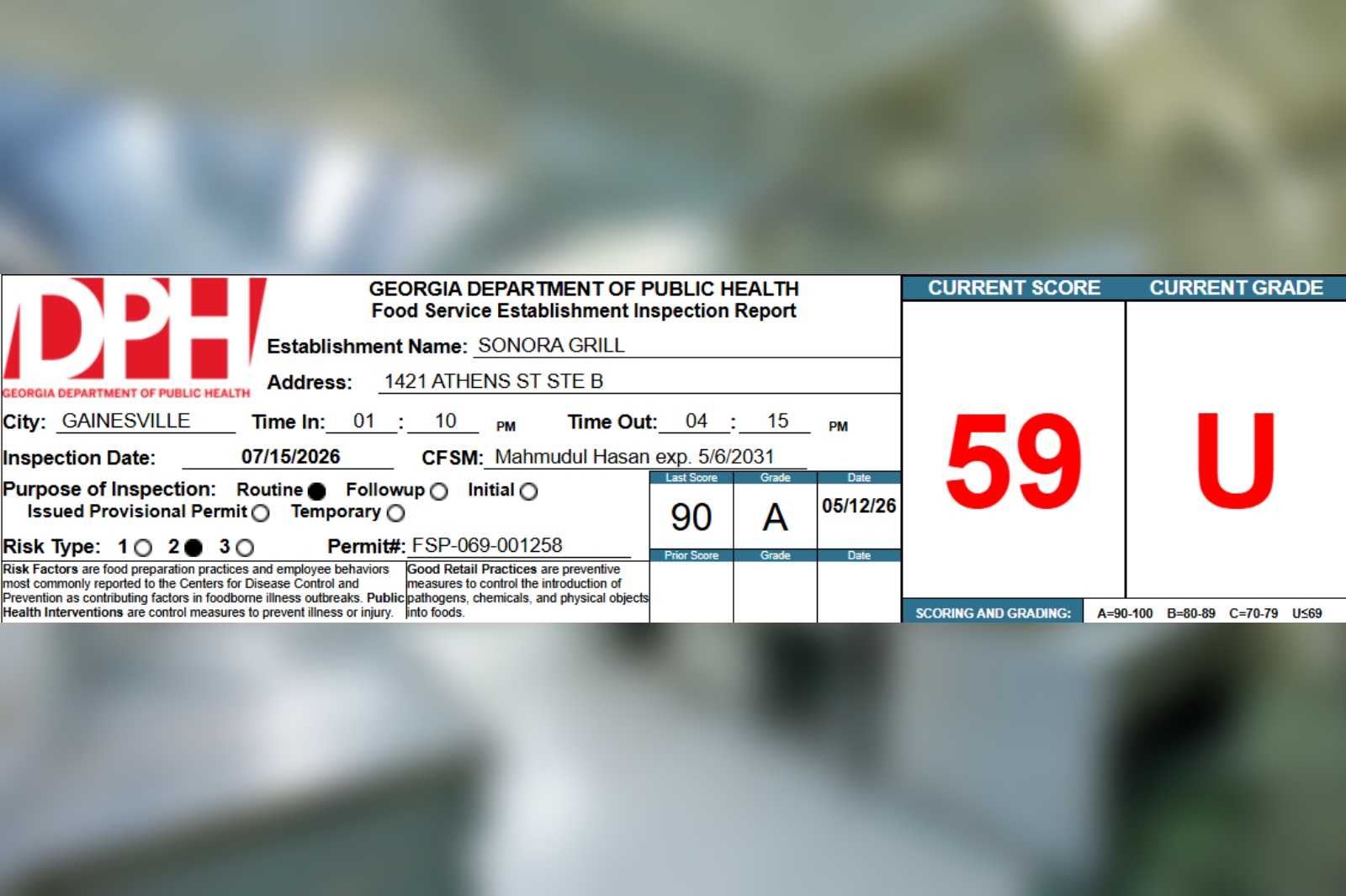
Sonora Grill, located at 1421 Athens St, Ste B, Gainesville, GA 30507, received a score of 59 points out of a possible 100 points during their 07/15/2026 inspection by the Georgia Department of Public Health.
The violations noted by the inspector were:
Violation #1:
1-2A – pic present, demonstrates knowledge, performs duties
511-6-1.03(2)(a)-(n)(p),(q) – responsibility of pic (pf)
Points: 4
Corrected during inspection?: No
Repeat: No
Inspector Notes: Observed no active managerial control in the facility based on the following: 1-2A. PIC present, demonstrates knowledge, performs duties 2-1B. Hands clean and properly washed 4-1A. Food separated and protected 6-1B. Proper hot holding temperatures 6-1D. Time as a public health control: procedures and records 6-2. Proper date marking and disposition Note: EHS recommends that all facility staff be retrained and that the CFSM be retrained as well.
Violation #2:
1-2A – pic present, demonstrates knowledge, performs duties
511-6-1.03(2)(a)-(n)(p),(q) – responsibility of pic (pf)
Points: 4
Corrected during inspection?: No
Repeat: No
Inspector Notes: Observed no employee health agreements in the facility or any verifiable manner of employee responsibility to report. 511-6-1.03(2)(a)-(n)(p),(q) – Responsibility of PIC (Pf) (o) Reporting Responsibilities. Food employees and conditional employees are informed in a verifiable manner of their responsibility to report in accordance with the Chapter, to the person in charge, information about their health and activities as they relate to diseases that are transmissible through food;Pf Note: The facility will need to have employee health agreements available on site. The facility was provided this in its initial inspection.
Violation #3:
2-1B – hands clean and properly washed
511-6-1.03(5)(b) – cleaning procedure (p)
Points: 9
Corrected during inspection?: Yes
Repeat: No
Inspector Notes: Observed food employee to wash their hands and turn off the faucet handle without the use of a barrier to prevent recontamination of the hands. 511-6-1.03(5)(b) – Cleaning Procedure (P) (b) Cleaning Procedure. 1. Except as specified in paragraph 4 of this subsection, food employees shall clean their hands and exposed portions of their arms, including surrogate prosthetic devices for hands or arms, for at least 20 seconds, using a cleaning compound in a handwashing sink that is properly equipped. P 2. Food employees shall use the following cleaning procedure in the order stated to clean their hands and exposed portions of their arms, including surrogate prosthetic devices for hands and arms: (i) Rinse under clean, running warm water; P (ii) Apply an amount of cleaning compound recommended by the cleaning compound manufacturer; P (iii) Rub together vigorously for at least 10 to 15 seconds while: (I) Paying particular attention to removing soil from underneath the fingernails during the cleaning procedure, P and (II) Creating friction on the surfaces of the hands and arms or surrogate prosthetic devices for hands and arms, finger tips, and areas between the fingers; P (iv) Thoroughly rinse under clean, running warm water; P and (v) Immediately follow the cleaning procedure with thorough drying using disposable paper towels, a continuous towel system, or a heated-air hand drying device. P 3. To avoid recontaminating their hands or surrogate prosthetic devices, food employees may use disposable paper towels or similar clean barriers when touching surfaces such as manually operated faucet handles on a handwashing sink or the handle of a restroom door. 4. If approved and capable of removing the types of soils encountered in the food operations involved, an automatic handwashing facility may be used by food employees to clean their hands or surrogate prosthetic devices. COS: The food employee rewashed their hands and used a paper towel to turn the faucet handle off.
Violation #4:
4-1A – food separated and protected
511-6-1.04(4)(c)1(i)(ii)(iii)(v)(vi)(vii)(viii) – packaged & unpackaged food separation, packaging, and segregation (p, c)
Points: 9
Corrected during inspection?: Yes
Repeat: Yes
Inspector Notes: Observed improper vertical separation of raw animal foods and ready-to-eat foods. Raw shelled eggs and raw bacon were stored above ready-to-eat shredded steak. 511-6-1.04(4)(c)1(i)(ii)(iii)(v)(vi)(vii)(viii) – Packaged & Unpackaged Food Separation, Packaging, and Segregation (P, C) (c) Packaged and Unpackaged Food – Separation, Packaging, and Segregation. 1. Food shall be protected from cross contamination by: (i) Except as specified in paragraph (i)(IV) of this subsection, separating raw animal foods during storage, preparation, holding, and display from: (I) Raw ready-to-eat food including other raw animal food such as fish for sushi or molluscan shellfish, or other raw ready-to-eat food such as fruits and vegetables, P and (II) Cooked ready-to-eat food; and P (III) Fruits and vegetables before they are washed; P (IV) Frozen, commercially processed and packaged raw animal food may be stored or displayed with or above frozen, commercially processed and packaged, ready-to-eat food. (ii) Except when combined as ingredients, separating types of raw animal foods from each other such as beef, fish, lamb, pork, and poultry during storage, preparation, holding, and display by: (I) Using separate equipment for each type, P or (II) Arranging each type of food in equipment so that cross contamination of one type with another is prevented, P and (III) Preparing each type of food at different times or in separate areas; P (iii) Cleaning and sanitizing equipment and utensils; (v) Cleaning hermetically sealed containers of food of visible soil before opening; (vi) Protecting food containers that are received packaged together in a case or overwrap from cuts when the case or overwrap is opened; (vii) Storing damaged, spoiled, or recalled food being held in the food service establishment separate from food, equipment, utensils, linens and single-service and single-use articles; or (viii) Separating fruits and vegetables, before they are washed from ready-to-eat food. COS: EHS rearranged food items and educated the PIC on proper food storage order based on cooking temperatures.
Violation #5:
6-1B – proper hot holding temperatures
511-6-1.04(6)(f) – time/temperature control for safety; hot holding (p)
Points: 9
Corrected during inspection?: Yes
Repeat: No
Inspector Notes: Observed refried beans and mexican rice to be hot holding below 135F. 511-6-1.04(6)(f) – Time/Temperature Control for Safety; Hot Holding (P) (f) Time/Temperature Control for Safety Food, Hot and Cold Holding. Except during preparation, cooking, or cooling, or when time is used as the public health control, time/temperature control for safety food shall be maintained at 41°F (5°C) or below or 135°F (57°C) or above, except that roasts cooked to a temperature and for a time specified in subsection (5)(a)2 of this Rule and reheated using the same temperature and time conditions as cooking may be held at a temperature of 130°F (54°C) or above. P COS: The PIC reheated the food to above 165F within 2 hours.
Violation #6:
6-1D – time as a public health control: procedures and records
511-6-1.04(6)(i) – time as a public health control (tphc) (p, pf, c)
Points: 9
Corrected during inspection?: Yes
Repeat: No
Inspector Notes: Observed no written procedures for using time as a public health control or time to indicate when the food item is rendered a time/temperature control for safety food. 511-6-1.04(6)(i) – Time as a Public Health Control (TPHC) (P, Pf, C) (i) Time as a Public Health Control. 1. Except as specified under paragraph 4 of this subsection, if time without temperature control is used as the public health control for a working supply of time/temperature control for safety food before cooking, or for ready-to-eat time/temperature control for safety food that is displayed or held for sale or service, written procedures shall be prepared in advance, maintained in the food service establishment, and made available to the regulatory authority upon request that specify: Pf (i) Methods of compliance with paragraphs 2(i) – (iv) or 3(i) through (v) of this subsection; and (ii) Methods of compliance with the cooling of time/temperature control for safety food that is prepared, cooked, and refrigerated before time is used as a public health control. Pf 2. If time without temperature control is used as the public health control up to a maximum of 4 hours: (i) Except as specified in paragraph 2.(ii) of this subsection, the food shall have an initial temperature of 41°F (5°C) or less when removed from cold holding temperature control, or 135°F (57°C) or greater when removed from hot holding temperature control;P (ii) The food may have an initial temperature of 70°F (21°C) or less if; (I) It is a ready-to-eat fruit or vegetable that upon cutting is rendered a time/temperature control for safety food, or (II) It is a ready-to-eat hermetically sealed food that upon opening is rendered a time/temperature control for safety food, (III) The food temperature does not exceed 70°F (21°C) within a maximum time period of 4 hours from the time it was rendered a time/temperature control for safety food; and (IV) The food is marked or otherwise identified to indicate the time that is 4 hours past the point in time when the food is rendered a time/temperature control for safety food as specified in paragraph 2.(ii)(I) and (II). (iii) The food shall be marked or otherwise identified to indicate the time that is 4 hours past the point in time when the food is removed from temperature control;Pf (iv) The food shall be cooked and served, served at any temperature if ready-to-eat, or discarded, within 4 hours from the point in time when the food is removed from temperature control;P and (v) The food in unmarked containers or packages, or marked to exceed a 4-hour limit shall be discarded.P 3. If time without temperature control is used as the public health control up to a maximum of 6 hours: (i) The food shall have an initial temperature of 41°F (5°C) or less when removed from temperature control and the food temperature may not exceed 70°F (21°C) within a maximum time period of 6 hours; P (ii) The food shall be monitored to ensure the warmest portion of the food does not exceed 70°F (21°C) during the 6-hour period, unless an ambient air temperature is maintained that ensures the food does not exceed 70°F (21°C) during the 6-hour holding period; Pf (iii) The food shall be marked or otherwise identified to indicate: Pf (I) The time when the food is removed from 41°F (5°C) or less cold holding temperature control, Pf and (II) The time that is 6 hours past the point in time when the food is removed from cold holding temperature control; (iv) The food shall be: (I) Discarded if the temperature of the food exceeds 70°F (21°C), P or (II) Cooked and served, served at any temperature if ready-to-eat, or discarded within a maximum of 6 hours from the point in time when the food is removed from 41°F (5°C) or less cold holding temperature control; P and (v) The food in unmarked containers or packages, or marked with a time that exceeds the 6-hour limit shall be discarded. P 4. A food service establishment that serves a highly susceptible population may not use time as the public health control for raw eggs. COS: The food items were voluntarily discarded.
Violation #7:
6-2 – proper date marking and disposition
511-6-1.04(6)(h) – ready-to-eat time/temperature control for safety food, disposition (p)
Points: 4
Corrected during inspection?: Yes
Repeat: No
Inspector Notes: Observed food to be date marked in excess of 7 days. Foods items included shredded lettuce on 6/29/2026 and mexican rice on 6/23/2026. 511-6-1.04(6)(h) – Ready-To-Eat Time/Temperature Control for Safety Food, Disposition (P) (h) Ready-to-Eat, Time/Temperature Control for Safety Food, Disposition. 1. A food that requires datemarking shall be discarded if it: (i) Exceeds 7 days, not including the time that the product is frozen; P (ii) Is in a container or package that does not bear a date or day; P or (iii) Is inappropriately marked with a date or day that exceeds 7 days . P 2. Refrigerated, ready-to-eat, time / temperature control for safety food prepared in a food service establishment and dispensed through a vending machine with an automatic shutoff control shall be discarded if it exceeds 7 days. P COS: The food items were voluntarily discarded.
Violation #8:
10D – food properly labeled; original container
511-6-1.04(7)(c) – food labels (pf, c)
Points: 3
Corrected during inspection?: Yes
Repeat: No
Inspector Notes: Observed several food items to not be labelled with the common name in English. 511-6-1.04(7)(c) – Food Labels (Pf, C) (c) Food Labels. 1. Food packaged in a food service establishment, that is not provided by a foodservice employee upon consumer request, shall be labeled as specified in law, including 21 CFR 101- Food labeling, and 9 CFR 317 Labeling, marking devices, and containers. 2. Label information shall include: (i) The common name of the food, or if there is no common name, an adequately descriptive identity statement; (ii) If made from two or more ingredients, a list of ingredients and sub-ingredients in descending order of predominance by weight, including a declaration of artificial color or flavors and chemical preservatives, if contained in the food; (iii) An accurate declaration of the net quantity of contents; (iv) The name and place of business of the manufacturer, packer, or distributor; and (v) The name of the food source for each major food allergen contained in the food unless the food source is already part of the common or usual name of the respective ingredient. Pf (vi) Except as exempted in the Federal Food, Drug, and Cosmetic Act § 403(Q)(3) – (5), nutrition labeling as specified in 21 CFR 101 – Food Labeling and 9 CFR 317 Subpart B Nutrition Labeling. (vii) For any salmonid fish containing canthaxanthin or astaxanthin as a color additive, the labeling of the bulk fish container, including a list of ingredients, displayed on the retail container or by other written means, such as a counter card, that discloses the use of canthaxanthin or astaxanthin. 3. Bulk food that is available for consumer self-dispensing shall be prominently labeled with the following information in plain view of the consumer: (i) The manufacturer’s or processor’s label that was provided with the food; or (ii) A card, sign, or other method of notification that includes the information specified under paragraphs 2(i), (ii), (v) and (vi) of this subsection. 4. Bulk, unpackaged foods such as bakery products and unpackaged foods that are portioned to consumer specification need not be labeled if: (i) A health, nutrient content, or other claim is not made; (ii) There are no state or local laws requiring labeling; and (iii) The food is manufactured or prepared on the premises of the food service establishment or at another food service establishment or a food processing plant that is owned by the same person and is regulated by the food regulatory agency that has jurisdiction. COS: The facility added labels on the food items to clearly state what the containers holds.
Violation #9:
17B – garbage/refuse properly disposed; facilities maintained
511-6-1.06(5)(o),(p) – using drain plugs; maintaining refuse areas (c)
Points: 1
Corrected during inspection?: No
Repeat: No
Inspector Notes: Observed drain plug to be missing from the dumpster. 511-6-1.06(5)(o),(p) – Using Drain Plugs; Maintaining Refuse Areas (C) (o) Using Drain Plugs. Drains in receptacles and waste handling units for refuse, recyclables, and returnables shall have drain plugs in place. Note: The facility will need to have the drain plug repaired.
Additional remarks:
Hand Sinks: 116F.
Vegetable Prep Sink: 112F.
Meat Prep Sink: 116F.
(3) Compartment Sink: 111F.
Unisex Restroom Hand Sink: 120F.
Mop Sink: 120F.
Note: The garbage/dumpster area and exterior were inspected, and no violations were observed during inspection unless otherwise noted.
Note: The facility has access to Bleach with 7.55% of Sodium Hypochlorite, effective against Norovirus.
Note: Establishments that receive a “C” or “U” food safety grade will have at least one additional routine inspection added in a twelve-month period and may have more inspections at the discretion of the Health Authority.
Follow-up inspections may be conducted at any time at the discretion of the Health Authority but must be conducted within ten days after an establishment receives a grade “U”.
Inspected by DMB.
CLICK HERE to read the full report
