Get notified by email when this case is updated.
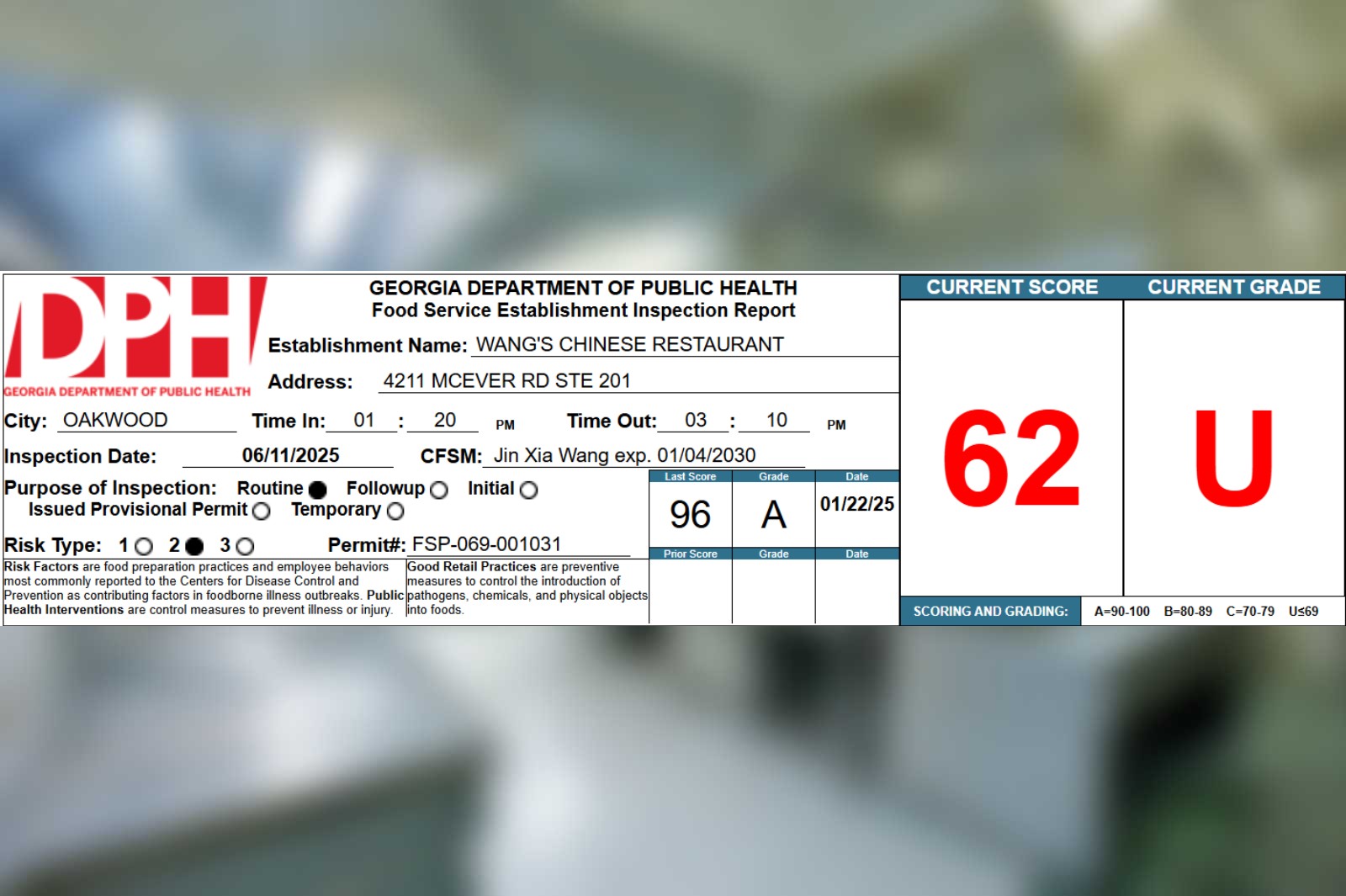
Wang’s Chinese Restaurant, located at 4211 McEver Rd Ste 201 in Oakwood, received a score of 62 points out of a possible 100 points during their 06/11/2025 inspection by the Georgia Department of Public Health.
The violations noted by the inspector were:
Violation #1:
1-2A – pic present, demonstrates knowledge, performs duties
511-6-1.03(2)(a)-(n)(p),(q) – responsibility of pic (pf)
Points: 4
Corrected during inspection?: No
Repeat: No
Inspector Notes: Observed no active managerial control over the facility for cooking temperatures, cooling methods, and separation of food products where required. Further training is recommended. 511-6-1.03(2)(a)-(n)(p),(q) – Responsibility of PIC (Pf) (a)Operations Not Conducted in Private Home. Food service establishment operations are not conducted in a private home or in a room used as living or sleeping quarters; Pf (b) Authorized Personnel Access. Persons unnecessary to the food service establishment operation are not allowed in the food preparation, food storage, or warewashing areas, except that brief visits and tours may be authorized by the person in charge if steps are taken to ensure that exposed food; clean equipment, utensils, and linens; and unwrapped single-service and single-use articles are protected from contamination; Pf (c) Authorized Persons Compliance. Employees and other persons such as delivery and maintenance persons and pesticide applicators entering the food preparation, food storage, and warewashing areas comply with this Chapter; Pf (d) Employee Handwashing. Employees are effectively cleaning their hands, by routinely monitoring the employees’ handwashing; Pf (e) Monitoring of Receiving. Employees are visibly observing and verifying delivered foods as they are received to determine that they are from approved sources and are placed into appropriate storage locations, as required by this Chapter, such that they are received and maintained at the required temperatures, protected from contamination, unadulterated, and accurately presented, by routinely monitoring the employees’ observations, maintaining receiving/corrective action records for deliveries during non-operating hours, and periodically evaluating foods upon their receipt as specified within DPH Rule 511-6-1-.04(3)(m);Pf (f) Monitoring of Receiving during Non-Operating Hours. Employees are verifying that foods delivered to the food service establishment during non-operating hours are from approved sources and are placed into appropriate storage locations such that they are maintained at the required temperatures, protected from contamination, unadulterated, accurately presented, by routinely monitoring the employees’ observations, maintaining receiving/corrective action records for deliveries during non-operating hours and periodically evaluating foods upon their receipt as specified within DPH Rule 511-6-1-.04(3)(m);Pf (g) Proper Cooking Techniques. Employees are properly cooking, cold/hot holding, and reheating for hot holding time/temperature control for safety food, being particularly careful in cooking, reheating, and holding those foods known to cause severe foodborne illness and death, such as eggs and comminuted meats, through daily oversight of the employees’ routine monitoring of the cooking, holding, and reheating for hot holding temperatures using appropriate temperature measuring devices properly scaled and calibrated;Pf (h) Proper Cooling Methods. Employees are using proper methods to rapidly cool time/temperature control for safety food, that are not held hot or are not for consumption within four hours, through daily oversight of the employees’ routine monitoring of food temperatures during cooling;Pf (i) Proper Thawing. Food employees are properly maintaining the temperature of Time/Temperature control for safety foods during thawing through daily oversight of the food employee’s routine monitoring of food temperatures;Pf (j) Consumer Food Safety. Consumers who order raw or partially cooked ready-to-eat foods of animal origin are informed that the food is not cooked sufficiently to ensure its safety;Pf (k) Proper Sanitizing. Employees are properly sanitizing cleaned multiuse equipment and utensils before they are reused, through routine monitoring of solution temperature and exposure time for hot water sanitizing, and chemical concentration, pH, temperature, and exposure time for chemical sanitizing;Pf (l) Clean Tableware. Consumers are notified that clean tableware is to be used when they return to self-service areas such as salad bars and buffets;Pf (m) Bare Hand Contact. Unless the conditions specified in DPH Rule 511-6-1-.04(4)(a)4. are met, employees are preventing cross-contamination of ready-to-eat food with bare hands by properly using suitable utensils such as deli tissue, spatulas, tongs, single-use gloves, or dispensing equipment;Pf (n) Food Safety Training. Employees are properly trained in food safety, including food allergy awareness, as it relates to their assigned duties. Food allergy awareness includes describing foods identified as major food allergens and the symptoms that a major food allergen could cause in a sensitive individual who has an allergic reaction;Pf (o) Reporting Responsibilities. Food employees and conditional employees are informed in a verifiable manner of their responsibility to report in accordance with the Chapter, to the person in charge, information about their health and activities as they relate to diseases that are transmissible through food;Pf (p) Imminent Health Hazard. If an imminent health hazard exists because of an emergency such as a fire, flood, interruption of electrical or water service for two or more hours, sewage malfunction, misuse of poisonous or toxic materials, onset of an apparent foodborne illness outbreak, gross unsanitary occurrence or condition, or other circumstances that may endanger public health, then operations are immediately discontinued and the Health Authority is notified. P However, establishments may continue to operate based upon emergency guidance provided by the Health Authority or under an emergency operation plan that has been approved by the Health Authority prior to the occurrence of such emergency events; Pf and (q) Procedures and Plans. Written procedures and plans, where specified by this Chapter and as developed by the food service establishment, are maintained and implemented as required. Pf Note: The food establishment needs to retrain their staff on proper cooking temperatures, cooling methods, and separation of raw meats.
Violation #2:
4-1A – food separated and protected
511-6-1.04(4)(c)1(i)(ii)(iii)(v)(vi)(vii)(viii) – packaged & unpackaged food separation, packaging, and segregation (p, c)
Points: 9
Corrected during inspection?: Yes
Repeat: No
Inspector Notes: Observed raw shrimp to be stored below raw chicken and raw beef. 511-6-1.04(4)(c)1(i)(ii)(iii)(v)(vi)(vii)(viii) – Packaged & Unpackaged Food Separation, Packaging, and Segregation (P, C) (c) Packaged and Unpackaged Food – Separation, Packaging, and Segregation. 1. Food shall be protected from cross contamination by: (i) Except as specified in paragraph (i)(IV) of this subsection, separating raw animal foods during storage, preparation, holding, and display from: (I) Raw ready-to-eat food including other raw animal food such as fish for sushi or molluscan shellfish, or other raw ready-to-eat food such as fruits and vegetables, P and (II) Cooked ready-to-eat food; and P (III) Fruits and vegetables before they are washed; P (IV) Frozen, commercially processed and packaged raw animal food may be stored or displayed with or above frozen, commercially processed and packaged, ready-to-eat food. (ii) Except when combined as ingredients, separating types of raw animal foods from each other such as beef, fish, lamb, pork, and poultry during storage, preparation, holding, and display by: (I) Using separate equipment for each type, P or (II) Arranging each type of food in equipment so that cross contamination of one type with another is prevented, P and (III) Preparing each type of food at different times or in separate areas; P (iii) Cleaning and sanitizing equipment and utensils; (v) Cleaning hermetically sealed containers of food of visible soil before opening; (vi) Protecting food containers that are received packaged together in a case or overwrap from cuts when the case or overwrap is opened; (vii) Storing damaged, spoiled, or recalled food being held in the food service establishment separate from food, equipment, utensils, linens and single-service and single-use articles; or (viii) Separating fruits and vegetables, before they are washed from ready-to-eat food. COS: The PIC immediately had a food employee correct the separation of raw foods to prevent cross contamination.
Violation #3:
4-2B – food-contact surfaces: cleaned & sanitized
511-6-1.05(6)(n) – manual and mechanical warewashing equipment, chemical sanitization-temperature, ph, concentration, hardness (p,pf)
Points: 4
Corrected during inspection?: Yes
Repeat: No
Inspector Notes: The dish machine wash cycle was observed at 118 Degrees Fahrenheit. 511-6-1.05(6)(n) – Manual and Mechanical Warewashing Equipment, Chemical Sanitization-Temperature, pH, Concentration, Hardness (P,Pf) (n) Manual and Mechanical Warewashing Equipment, Chemical Sanitization – Temperature, pH, Concentration, and Hardness. A chemical sanitizer used in a sanitizing solution for a manual or mechanical operation at contact times specified under subsection (8)(b)3 of this Rule shall meet the requirements specified in DPH Rule 511-6-1-.07(6)(g), shall be used in accordance with the Environmental Protection Agency (EPA)-registered label use instructions P, and shall be used as follows: 1. A chlorine solution shall have a minimum temperature based on the concentration and pH of the solution as listed in the following chart; P Concentration Range Minimum Temperature MG/L PH 10 or less oF (oC) PH 8 or less oF (oC) 25-49 120 (49) 120 (49) 50-99 100 (38) 75 (24) 100 55 (13) 55 (13) Note: The facility proceeded to use their (3) Compartment sink to wash, rinse and Sanitize their equipment.
Violation #4:
5-1A – proper cooking time and temperatures
511-6-1.04(5)(a) – raw animal foods (p, pf)
Points: 9
Corrected during inspection?: Yes
Repeat: No
Inspector Notes: Observed the same kung pao chicken 1 cooked to 151 Degrees Fahrenheit. 511-6-1.04(5)(a) – Raw Animal Foods (P, Pf) (5) Pathogen Destruction. (a) Raw Animal Foods. 1. Except as specified under paragraphs 2, 3 and 4 of this subsection, raw animal foods such as eggs, fish, meat, poultry, and foods containing these raw animal foods, shall be cooked to heat all parts of the food to a temperature and for a time that complies with one of the following methods based on the food that is being cooked: (i) 145°F (63°C) or above for 15 seconds for: P (I) Raw eggs that are broken and prepared in response to a consumer’s order and for immediate service, P and (II) Except as specified under paragraphs 1(ii) and (iii), 2, and 3 of this subsection, fish and meat including game animals commercially raised for food or under a voluntary inspection program; P (ii) 155°F (68°C) for 17 seconds or the temperature specified in the following chart that corresponds to the holding time for ratites, non intact meat, and injected meats; the following if they are comminuted: fish, meat, game animals raised for food, and commercially game animals or under a voluntary inspection program; and raw eggs that are not prepared to a consumer’s order and for immediate service P ; or Minimum Temperature Time °F (°C) 145 (63) 3 minutes 150 (66) 1 minute 158 (70) < 1 second (instantaneous) (iii) 165°F (74°C) or above for <1 sec instantaneous for poultry, baluts, wild game animals, stuffed fish, stuffed meat, stuffed pasta, stuffed poultry, stuffed ratites, or stuffing containing fish, meat, poultry, or ratites. P 2. Whole meat roasts including beef, corned beef, lamb, pork, and cured pork roasts such as ham shall be cooked: (ii) If cooked in an oven, use an oven that is preheated to the temperature specified for the roast’s weight in the following chart and that is held at that temperature: Pf Oven Type Oven Temperature Based on Roast Weight Less than 10 lbs (4.5 kg) 10 lbs (4.5 kg) or More Still Dry 350°F (177°C) or more 250°F (121°C) or more Convection 325°F (163°C) or more 250°F (121°C) or more High Humidity1 250°F (121°C) or less 250°F (121°C) or less 1 Relative humidity greater than 90% for at least 1 hour as measured in the cooking chamber or exit of the oven; or in a moisture-impermeable bag that provides 100% humidity. and (i) As specified in the following chart, to heat all parts of the food to a temperature and for the holding time that corresponds to that temperature: P Temperature °F (°C) Time1 in Minutes Temperature °F (°C) Time1 in Seconds 130 (54.4) 112 147 (63.9) 134 131 (55.0) 89 149 (65.0) 85 133 (56.1) 56 151 (66.1) 54 135 (57.2) 36 153 (67.2) 34 136 (57.8) 28 155 (68.3) 22 138 (58.9) 18 157 (69.4) 14 140 (60.0) 12 158 (70.0) 0 142 (61.1) 8 144 (62.2) 5 145 (62.8) 4 1Holding time may include postoven heat rise. 3. A raw or undercooked whole-muscle, intact beef steak may be served or offered for sale in a ready-to-eat form if: (i) The food service establishment serves a population that is not a highly susceptible population, and (ii) The steak is prepared so that it remains intact, and (iii) The steak is cooked on both the top and bottom to a surface temperature of 145°F (63°C) or above and a cooked color change is achieved on all external surfaces. 4. A raw animal food such as raw egg, raw fish, raw-marinated fish, raw molluscan shellfish, or steak tartare; or a partially cooked food such as lightly cooked fish, soft cooked eggs, or rare meat other than whole-muscle, intact beef steaks as specified in paragraph 3 of this subsection, may be served or offered for sale upon consumer request or selection in a ready-to-eat form if: (i) The food service establishment serves a population that is not a highly susceptible population; and (ii) The food, if served or offered for service by consumer selection from a children’s menu, does not contain comminuted meat, Pf and (iii) The consumer is informed that to ensure its safety, the food should be cooked as specified under paragraphs 1 or 2 of this subsection; or (iv) The Health Authority grants a variance from paragraphs 1 or 2 of this subsection as specified in DPH Rule 511-6-1-.10(5)(a) based on a HACCP plan that: (I) Is submitted by the permit holder and granted as specified under DPH Rule 511-6-1-.10(5)(b), and (II) Documents scientific data or other information showing that a lesser time and temperature regimen results in a safe food, and (III) Verifies that equipment and procedures for food preparation and training of food employees at. the food service establishment meet the conditions of the variance. COS: The Health inspector told the server to return the chicken to the kitchen. The chicken was given back to the cook who continued to cook the chicken until it reached a temperature of 176 Degrees Fahrenheit.
Violation #5:
6-1D – time as a public health control: procedures and records
511-6-1.04(6)(i) – time as a public health control (tphc) (p, pf, c)
Points: 9
Corrected during inspection?: Yes
Repeat: No
Inspector Notes: Cut cabbage was observed at room temperature being held using Time as a Public Health Control. Cut cabbage was placed on the table at 10:00am more than 4 hours ago. 511-6-1.04(6)(i) – Time as a Public Health Control (TPHC) (P, Pf, C) (i) Time as a Public Health Control. 1. Except as specified under paragraph 4 of this subsection, if time without temperature control is used as the public health control for a working supply of time/temperature control for safety food before cooking, or for ready-to-eat time/temperature control for safety food that is displayed or held for sale or service, written procedures shall be prepared in advance, maintained in the food service establishment, and made available to the regulatory authority upon request that specify: Pf (i) Methods of compliance with paragraphs 2(i) – (iv) or 3(i) through (v) of this subsection; and (ii) Methods of compliance with the cooling of time/temperature control for safety food that is prepared, cooked, and refrigerated before time is used as a public health control. Pf 2. If time without temperature control is used as the public health control up to a maximum of 4 hours: (i) Except as specified in paragraph 2.(ii) of this subsection, the food shall have an initial temperature of 41°F (5°C) or less when removed from cold holding temperature control, or 135°F (57°C) or greater when removed from hot holding temperature control;P (ii) The food may have an initial temperature of 70°F (21°C) or less if; (I) It is a ready-to-eat fruit or vegetable that upon cutting is rendered a time/temperature control for safety food, or (II) It is a ready-to-eat hermetically sealed food that upon opening is rendered a time/temperature control for safety food, (III) The food temperature does not exceed 70°F (21°C) within a maximum time period of 4 hours from the time it was rendered a time/temperature control for safety food; and (IV) The food is marked or otherwise identified to indicate the time that is 4 hours past the point in time when the food is rendered a time/temperature control for safety food as specified in paragraph 2.(ii)(I) and (II). (iii) The food shall be marked or otherwise identified to indicate the time that is 4 hours past the point in time when the food is removed from temperature control;Pf (iv) The food shall be cooked and served, served at any temperature if ready-to-eat, or discarded, within 4 hours from the point in time when the food is removed from temperature control;P and (v) The food in unmarked containers or packages, or marked to exceed a 4-hour limit shall be discarded.P 3. If time without temperature control is used as the public health control up to a maximum of 6 hours: (i) The food shall have an initial temperature of 41°F (5°C) or less when removed from temperature control and the food temperature may not exceed 70°F (21°C) within a maximum time period of 6 hours; P (ii) The food shall be monitored to ensure the warmest portion of the food does not exceed 70°F (21°C) during the 6-hour period, unless an ambient air temperature is maintained that ensures the food does not exceed 70°F (21°C) during the 6-hour holding period; Pf (iii) The food shall be marked or otherwise identified to indicate: Pf (I) The time when the food is removed from 41°F (5°C) or less cold holding temperature control, Pf and (II) The time that is 6 hours past the point in time when the food is removed from cold holding temperature control; (iv) The food shall be: (I) Discarded if the temperature of the food exceeds 70°F (21°C), P or (II) Cooked and served, served at any temperature if ready-to-eat, or discarded within a maximum of 6 hours from the point in time when the food is removed from 41°F (5°C) or less cold holding temperature control; P and (v) The food in unmarked containers or packages, or marked with a time that exceeds the 6-hour limit shall be discarded. P 4. A food service establishment that serves a highly susceptible population may not use time as the public health control for raw eggs. COS: The cut cabbage was discarded at 2:17 pm by the PIC voluntarily.
Violation #6:
11A – proper cooling methods used: adequate equipment for temperature control
511-6-1.04(6)(e) – cooling methods (pf, c)
Points: 3
Corrected during inspection?: Yes
Repeat: No
Inspector Notes: Observed several containers of egg rolls, raw meat, and tomatoes fully covered with a lid and saran wrap, preventing adequate cooling of the food product. 511-6-1.04(6)(e) – Cooling Methods (Pf, C) (e) Cooling Methods. 1. Cooling shall be accomplished in accordance with the time and temperature criteria specified under DPH Rule 511-6-1-.04(6)(d) by using one or more of the following methods depending on the type of food being cooled: (i) Placing the food in shallow pans; Pf (ii) Separating the food into smaller or thinner portions; Pf (iii) Using rapid cooling equipment; Pf (iv) Stirring the food in a container placed in an ice water bath; Pf (v) Using containers that facilitate heat transfer; Pf (vi) Adding ice as an ingredient; Pf or (vii) Other effective methods. Pf 2. When placed in cooling or cold holding equipment, food containers in which food is being cooled shall be: (i) Arranged in the equipment to provide maximum heat transfer through the container walls; and (ii) Loosely covered, or uncovered if protected from overhead contamination during the cooling period to facilitate heat transfer from the surface of the food. COS: The PIC immediately had a food employee correct the cooling methods by uncovering the product and putting the product in an ice bath for proper cooling.
Additional remarks:
Hand sinks: 92°F
Meat prep sink: 116°F
Vegetable prep sink: 117°F
(3) compartment sink: 110°F
Men’s Restroom hand sinks: 112°F and 115°F
Women’s Restroom hand sinks: 91°F and 101°F
Note: The dishwashing machine did not meet required minimum temperature of 120°F, when washing. The 3-compartment sink was set up to facilitate proper washing, rinsing, and sanitizing of dishware.
Note: The facility has access to bleach with 6.0% sodium hypochlorite, effective against Norovirus.
Note: The dumpster/garbage area was inspected and no violations were observed.
Note: The facility will need a follow-up inspection within 10 working days time on 06/25/2025.
If a food service establishment is graded as a “U” and does not earn at least a grade “C” within ten days of receiving the “U” it may be requested to voluntarily close until all violations are corrected or have its food service permit suspended or revoked according to subsection (1)(b) of this rule.
CLICK HERE to read the full report
Get notified by email when this case is updated.