Get notified by email when this case is updated.
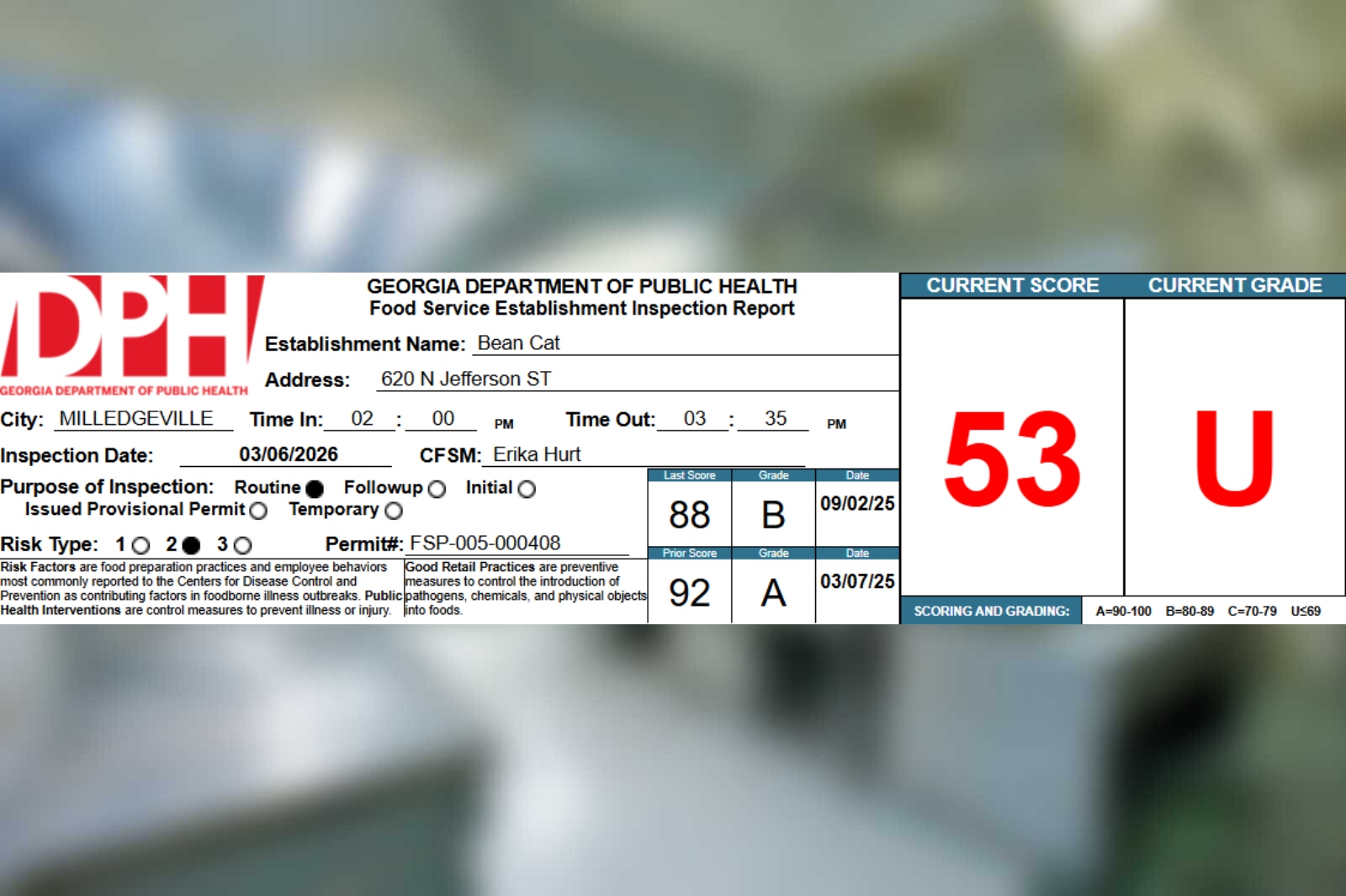
Bean Cat, located at 620 N Jefferson St in Milledgeville, received a score of 53 points out of a possible 100 points during their 03/06/2026 inspection by the Georgia Department of Public Health.
The violations noted by the inspector were:
Violation #1:
2-2B – proper eating, tasting, drinking, or tobacco use
511-6-1.03(5)(k)1&2 – eating, drinking, or using tobacco (c)
Points: 4
Corrected during inspection?: No
Repeat: No
Inspector Notes: Observed employee beverage on prep surface. 511-6-1.03(5)(k)1&2 – Eating, Drinking, or Using Tobacco (C) (k) Hygienic Practices. 1. Employees shall not use any form of tobacco products, or electronic devices that simulate tobacco smoking, while engaged in food preparation or service, nor while in areas used for equipment or utensil washing and storage, food preparation or food storage. Employees shall only use tobacco products or electronic devices that simulate tobacco smoking in approved designated areas. 2. Employees shall consume food only in approved designated areas separate from food preparation and serving areas, equipment or utensil areas and food storage areas. However, drinking from a single service beverage cup with a secure lid and straw that is handled to prevent contamination of the employee’s hands, the container, exposed food, clean equipment, utensils and linens, unwrapped single-service and single-use articles will be allowed. PIC was notified. Education was provided.
Violation #2:
2-2D – adequate handwashing facilities supplied & accessible
511-6-1.06(2)(o) – using a handwashing sink- operation & maintenance (pf)
Points: 4
Corrected during inspection?: No
Repeat: No
Inspector Notes: Observed hand wash sink broken. Employees using mop sink to wash hands. 511-6-1.06(2)(o) – Using a Handwashing Sink- Operation & maintenance (Pf) (o) Using a Handwashing Sink. 1. A handwashing sink shall be maintained so that it is accessible at all times for employee use. Pf 2. A handwashing facility may not be used for purposes other than handwashing. Pf 3. An automatic handwashing facility shall be used in accordance with manufacturer’s instructions. Pf PIC was notified. Education was provided.
Violation #3:
2-2D – adequate handwashing facilities supplied & accessible
511-6-1.06(2)(c) – handwashing sinks, installation (pf, c)
Points: 4
Corrected during inspection?: No
Repeat: No
Inspector Notes: Observed handwash sink in the customer restroom without hot water. 511-6-1.06(2)(c) – Handwashing sinks, Installation (Pf, C) (c) Handwashing Sink Installation. 1. A handwashing sink shall be equipped to provide tempered water at a temperature of at least 85ºF (29.4 ºC) through a mixing valve or combination faucet. Pf 2. A steam mixing valve may not be used at a handwashing sink. 3. A self-closing, slow-closing, or metering faucet shall provide a flow of water for at least 15 seconds without the need to reactivate the faucet. 4. An automatic handwashing facility shall be installed in accordance with manufacturer’s instructions. PIC was notified. Education was provided.
Violation #4:
3-1C – food in good condition, safe, and unadulterated
511-6-1.04(1) – safe, unadulterated and honestly presented (p)
Points: 9
Corrected during inspection?: No
Repeat: No
Inspector Notes: Observed green peppers, chicken livers, raw beef, and lids of condiments with green/ white mold like substance in WIC. 511-6-1.04(1) – Safe, unadulterated and Honestly Presented (P) (1) Condition. Food shall be safe, unadulterated, and honestly presented. P PIC was notified. Education was provided.
Violation #5:
4-1A – food separated and protected
511-6-1.04(4)(c)1(i)(ii)(iii)(v)(vi)(vii)(viii) – packaged & unpackaged food separation, packaging, and segregation (p, c)
Points: 9
Corrected during inspection?: No
Repeat: No
Inspector Notes: Observed cooked beef stored below raw beef in RIC. 511-6-1.04(4)(c)1(i)(ii)(iii)(v)(vi)(vii)(viii) – Packaged & Unpackaged Food Separation, Packaging, and Segregation (P, C) (c) Packaged and Unpackaged Food – Separation, Packaging, and Segregation. 1. Food shall be protected from cross contamination by: (i) Except as specified in paragraph (i)(IV) of this subsection, separating raw animal foods during storage, preparation, holding, and display from: (I) Raw ready-to-eat food including other raw animal food such as fish for sushi or molluscan shellfish, or other raw ready-to-eat food such as fruits and vegetables, P and (II) Cooked ready-to-eat food; and P (III) Fruits and vegetables before they are washed; P (IV) Frozen, commercially processed and packaged raw animal food may be stored or displayed with or above frozen, commercially processed and packaged, ready-to-eat food. (ii) Except when combined as ingredients, separating types of raw animal foods from each other such as beef, fish, lamb, pork, and poultry during storage, preparation, holding, and display by: (I) Using separate equipment for each type, P or (II) Arranging each type of food in equipment so that cross contamination of one type with another is prevented, P and (III) Preparing each type of food at different times or in separate areas; P (iii) Cleaning and sanitizing equipment and utensils; (v) Cleaning hermetically sealed containers of food of visible soil before opening; (vi) Protecting food containers that are received packaged together in a case or overwrap from cuts when the case or overwrap is opened; (vii) Storing damaged, spoiled, or recalled food being held in the food service establishment separate from food, equipment, utensils, linens and single-service and single-use articles; or (viii) Separating fruits and vegetables, before they are washed from ready-to-eat food. PIC was notified. Education was provided.
Violation #6:
4-2B – food-contact surfaces: cleaned & sanitized
511-6-1.05(7)(b) – food contact surfaces and utensils – cleaning frequency (p, c)
Points: 4
Corrected during inspection?: No
Repeat: Yes
Inspector Notes: Observed black mold like substance in ice machine. 511-6-1.05(7)(b) – Food Contact Surfaces and Utensils – Cleaning Frequency (P, C) (b) Equipment Food-Contact Surfaces and Utensils. (iv) In equipment such as ice bins and beverage dispensing nozzles and enclosed components of equipment such as ice makers, cooking oil storage tanks and distribution lines, beverage and syrup dispensing lines or tubes, coffee bean grinders, and water vending equipment: (I) At a frequency specified by the manufacturer; or (II) Absent manufacturer specifications, at a frequency necessary to preclude accumulation of soil or mold. PIC was notified. Education was provided.
Violation #7:
6-1A – proper cold holding temperatures
511-6-1.04(6)(f) – time/temperature control for safety; cold holding (p)
Points: 9
Corrected during inspection?: No
Repeat: No
Inspector Notes: Observed lettuce in PTC at 63F and raw chicken in RIC at 63F. 511-6-1.04(6)(f) – Time/Temperature Control for Safety; Cold Holding (P) (f) Time/Temperature Control for Safety Food, Hot and Cold Holding. Except during preparation, cooking, or cooling, or when time is used as the public health control, time/temperature control for safety food shall be maintained at 41°F (5°C) or below or 135°F (57°C) or above, except that roasts cooked to a temperature and for a time specified in subsection (5)(a)2 of this Rule and reheated using the same temperature and time conditions as cooking may be held at a temperature of 130°F (54°C) or above. P PIC was notified. Education was provided.
Violation #8:
6-2 – proper date marking and disposition
Points: 4
Corrected during inspection?: No
Repeat: Yes
Inspector Notes: Observed raw porkchop, raw fish, raw chicken, and raw bacon in a bag without a date in WIC. 511-6-1.04(6)(g) – Ready-To-Eat Time/Temperature Control for Safety Food, Date Marking (Pf) (g) Ready-to-Eat Time/Temperature Control for Safety Food, Date Marking 1. Except when packaging food using a reduced oxygen packaging method, and except as specified in paragraphs 5 and 6 of this subsection, refrigerated, ready-to-eat, time/temperature control for safety food prepared and held in a food establishment for more than 24 hours shall be clearly marked to indicate the date or day by which the food shall be consumed on the premises, sold, or discarded, when held at a temperature of 41°F (5°C) or below for a maximum of 7 days. The day of preparation shall be counted as Day 1. Pf 2. Except as specified in paragraphs 5 through 7 of this subsection, refrigerated, ready-to-eat, time/temperature control for safety food prepared and packaged by a food processing plant shall be clearly marked, at the time the original container is opened in a food service establishment and if the food is held for more than 24 hours, to indicate the date or day by which the food shall be consumed on the premises, sold, or discarded, when held at a temperature of 41°F (5°C) or below for a maximum of 7 days after the original container is opened. The day the original container is opened in the food service establishment shall be counted as Day 1, except, the day or date marked by the food service establishment may not exceed a manufacturer’s use by date if the manufacturer determined the use-by date based on food safety; Pf 3. A refrigerated, ready-to-eat, time/temperature control for safety food ingredient or a portion of a refrigerated, ready-to-eat, time/temperature control for safety food that is subsequently combined with additional ingredients or portions of food shall retain the date marking of the earliest-prepared or first-prepared ingredient. Pf 4. A date marking system that meets the criteria stated in paragraphs 1 and 2 of this subsection may include: (i) Using a method approved by the Health Authority for refrigerated, ready-to-eat time / temperature control for safety food that is frequently rewrapped, such as lunchmeat or a roast, or for which date marking is impractical, such as soft serve mix or milk in a dispensing machine; (ii) Marking the date or day of preparation, with a procedure to discard the food on or before the last date or day by which the food must be consumed on the premises, sold, or discarded; (iii) Marking the date or day the original container is opened in a food service establishment, with a procedure to discard the food on or before the last date or day by which the food must be consumed on the premises, sold, or discarded; or (iv) Using calendar dates, days of the week, color-coded marks, or other effective marking methods, provided that the marking system is disclosed to the Health Authority upon request. 5. The requirements in paragraphs 1 and 2 of this subsection do not apply to individual meal portions served or repackaged for sale from a bulk container upon a consumer’s request. 6. The requirements in paragraphs 1 and 2 of this subsection do not apply to shellstock. 7. The requirement in paragraph 2 of this subsection does not apply to the following foods prepared and packaged by a food processing plant inspected by a Health Authority: (i) Deli salads, such as ham salad, seafood salad, chicken salad, egg salad, pasta salad, potato salad, and macaroni salad, manufactured in accordance with 21 CFR 117 Current good manufacturing practice in manufacturing, packing, or holding human food; (ii) Hard cheeses containing not more than 39% moisture as defined in 21 CFR 133 Cheeses and related cheese products, such as cheddar, gruyere, parmesan and reggiano, and romano; (iii) Semi-soft cheeses containing more than 39% moisture, but not more than 50% moisture, as defined in 21 CFR 133 Cheeses and related cheese products, such as blue, edam, gorgonzola, gouda, and monterey jack; (iv) Cultured dairy products as defined in 21 CFR 131 Milk and cream, such as yogurt, sour cream, and buttermilk; (v) Preserved fish products, such as pickled herring and dried or salted cod, and other acidified fish products defined in 21 CFR 114 Acidified foods; (vi) Shelf stable, dry fermented sausages, such as pepperoni and Genoa salami; and (vii) Shelf stable salt-cured products, such as prosciutto and Parma ham. PIC was notified. Education was provided.
Violation #9:
8-2B – toxic substances properly identified, stored, used
511-6-1.07(6)(c) – storage, separation (p)
Points: 4
Corrected during inspection?: No
Repeat: No
Inspector Notes: Observed chemicals being stored with food products. 511-6-1.07(6)(c) – Storage, Separation (P) (c) Storage, Separation. Poisonous or toxic materials shall be stored so they cannot contaminate food, equipment, utensils, linens, and single-service and single-use articles by: 1. Separating the poisonous or toxic materials by spacing or partitioning; P and 2. Locating the poisonous or toxic materials in an area that is not above food, equipment, utensils, linens, and single-service or single-use articles. This requirement does not apply to equipment and utensil cleaners and sanitizers that are stored in warewashing areas for availability and convenience if the materials are stored to prevent contamination of food, equipment, utensils, linens, and single-service and single-use articles. P PIC was notified. Education was provided.
CLICK HERE to read the full report
Get notified by email when this case is updated.