Get notified by email when this case is updated.
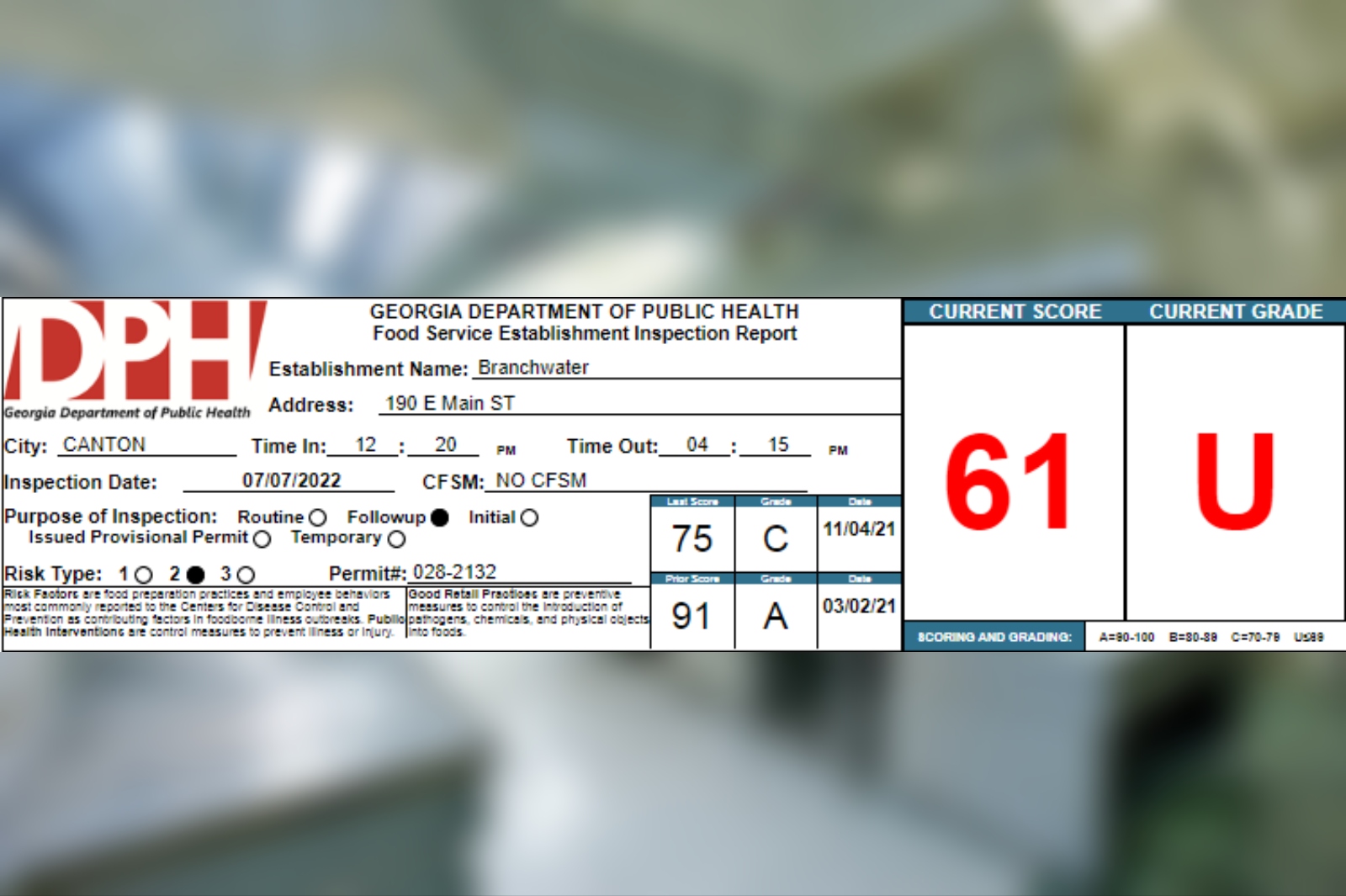
Branchwater, located at 190 E Main ST in Canton, received a score of 61 points out of a possible 100 points during their 07/7/2022 inspection by the Georgia Department of Public Health.
The violations noted by the inspector were:
Violation #1
1-2A – pic present, demonstrates knowledge, performs duties
Points: 4
Corrected during inspection?: No
Repeat: No
Inspector Notes: Observed several critical violations during this follow-up inspection and an overall lack of active managerial control. Please see the responsibilities of the person-in charge below: 511-6-1.03(2)(a)-(l)(n)(o) – Responsibility of PIC (Pf) (a) Food service establishment operations are not conducted in a private home or in a room used as living or sleeping quarters; Pf (b) Authorized Personnel Access. Persons unnecessary to the food service establishment operation are not allowed in the food preparation, food storage, or warewashing areas, except that brief visits and tours may be authorized by the person in charge if steps are taken to ensure that exposed food; clean equipment, utensils, and linens; and unwrapped single-service and single-use articles are protected from contamination; Pf (c) Authorized Persons Compliance. Employees and other persons such as delivery and maintenance persons and pesticide applicators entering the food preparation, food storage, and warewashing areas comply with this Chapter; Pf (d) Employee Handwashing. Employees are effectively cleaning their hands, by routinely monitoring the employees’ handwashing; Pf (e) Monitoring of Receiving. Employees are visibly observing and verifying delivered foods as they are received to determine that they are from approved sources and are placed into appropriate storage locations, as required by this Chapter, such that they are received and maintained at the required temperatures, protected from contamination, unadulterated, and accurately presented, by routinely monitoring the employees’ observations, maintaining receiving/corrective action records for deliveries during non-operating hours, and periodically evaluating foods upon their receipt as specified within DPH Rule 511-6-1-.04(3)(m);Pf (f) Proper Cooking Techniques. Employees are properly cooking cold/hot holding, and reheating for hot holding time/temperature control for safety food, being particularly careful in cooking, reheating, and holding those foods known to cause severe foodborne illness and death, such as eggs and comminuted meats, through daily oversight of the employees’ routine monitoring of the cooking, holding, and reheating for hot holding temperatures using appropriate temperature measuring devices properly scaled and calibrated. Pf (g) Proper Cooling Methods. Employees are using proper methods to rapidly cool time/temperature control for safety food, that are not held hot or are not for consumption within four hours, through daily oversight of the employees’ routine monitoring of food temperatures during cooling; Pf (h) Consumer Food Safety. Consumers who order raw or partially cooked ready-to-eat foods of animal origin are informed that the food is not cooked sufficiently to ensure its safety; Pf (i) Proper Sanitizing. Employees are properly sanitizing cleaned multiuse equipment and utensils before they are reused, through routine monitoring of solution temperature and exposure time for hot water sanitizing, and chemical concentration, pH, temperature, and exposure time for chemical sanitizing; Pf (j) Clean Tableware. Consumers are notified that clean tableware is to be used when they return to self-service areas such as salad bars and buffets; Pf (k) Bare Hand Contact. Unless the conditions specified in DPH Rule 511-6-1-.04(4)(a)4 are met, employees are preventing cross-contamination of ready-to-eat food with bare hands by properly using suitable utensils such as deli tissue, spatulas, tongs, single-use gloves, or dispensing equipment; Pf (l) Food Safety Training. Employees are properly trained in food safety, including food allergy awareness, as it relates to their assigned duties; Pf (n) Imminent Health Hazard. If an imminent health hazard exists because of an emergency such as a fire, flood, interruption of electrical or water service for two or more hours, sewage malfunction, misuse of poisonous or toxic materials, onset of an apparent foodborne illness outbreak, gross unsanitary occurrence or condition, or other circumstances that may endanger public health, then operations are immediately discontinued and the Health Authority is notified. P However, establishments may continue to operate under an emergency operation plan that has been approved by the Health Authority prior to the occurrence of such emergency events.Pf (o) Procedures and Plans. Written procedures and plans, where specified by this Chapter and as developed by the food service establishment, are maintained and implemented as required.Pf
Violation #2
1-2B – certified food protection manager
Points: 4
Corrected during inspection?: No
Repeat: No
Inspector Notes: Facility does not appear to have a certified food safety manager (CFSM). There was a certificate for Steven Hogan, however employees did not know who that was. Employees were unsure if the certificate was for the owner (Todd Hogan) and that Steven was his government name. If so, according to employees Todd only visits the facility for about 30 mins once a week, which does not qualify him to be the CFSM as he does not actively oversee food preparation on a daily basis. Please see the Rule below: 511-6-1-.03(3)(d) – Certified Food Safety Manager Responsibility 1. The responsibility of the CFSM shall include the safety of food preparation and service by ensuring that all employees who handle, or have responsibility for handling, unpackaged foods of any kind, have sufficient knowledge of safe preparation and service of the food. The nature and extent of the knowledge that each employee is required to have may be tailored, as appropriate, to the employee’s duties related to food safety issues. 2. The CFSM shall: (i) Be the person-in-charge while on the premises of the food service establishment and shall designate someone else to be the person in charge when not on the premises; (ii) Supervise and instruct food service employees in the techniques of sanitary food handling and proper maintenance of the facility; (iii) Offer a training program for all food service employees to satisfy employee proficiency in their job responsibilities for food safety; (iv) Communicate with representatives of the Health Authority about the effectiveness of employee training programs; and (v) Assess training needs of the food service employees and request formal training as needed. Must have a CFSM within 30 days.
Violation #3
2-2A – management knowledge, responsibilities, reporting
Points: 4
Corrected during inspection?: No
Repeat: No
Inspector Notes: Observed no Employee Health Policy (EHP) where employees acknowledge they are aware of the symptoms/illnesses they must report to the Person-In Charge (PIC). The permit holder shall require food employees and conditional employees to report to the CFSM and PIC, information about their health and activities as they relate to diseases that are transmissible through food. Blank EHP forms were provided. PIC must ensure all employees read and sign form.
Violation #4
2-2B – proper eating, tasting, drinking, or tobacco use
Points: 4
Corrected during inspection?: Yes
Repeat: Yes
Inspector Notes: Observed employee drinking from open cups and stored on the prep top cutting board. Also observed other employee drinks stored in food prep areas. Employees shall consume food only in approved designated areas separate from food preparation and serving areas, equipment or utensil areas and food storage areas. However, drinking from a single service beverage cup with a secure lid and straw that is handled to prevent contamination of the employee’s hands, the container, exposed food, clean equipment, utensils and linens, unwrapped single-service and single-use articles will be allowed. COS by discarding drinks.
Violation #5
2-2D – adequate handwashing facilities supplied & accessible
Points: 4
Corrected during inspection?: No
Repeat: No
Inspector Notes: Observed no paper towels at handwashing sink nearest grill area. Employees stated that sink is not in use due to a draining issue, however, the sink did have running hot/cold water. All handwashing sinks must be supplied with soap and paper towels. Sink must be fixed.
Violation #6
2-2D – adequate handwashing facilities supplied & accessible
Points: 4
Corrected during inspection?: Yes
Repeat: No
Inspector Notes: Observed handwashing sink at bar being used as a dump sink and had a bowl inside. 1. A handwashing sink shall be maintained so that it is accessible at all times for employee use. 2. A handwashing facility may not be used for purposes other than handwashing. COS by removing bowl.
Violation #7
4-2B – food-contact surfaces: cleaned & sanitized
Points: 4
Corrected during inspection?: No
Repeat: No
Inspector Notes: Observed employee washing utensils in produce sink (with soap) and failing to sanitize. Dishes should NOT be washed in a prep sink and all dishes must be properly washed and sanitized.
Violation #8
6-1A – proper cold holding temperatures
Points: 9
Corrected during inspection?: Yes
Repeat: Yes
Inspector Notes: Observed cooked brussels sprouts, blanched fries, and egg wash left out at room temperature. Except during preparation, cooking, or cooling, or when time is used as the public health control, TCS food shall be maintained at 41°F or below. COS by discarding fries, moving brussels sprouts to a different unit, and creating an effective ice bath for egg wash.
Violation #9
6-1A – proper cold holding temperatures
Points: 9
Corrected during inspection?: Yes
Repeat: Yes
Inspector Notes: Observed time/temperature control for safety foods (TCS) in walk-in cooler and reach-in cooler nearest tea urns being cold held at temperatures greater than 41°F. Ambient temperature of walk-in cooler was 44°F and ambient temperature of reach-in was 46°F. COS by discarding TCS food.
Violation #10
6-1A – proper cold holding temperatures
Points: 9
Corrected during inspection?: No
Repeat: No
Inspector Notes: Observed several dairy based dressings (made in-house) being improperly cold held in ice box container. Dressings were between 50-56°F, however, they must be cold held at 41°F or below. COS by discarding. NOTE: ice box container is not an effective way to cold hold TCS foods. Health Authority recommends storing in adjacent cooler
Violation #11
6-1C – proper cooling time and temperature
Points: 9
Corrected during inspection?: Yes
Repeat: No
Inspector Notes: Observed cooked lamb, pot roast, and cheddar grits not cooled to 41°F below within the 6 hour cooling window. Lamb was 44°F, pot was was 46°F, and grits were 48°F–all were prepared on previous days. 1. Cooked time/temperature control for safety food shall be cooled: (i) Within 2 hours from 135°F (57°C) to 70°F (21°C); P and (ii) Within a total of 6 hours from 135°F (57°C) to 41°F (5°C) or less. P COS by discarding. Person in charge is responsible for ensuring that TCS foods are properly cooled within allotted time. Also, must practice effective cooling methods (i.e., using ice wands for cooling cheddar grits in large, deep containers and creating ice baths for lamb and beef).
Violation #12
6-2 – proper date marking and disposition
Points: 4
Corrected during inspection?: Yes
Repeat: No
Inspector Notes: Observed numerous (8+) TCS foods in prep top unit not date marked. TCS food prepared and held in a food establishment for more than 24 hours shall be clearly marked to indicate the date or day by which the food shall be consumed on the premises, sold, or discarded, when held at a temperature of 41°F or below for a maximum of 7 days. The day of preparation shall be counted as Day 1. COS by placing dates on products. NOTE: all items not date marked on future inspections will be discarded.
Violation #13
6-2 – proper date marking and disposition
Points: 4
Corrected during inspection?: Yes
Repeat: No
Inspector Notes: Observed numerous (10+) TCS foods in walk-in cooler and a few items in prep top units held past its discard date. 1. A food that requires datemarking shall be discarded if it: (i) Exceeds 7 days, not including the time that the product is frozen; (ii) Is in a container or package that does not bear a date or day; or (iii) Is appropriately marked with a date or day that exceeds 7 days. COS by discarding. Person in charge is responsible for ensure that all TCS foods are discarded within 7 days.
Violation #14
10D – food properly labeled; original container
Points: 3
Corrected during inspection?: Yes
Repeat: No
Inspector Notes: Observed 3 gallons of milk that expired 7/2/22 and more than 10 containers of half & half that expired 7/4/22 stored in walk-in cooler. Prepackaged sandwiches, eggs, infant formula, shucked oysters, milk, and time/temperature control safety foods that are labeled as “keep refrigerated” and that are for sale or service to the consumer or used as an ingredient in other foods shall be immediately discarded and shall not be sold, served, or used after the manufacturer’s expiration date or the sell-by date. COS by discarding.
Violation #15
12A – contamination prevented during food preparation, storage, display
Points: 3
Corrected during inspection?: No
Repeat: Yes
Inspector Notes: Observed food stored in unapproved area/basement. The area is not complete according to the code. There are exposed pipes with no proper flooring. Observed 3 chest freezers stored in the basement area as well as keg cooler. Must move the freezers to approved storage area.
Violation #16
12A – contamination prevented during food preparation, storage, display
Points: 3
Corrected during inspection?: No
Repeat: No
Inspector Notes: Observed numerous bottles of alcohol stored on floor in upstairs alcohol storage room. 1. Except as specified in paragraphs 2 and 3 of this subsection, food shall be protected from contamination by storing the food: (i) In a clean, dry location; (ii) Where it is not exposed to splash, dust, or other contamination; and (iii) At least 6 inches (15 cm) above the floor. Drinks must be moved 6 inches off floor.
Violation #17
12A – contamination prevented during food preparation, storage, display
Points: 3
Corrected during inspection?: No
Repeat: Yes
Inspector Notes: Upstairs bar does not have an approved ceiling as there is exposed piping.
Violation #18
13A – posted: permit/inspection/choking poster/handwashing
Points: 1
Corrected during inspection?: Yes
Repeat: No
Inspector Notes: Observed most recent inspection report from 11/4/21 (75/C) not posted in facility. There was only an addendum form from an inspection from 2020 posted. The most current inspection report shall be PROMINENTLY displayed in public view at all times, within fifteen feet of the front or primary public door and between five feet and seven feet from the floor and in an area where it can be read at a distance of one foot away. COS by positing score. Today’s score must be posted and stay posted.
Violation #19
15A – food and nonfood-contact surfaces cleanable, properly designed, constructed, and used
Points: 1
Corrected during inspection?: No
Repeat: No
Inspector Notes: Lids to prep top units are in in disrepair and must be fixed. Lids should be able to stay open without having to hold it
Violation #20
15C – nonfood-contact surfaces clean
Points: 1
Corrected during inspection?: No
Repeat: No
Inspector Notes: Kitchen is in need of cleaning. Must clean behind, beneath, and on the side of all equipment. There is a large amount of grease build-up on left side of fryer. Also, hood vents must be cleaned and soon as possible as there is heavy grease build-up.
Violation #21
15C – nonfood-contact surfaces clean
Points: 1
Corrected during inspection?: No
Repeat: No
Inspector Notes: Observed glassware stored face down on heavily rusted shelving in cooler at upstairs bar. Must replace shelving or place a barrier in between (i.e. a food grade rubber mat).
Violation #22
17C – physical facilities installed, maintained, and clean
Points: 1
Corrected during inspection?: No
Repeat: No
Inspector Notes: Observed missing ceiling tiles in dry storage room holding alcohol. There should be no openings in the ceiling
CLICK HERE to read the full report
Get notified by email when this case is updated.
