Get notified by email when this case is updated.
Remove ads by Supporting Independent News
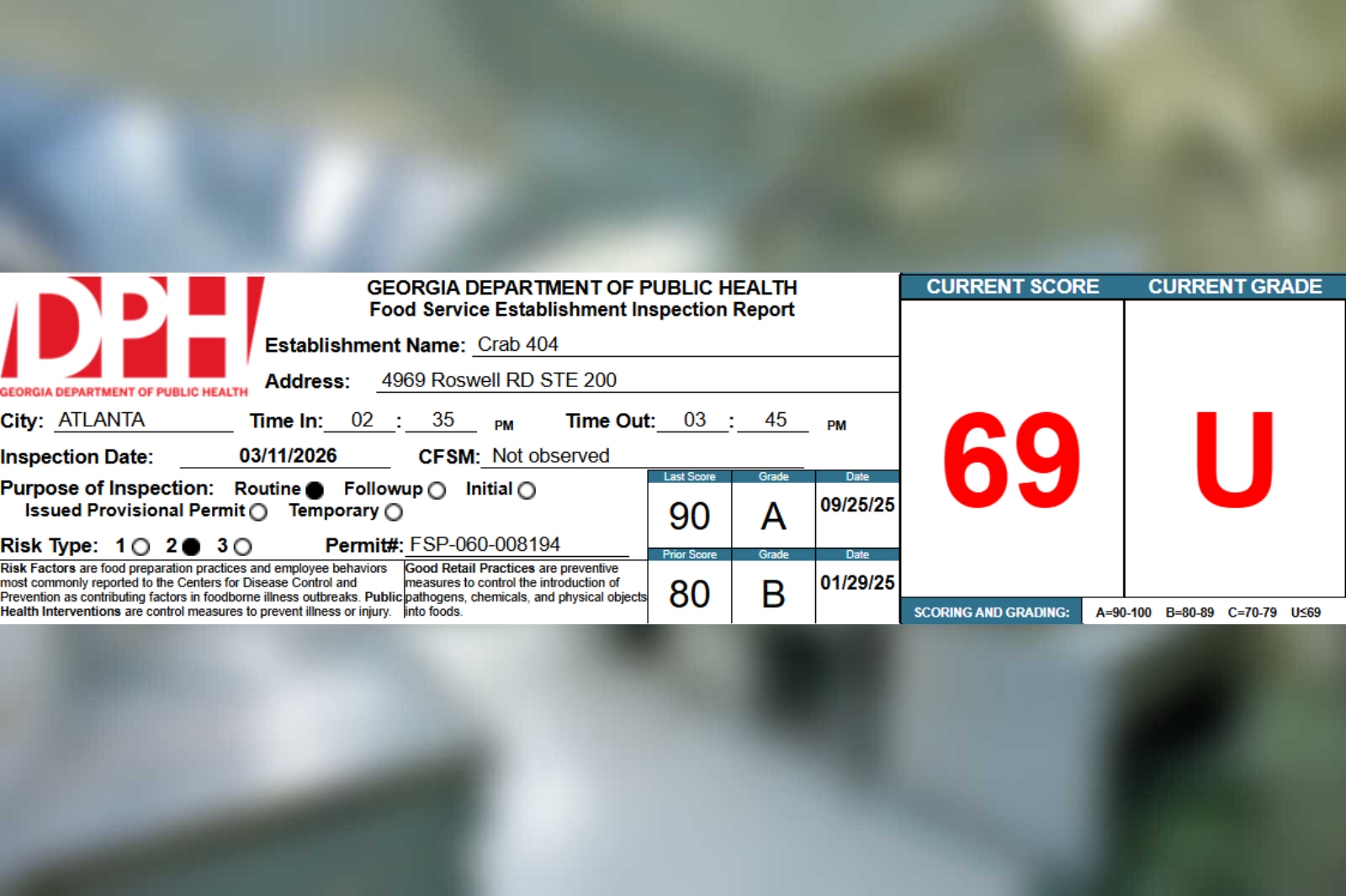
Crab 404, located at 4969 Roswell Rd Ste 200 in Atlanta, received a score of 69 points out of a possible 100 points during their 03/11/2026 inspection by the Georgia Department of Public Health.
The violations noted by the inspector were:
Violation #1:
1-2B – certified food protection manager
511-6-1.03(3)(a) – food safety manager certification (pf)
Points: 4
Corrected during inspection?: No
Repeat: Yes
Inspector Notes: Observed lack of CFSM certificate in facility. PIC showed food safety handler certificate. CA: Advised PIC to obtain certified food safety manager certificate. 511-6-1.03(3)(a) – Food Safety Manager Certification (Pf) Food service establishments shall have in its employ a Certified Food Safety Manager (CFSM) as specified in paragraph (b) of this subsection to ensure food safety is being managed within the food service establishment during all hours of operation as specified within paragraph (d) of this subsection. Pf
Violation #2:
2-2E – response procedures for vomiting & diarrheal events
511-6-1.03(6) – clean-up of vomiting and diarrheal events(pf)
Points: 4
Corrected during inspection?: No
Repeat: No
Inspector Notes: Observed lack of vomit or vomit clean up procedures in facility. CA: Advised PIC to obtain vomit kit. Will email vomit clean up document. 511-6-1.03(6) – Clean-up of Vomiting and Diarrheal Events(Pf) (6) Responding To Contamination Events. A food establishment shall have written procedures for employees to follow and an EPA registered disinfectant effective against Norovirus available on-site at the food service establishment when responding to vomiting or diarrheal events that involve the discharge of vomitus or fecal matter onto surfaces in the food service establishment. The procedures shall address the specific actions employees must take to minimize the spread of contamination and the exposure of employees, consumers, food, and surfaces to vomitus or fecal matter.Pf
Violation #3:
4-2B – food-contact surfaces: cleaned & sanitized
511-6-1.05(6)(n) – manual and mechanical warewashing equipment, chemical sanitization-temperature, ph, concentration, hardness (p,pf)
Points: 4
Corrected during inspection?: No
Repeat: No
Inspector Notes: Observed 0ppm chlorine at bar WW machine. CA: Advised PIC to get WW machine serviced. 511-6-1.05(6)(n) – Manual and Mechanical Warewashing Equipment, Chemical Sanitization-Temperature, pH, Concentration, Hardness (P,Pf) (n) Manual and Mechanical Warewashing Equipment, Chemical Sanitization – Temperature, pH, Concentration, and Hardness. A chemical sanitizer used in a sanitizing solution for a manual or mechanical operation at contact times specified under subsection (8)(b)3 of this Rule shall meet the requirements specified in DPH Rule 511-6-1-.07(6)(g), shall be used in accordance with the Environmental Protection Agency (EPA)-registered label use instructions P, and shall be used as follows: 1. A chlorine solution shall have a minimum temperature based on the concentration and pH of the solution as listed in the following chart; P Concentration Range Minimum Temperature MG/L PH 10 or less oF (oC) PH 8 or less oF (oC) 25-49 120 (49) 120 (49) 50-99 100 (38) 75 (24) 100 55 (13) 55 (13) 2. An iodine solution shall have a minimum temperature of 68°F (20°C)P minimum concentration between 12.5 ppm and 25 ppm, P and pH of 5.0 or less or a pH no higher than the level for which the manufacturer specifies for the solution to be effective; P 3. A quaternary ammonium compound solution shall have a minimum temperature of 75ºF (24ºC), P have a concentration as specified in DPH Rule 511-6-1-.07(6)(g) and as indicated by the manufacturer’s use directions included in the labeling, P and be used only in water with 500 ppm hardness or less or in water having a hardness no greater than specified by the EPA-registered label use instructions; P 4. If another solution of a chemical specified under paragraphs 1 through 3 of this subsection is used, the permit holder shall demonstrate to the Health Authority that the solution achieves sanitization and the use of the solution shall be approved; P 5. If a chemical sanitizer other than chlorine, iodine, or a quaternary ammonium compound is used, it shall be applied in accordance with the EPA-registered label use instructions ;P and
Violation #4:
4-2B – food-contact surfaces: cleaned & sanitized
511-6-1.05(7)(b) – food contact surfaces and utensils – cleaning frequency (p, c)
Points: 4
Corrected during inspection?: No
Repeat: No
Inspector Notes: Observed black and pink mold like substance inside ice machine. CA: Advised PIC to routinely clean inside ice machine. 511-6-1.05(7)(b) – Food Contact Surfaces and Utensils – Cleaning Frequency (P, C) (b) Equipment Food-Contact Surfaces and Utensils. 1. Equipment food-contact surfaces and utensils shall be cleaned: (i) Before each use with a different type of raw animal food such as beef, fish, lamb, pork, or poultry. It does not apply if the food-contact surface or utensil is in contact with a succession of different types of raw meat and raw poultry each requiring a higher cooking temperature as specified under DPH Rule 511-6-1.04(5)(a) than the previous type such as preparing raw pork followed by cutting raw poultry on the same cutting board; P (ii) Each time there is a change from working with raw foods to working with ready-to-eat foods; P (iii) Between uses with raw fruits and vegetables and with Time/Temperature Control for safety food; P (iv) Before using or storing a food temperature measuring device; P and (v) At any time during the operation when contamination may have occurred. P 2. Except as specified in paragraph 3 of this subsection, if used with time/temperature control for safety food, equipment food-contact surfaces and utensils shall be cleaned at least every 4 hours throughout the day. P 3. Surfaces of utensils and equipment contacting time/temperature control for safety food may be cleaned less frequently than every 4 hours if: (i) In storage, containers of time/temperature control for safety food and their contents are maintained at temperatures specified under DPH Rule 511-6-1-.04 and the containers are cleaned when they are empty; (ii) Utensils and equipment are used to prepare food in a refrigerated room or area that is maintained at one of the temperatures in the following chart and: (I) The utensils and equipment are cleaned at the frequency in the following chart that corresponds to the temperature: Temperature Cleaning Frequency 41ºF (5.0ºC) or less 24 hours >41ºF – 45ºF (>5.0ºC – 7.2ºC) 20 hours >45ºF – 50ºF (>7.2ºC – 10.0ºC) 16 hours >50ºF – 55ºF (>10.0ºC – 12.8ºC) 10 hours and (II) The cleaning frequency based on the ambient temperature of the refrigerated room or area is documented in the food service establishment. (iii) Temperature measuring devices are maintained in contact with food, such as when left in a container of deli food or in a roast, held at temperatures specified under DPH Rule 511-6-1- .04; (iv) Equipment is used for storage of packaged or unpackaged food, such as a reach-in refrigerator, and the equipment is cleaned at a frequency necessary to preclude accumulation of soil residues; (v) The cleaning schedule is approved based on consideration of: (I) Characteristics of the equipment and its use, (II) The type of food involved, (III) The amount of food residue accumulation, and (IV) The temperature at which the food is maintained during the operation and the potential for the rapid and progressive multiplication of pathogenic or toxigenic microorganisms that are capable of causing foodborne disease; or (vi) In-use utensils are intermittently stored in a container of water in which the water is maintained at 135ºF (57ºC) or more and the utensils and container are cleaned at least every 24 hours or at a frequency necessary to preclude accumulation of soil residues. 4. Dining counters and table-tops shall be cleaned and sanitized routinely after removing all soiled tableware and food trays shall be cleaned and sanitized after each use by one of the following methods: (i) A two step method in which one cloth, rinsed in sanitizing solution is used to clean food debris from the surface and a second cloth in separate sanitizing solution is used to rinse; (ii) Sanitizing solution is sprayed onto the surface and the surface is then wiped clean with a disposable towel; (iii) If used for cleaning and sanitizing, single-use disposable sanitizer wipes shall be used in accordance with EPA-registered label use instructions; or (iv) Other methods approved by the Health Authority. (v) Food trays may be cleaned and sanitized the same as table ware. 5. Except when dry cleaning methods are used as specified under subsection (7)(e) of this Rule, surfaces of utensils and equipment contacting food that is not time/temperature control for safety food shall be cleaned: (i) At any time when contamination may have occurred; (ii) At least every 24 hours for iced tea dispensers including nozzles and consumer self-service utensils such as tongs, scoops, or ladles; (iii) Before restocking consumer self-service equipment and utensils such as condiment dispensers and display containers; and (iv) In equipment such as ice bins and beverage dispensing nozzles and enclosed components of equipment such as ice makers, cooking oil storage tanks and distribution lines, beverage and syrup dispensing lines or tubes, coffee bean grinders, and water vending equipment: (I) At a frequency specified by the manufacturer; or (II) Absent manufacturer specifications, at a frequency necessary to preclude accumulation of soil or mold.
Violation #5:
6-1A – proper cold holding temperatures
511-6-1.04(6)(f) – time/temperature control for safety; cold holding (p)
Points: 9
Corrected during inspection?: No
Repeat: No
Inspector Notes: Observed multiple foods in RIC above 41 degrees. CA: Advised PIC to fix gasket on fridge door to prevent cold air loss. 511-6-1.04(6)(f) – Time/Temperature Control for Safety; Cold Holding (P) (f) Time/Temperature Control for Safety Food, Hot and Cold Holding. Except during preparation, cooking, or cooling, or when time is used as the public health control, time/temperature control for safety food shall be maintained at 41°F (5°C) or below or 135°F (57°C) or above, except that roasts cooked to a temperature and for a time specified in subsection (5)(a)2 of this Rule and reheated using the same temperature and time conditions as cooking may be held at a temperature of 130°F (54°C) or above. P
Violation #6:
6-2 – proper date marking and disposition
511-6-1.04(6)(g) – ready-to-eat time/temperature control for safety food, date marking (pf)
Points: 4
Corrected during inspection?: No
Repeat: No
Inspector Notes: Observed multiple food containers in prep top cooler without any date markers. CA: Advised PIC to date mark all food items once opened. 511-6-1.04(6)(g) – Ready-To-Eat Time/Temperature Control for Safety Food, Date Marking (Pf) (g) Ready-to-Eat Time/Temperature Control for Safety Food, Date Marking 1. Except when packaging food using a reduced oxygen packaging method, and except as specified in paragraphs 5 and 6 of this subsection, refrigerated, ready-to-eat, time/temperature control for safety food prepared and held in a food establishment for more than 24 hours shall be clearly marked to indicate the date or day by which the food shall be consumed on the premises, sold, or discarded, when held at a temperature of 41°F (5°C) or below for a maximum of 7 days. The day of preparation shall be counted as Day 1. Pf 2. Except as specified in paragraphs 5 through 7 of this subsection, refrigerated, ready-to-eat, time/temperature control for safety food prepared and packaged by a food processing plant shall be clearly marked, at the time the original container is opened in a food service establishment and if the food is held for more than 24 hours, to indicate the date or day by which the food shall be consumed on the premises, sold, or discarded, when held at a temperature of 41°F (5°C) or below for a maximum of 7 days after the original container is opened. The day the original container is opened in the food service establishment shall be counted as Day 1, except, the day or date marked by the food service establishment may not exceed a manufacturer’s use by date if the manufacturer determined the use-by date based on food safety; Pf 3. A refrigerated, ready-to-eat, time/temperature control for safety food ingredient or a portion of a refrigerated, ready-to-eat, time/temperature control for safety food that is subsequently combined with additional ingredients or portions of food shall retain the date marking of the earliest-prepared or first-prepared ingredient. Pf 4. A date marking system that meets the criteria stated in paragraphs 1 and 2 of this subsection may include: (i) Using a method approved by the Health Authority for refrigerated, ready-to-eat time / temperature control for safety food that is frequently rewrapped, such as lunchmeat or a roast, or for which date marking is impractical, such as soft serve mix or milk in a dispensing machine; (ii) Marking the date or day of preparation, with a procedure to discard the food on or before the last date or day by which the food must be consumed on the premises, sold, or discarded; (iii) Marking the date or day the original container is opened in a food service establishment, with a procedure to discard the food on or before the last date or day by which the food must be consumed on the premises, sold, or discarded; or (iv) Using calendar dates, days of the week, color-coded marks, or other effective marking methods, provided that the marking system is disclosed to the Health Authority upon request. 5. The requirements in paragraphs 1 and 2 of this subsection do not apply to individual meal portions served or repackaged for sale from a bulk container upon a consumer’s request. 6. The requirements in paragraphs 1 and 2 of this subsection do not apply to shellstock. 7. The requirement in paragraph 2 of this subsection does not apply to the following foods prepared and packaged by a food processing plant inspected by a Health Authority: (i) Deli salads, such as ham salad, seafood salad, chicken salad, egg salad, pasta salad, potato salad, and macaroni salad, manufactured in accordance with 21 CFR 117 Current good manufacturing practice in manufacturing, packing, or holding human food; (ii) Hard cheeses containing not more than 39% moisture as defined in 21 CFR 133 Cheeses and related cheese products, such as cheddar, gruyere, parmesan and reggiano, and romano; (iii) Semi-soft cheeses containing more than 39% moisture, but not more than 50% moisture, as defined in 21 CFR 133 Cheeses and related cheese products, such as blue, edam, gorgonzola, gouda, and monterey jack; (iv) Cultured dairy products as defined in 21 CFR 131 Milk and cream, such as yogurt, sour cream, and buttermilk; (v) Preserved fish products, such as pickled herring and dried or salted cod, and other acidified fish products defined in 21 CFR 114 Acidified foods; (vi) Shelf stable, dry fermented sausages, such as pepperoni and Genoa salami; and (vii) Shelf stable salt-cured products, such as prosciutto and Parma ham.
Violation #7:
10D – food properly labeled; original container
511-6-1.04(8)(b) – expired foods (p)
Points: 3
Corrected during inspection?: Yes
Repeat: No
Inspector Notes: Observed multiple milk containers dated March 3. COS: PIC discarded of expired milks. 511-6-1.04(8)(b) – Expired Foods (P) (b) Expired Foods. Prepackaged sandwiches, eggs, infant formula, shucked oysters, milk, and time/temperature control safety foods that are labeled as “keep refrigerated” and that are for sale or service to the consumer or used as an ingredient in other foods shall be immediately discarded and shall not be sold, served, or used after the manufacturer’s expiration date or the sell-by date. P
Violation #8:
17C – physical facilities installed, maintained, and clean
511-6-1.07(5)(a),(b) – good repair, physical facilities maintained; cleaning, frequency & restrictions, cleaned often enough to keep them clean (c)
Points: 1
Corrected during inspection?: No
Repeat: No
Inspector Notes: Observed reach in cooler with a broken gasket preventing door to close properly. CA: Advised PIC to replace gasket. 511-6-1.07(5)(a),(b) – Good Repair, physical facilities maintained; Cleaning, Frequency & Restrictions, cleaned often enough to keep them clean (C) (5) Maintenance and Operation. (a) Good Repair. All physical facilities shall be maintained in good repair. (b) Cleaning, Frequency and Restrictions. 1. The physical facilities shall be cleaned as often as necessary to keep them clean and by methods that prevent contamination of food products. 2. Except for cleaning that is necessary due to a spill or other accident, cleaning shall be done during periods when the least amount of food is exposed, such as after closing. 3. If present, playground equipment and associated areas shall be maintained in a clean and sanitary condition. In addition, a cleaning and sanitizing plan along with cleaning and sanitizing records for playground equipment and associated areas shall be maintained within the food service establishment for review upon request by the Health Authority. Further, such cleaning and sanitizing plan for employees to follow in the event of encountering vomitus or fecal matter shall be included and submitted at the time of permit application as specified in DPH Rule 511-6-1-.02(1)(c). Pf
Additional remarks:
50ppm chlorine WW main, 0ppm chlorine WW bar
CLICK HERE to read the full report
Remove ads by Supporting Independent News
Get notified by email when this case is updated.