Get notified by email when this case is updated.
Remove ads by Supporting Independent News
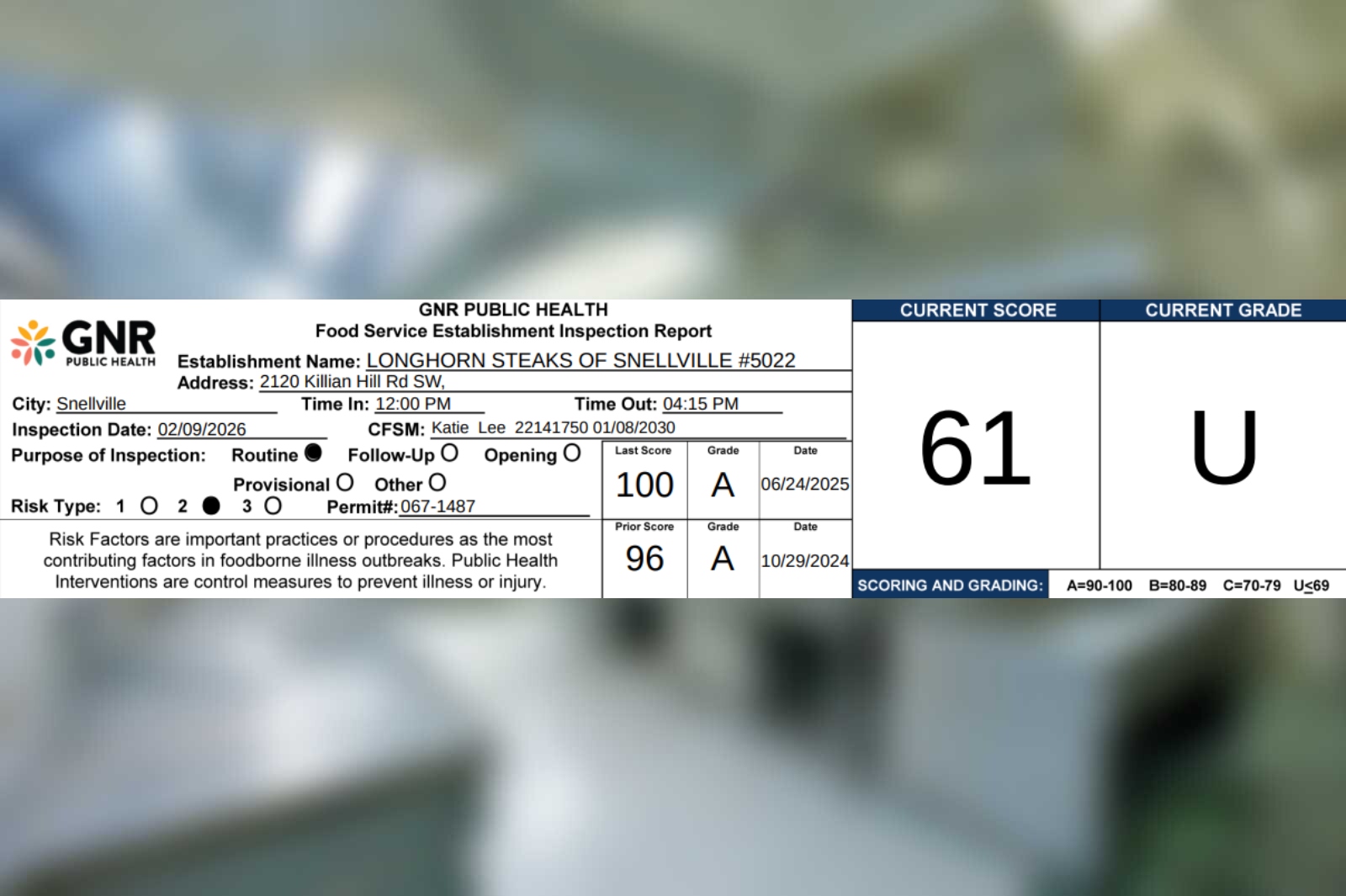
Longhorn Steaks Of Snellville, located at 2120 Killian Hill Rd SW in Snellville, received a score of 61 points out of a possible 100 points during their 02/09/2026 inspection by the Georgia Department of Public Health.
The violations noted by the inspector were:
Violation #1:
2-1B: .03(5)(c)Food employee did not wash hands before putting on new set of gloves after pulling up his pants. Employees must wash hands and exposed portions of arms immediately before engaging in food preparation including working with exposed food, clean equipment and utensils, and unwrapped single-service articles, and: 1) after touching exposed body parts; 2) after using the restroom; 3) after coughing, sneezing, using tobacco, eating, or drinking; 4) after handling soiled equipment or utensils; 5) during food preparation, as often as needed to remove soil and contamination and to prevent cross contamination when changing tasks; 6) before putting on gloves; 7) after engaging in other activities that contaminate hands; 8) a second time when entering the kitchen from using the restroom. (P)
Corrective Actions: Employee washed his hands.
Violation #2:
2-1C: .04(4)(a)1,2,3Food employee preparing a hamburger and setting it on the plate, touched hamburger bun with his hand that did not have a glove. Food employees shall minimize bare hand and arm contact with exposed food that is not in a ready- to-eat form. (Pf)
Corrective Actions: Hamburger bun was discarded.
Violation #3:
2-2D: .06(2)(c)Handwashing sink near the dish machine area and the handwashing sink next to the oven are not reaching 100F water. A handwashing sink shall be equipped to provide tempered water at a temperature of at least 100ºF (38ºC) through a mixing valve or combination faucet. (Pf)
Violation #4:
4-1A: .04(4)(n)1Food employee had one glove on and grabbed a raw meat and placed it on the grill, he then leaned and touched the prep cooler and took of his glove after and then put on new gloves. If used, single-use gloves shall be used for only one task such as working with ready-to-eat food or with raw animal food, used for no other purpose, and discarded when damaged or soiled, or when interruptions occur in the operation. (P)
Corrective Actions: Employee washed hands and glove limitations were discussed.
Violation #5:
6-1C: .04(6)(d)Chopped lettuce cooling did not cool down in a fast enough rate. Cooling Rate: TCS foods being cooled from 135°F to 70°F in 2 hours MUST cool 0.54°F per minute (roughly 32.5°F per hour). To successfully cool from 135°F to 70°F within two hours, the food must be cooled at a rate of approximately 0.54°F per minute (135°F -70°F = 65°F total divided by 120 minutes = 0.54°F per minute) or 32.5°F per hour. TCS foods being cooled from 70°F to 41°F MUST cool 7.25°F per hour (29°F in 4 hours). To successfully cool from 70°F to 41°F within 4 hours, the food must be cooled at a rate of 0.121°F per minute (70-41 = 29°F total divided by 240 minutes = 0.121°F per minute) or 7.25°F per hour.
Corrective Actions: Lettuce was discarded.
Violation #6:
11A: .04(6)(e)Chopped lettuce cooling was placed in a deep plastic container, overly stuffed, cooling in a reach in drawer. 1. Cooling shall be accomplished in accordance with the time and temperature criteria specified under DPH Rule 511-6-1-.04(6)(d) by using one or more of the following methods depending on the type of food being cooled: (i) Placing the food in shallow pans; (Pf) (ii) Separating the food into smaller or thinner portions; (Pf) (iii) Using rapid cooling equipment; (Pf) (iv) Stirring the food in a container placed in an ice water bath; (Pf) (v) Using containers that facilitate heat transfer; (Pf) (vi) Adding ice as an ingredient; (Pf) or (vii) Other effective methods. (Pf) 2. When placed in cooling or cold holding equipment, food containers in which food is being cooled shall be: (i) Arranged in the equipment to provide maximum heat transfer through the container walls; (C) and (ii) Loosely covered, or uncovered if protected from overhead contamination during the cooling period to facilitate heat transfer from the surface of the food. (C)
Corrective Actions: Cooling methods were discussed.
Violation #7:
15C: .05(7)(a)2,3Walk in cooler fan unit has accumulation of debris on the unit and piping. The prep shelving in the battering station has an accumulation of dust and other debris. The bottom of the two sided salad cooler is heavily soiled with food residue. Nonfood-contact surfaces of equipment shall be kept free of an accumulation of dust, dirt, food residue, and other debris. (C)
Violation #8:
17B: .06(5)(q)Dumpster outside has a lot of build up in the exterior of the container. Soiled receptacles and waste handling units for refuse, recyclables, and returnables shall be cleaned at a frequency necessary to prevent them from developing a buildup of soil or becoming attractants for insects and rodents. (C)
Violation #9:
17C: .07(5)(a),(b)1,2,3Wall in the ware washing area is heavily soiled with black like substance. Floor underneath the prep coolers in front of the cooking station has a lot of food debris. Grout around the vegetable sink and fryers is starting to collect water and food debris. All physical facilities shall be maintained in good repair and shall be cleaned as often as necessary to keep them clean and by methods that prevent contamination of food products. (C)
Violation #10:
18: .07(2)(m)Back door to the facility closest to the walk in cooler has an air gap at the bottom corners of the door. Outer openings of a food service establishment shall be protected against the entry of insects and rodents by: 1) filling or closing holes and other gaps along floors, walls, and ceilings; (C) 2) closed, tight-fitting windows; (C) and 3) solid self-closing, tight-fitting doors. (C)
Additional remarks:
Note: All cold holding and hot holding temperature observed were in compliance unless otherwise noted.
Note: A follow up inspection will occur within the next 10 days.
Note: A required additional inspection will occur withing the next 12 months.
CLICK HERE to read the full report