Get notified by email when this case is updated.
Remove ads by Supporting Independent News
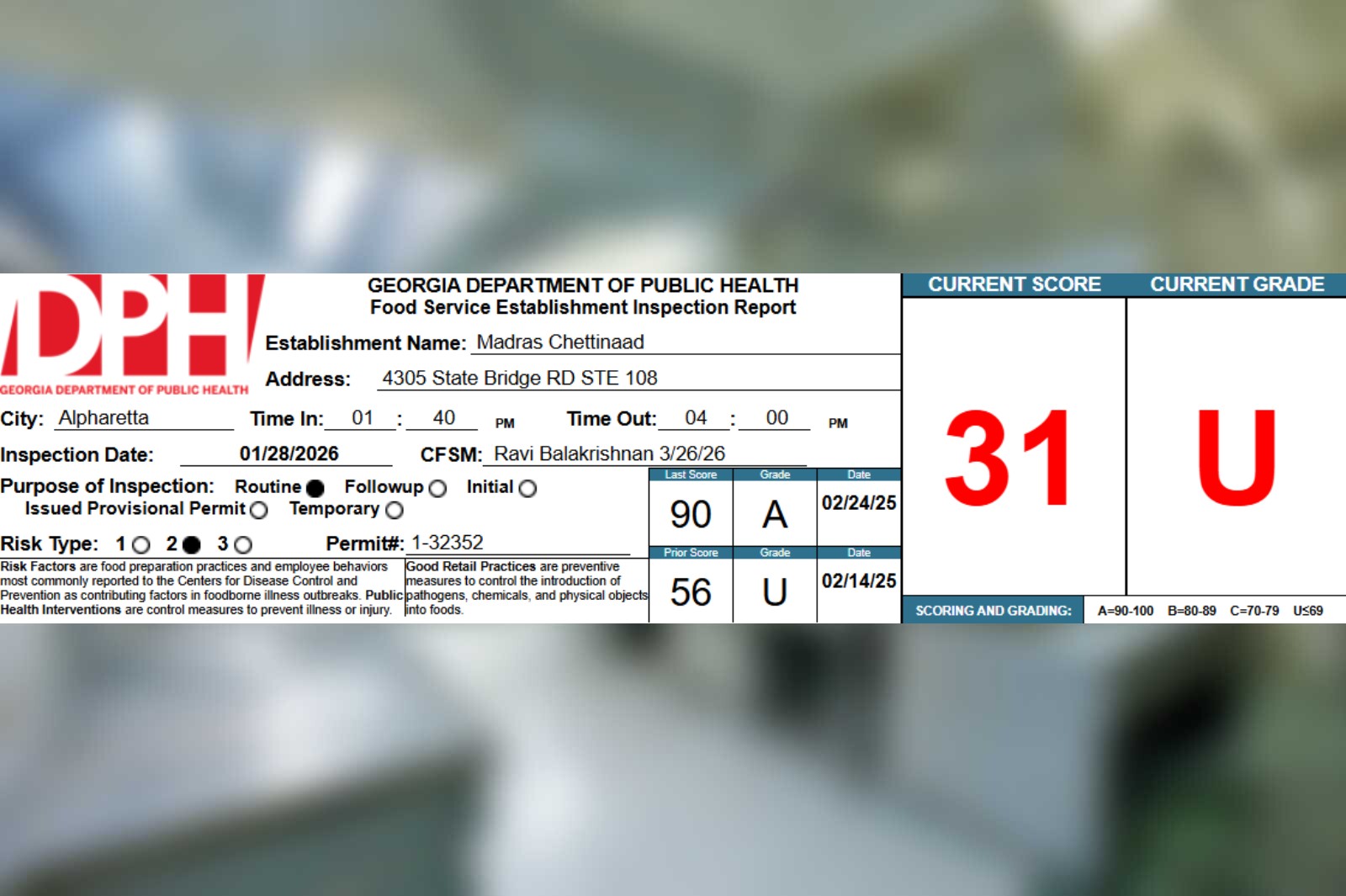
Madras Chettinaad, located at 4305 State Bridge RD STE 108 in Alpharetta, received a score of 31 points out of a possible 100 points during their 01/28/2026 inspection by the Georgia Department of Public Health.
The violations noted by the inspector were:
Violation #1:
1-2A – pic present, demonstrates knowledge, performs duties
511-6-1.03(1)(a)-(c)1,4,5,6-14,15, 16 – demonstration of knowledge (pf)
Points: 4
Corrected during inspection?: Yes
Repeat: Yes
Inspector Notes: PIC unable to answer food safety questions and demonstrated lack of knowledge. 511-6-1.03(1)(a)-(c)1,4,5,6-14,15, 16 – Demonstration of knowledge (Pf) (1) Demonstration of Knowledge. Based on the risk of foodborne illness inherent to the food service operation, during inspections and upon request, the person in charge shall demonstrate to the Health Authority knowledge of foodborne disease prevention, application of the Hazard Analysis Critical Control Point principles, and the requirements of this Chapter. The person in charge shall demonstrate this knowledge in one of the following ways: (a) Compliance with Chapter. Complying with this Chapter by having no violations of Priority Items during the current inspection; Pf (b) Certified Food Service Manager. Being a certified food service manager who has shown proficiency of required information through passing a test that is part of an accredited program; Pf or (c) Correct Answers to Food Safety Questions. Responding correctly to the inspector’s questions as they relate to the specific food operation.
Violation #2:
2-1B – hands clean and properly washed
511-6-1.03(5)(c) – when to wash (p)
Points: 9
Corrected during inspection?: Yes
Repeat: No
Inspector Notes: Observed employee prep raw chicken, then continue other tasks throughout the kitchen without washing hands. Employee washed hands, and coached on when to wash in the future. 511-6-1.03(5)(c) – When to Wash (P) (c) When to Wash. 1. Food employees shall clean their hands and exposed portions of their arms immediately before engaging in food preparation including working with exposed food, clean equipment and utensils, and unwrapped single-service and single-use articles P and: (i) After touching bare human body parts other than clean hands and clean, exposed arms; P (ii) After using the toilet room; P (iii) After caring for or handling service animals or aquatic animals; P (iv) After coughing, sneezing, using a handkerchief or disposable tissue, using tobacco products or electronic devices that simulate tobacco smoking, eating or drinking, except for drinking from a closed beverage container and the container is handled to prevent contamination of the hands;P (v) After handling soiled equipment or utensils; P (vi) During food preparation, as often as necessary to remove soil and contamination and to prevent cross contamination when changing tasks; P (vii) When switching between working with raw food and working with ready-to-eat food; P (viii) Before donning gloves to initiate a task that involves working with food; P and (ix) After engaging in other activities that contaminate the hands. P 2. All employees shall wash hands before leaving the restroom. All food employees leaving the restroom shall wash their hands again upon re-entering the food preparation area. P
Violation #3:
2-2A – management knowledge, responsibilities, reporting
511-6-1.03(1)(c)17 – demonstration (pf)
Points: 4
Corrected during inspection?: No
Repeat: Yes
Inspector Notes: Observed several current employees who had not reviewed and signed the employee health reporting agreement. PIC will make copies to review with all employees in the facility. 511-6-1.03(1)(c)17 – Demonstration (Pf) 17. Explaining how the person in charge, food employees, and conditional employees comply with reporting responsibilities and exclusion or restriction of food employees. Pf
Violation #4:
2-2D – adequate handwashing facilities supplied & accessible
Points: 4
Corrected during inspection?: Yes
Repeat: Yes
Inspector Notes: Observed no hand drying provisions at 4 hand sinks throughout facility. PIC replaced all paper towels. 511-6-1.07(3)(b) – Hand Drying Provision (Pf) (b) Hand Drying Provision. Each handwashing sink or group of adjacent handwashing sinks shall be provided with: 1. Individual, disposable towels; Pf 2. A continuous towel system that supplies the user with a clean towel; Pf 3. A heated-air hand drying device; Pf or 4. A hand drying device that employs an air-knife system that delivers high velocity, pressurized air at ambient temperatures.Pf
Violation #5:
3-1C – food in good condition, safe, and unadulterated
511-6-1.04(3)(e) – package integrity (pf)
Points: 9
Corrected during inspection?: Yes
Repeat: Yes
Inspector Notes: Observed dented cans. PIC discarded. 511-6-1.04(3)(e) – Package Integrity (Pf) (e) Package Integrity. Food packages shall be in good condition and protect the integrity of the contents so that the food is not exposed to adulteration or potential contaminants. Pf
Violation #6:
4-2A – food stored covered
511-6-1.04(4)(c)1(iv) – packaged & unpackaged food, food stored covered(c)
Points: 4
Corrected during inspection?: Yes
Repeat: No
Inspector Notes: Observed food stored uncovered in multiple walk in coolers, and a walk in freezer, and in the dry storage. PIC put lids on everything. 511-6-1.04(4)(c)1(iv) – Packaged & Unpackaged Food, food stored covered(C) (iv) Except as specified under paragraph 2. of this subsection and when cooling as specified in DPH Rule 511-6-1-.04(6)(e)2.(ii), storing the food in packages, covered containers, or wrappings, except for loosely covered or uncovered containers in which food is being cooled if protected from overhead contamination;
Violation #7:
4-2B – food-contact surfaces: cleaned & sanitized
511-6-1.05(7)(a)1 – equipment, food-contact surfaces,& utensils (pf)
Points: 4
Corrected during inspection?: No
Repeat: No
Inspector Notes: Observed can opener and microwave with debris build up. PIC advised to clean. 11-6-1.05(7)(a)1 – Equipment, Food-Contact Surfaces,& Utensils (Pf) (7) Cleaning of Equipment and Utensils. (a) Equipment, Food-Contact Surfaces, and Utensils. 1. Equipment food-contact surfaces and utensils shall be clean to sight and touch. Pf.
Violation #8:
6-1A – proper cold holding temperatures
511-6-1.04(6)(f) – time/temperature control for safety; cold holding (p)
Points: 9
Corrected during inspection?: Yes
Repeat: No
Inspector Notes: Observed several TCS food items cold holding above 41F in the main kitchen area (Tomato Chutney 45F, Tomato Base 43F, Milk 45). PIC placed items in cooler to reach 41F within 4 hours. 511-6-1.04(6)(f) – Time/Temperature Control for Safety; Cold Holding (P) (f) Time/Temperature Control for Safety Food, Hot and Cold Holding. Except during preparation, cooking, or cooling, or when time is used as the public health control, time/temperature control for safety food shall be maintained at 41°F (5°C) or below or 135°F (57°C) or above, except that roasts cooked to a temperature and for a time specified in subsection (5)(a)2 of this Rule and reheated using the same temperature and time conditions as cooking may be held at a temperature of 130°F (54°C) or above. P
Violation #9:
6-1B – proper hot holding temperatures
511-6-1.04(6)(f) – time/temperature control for safety; hot holding (p)
Points: 9
Corrected during inspection?: Yes
Repeat: Yes
Inspector Notes: Observed several cooked TCS items held below 135F in warming cabinet. PIC discarded the product that was held below 135F and advised to temp regularly while hot holding. 511-6-1.04(6)(f) – Time/Temperature Control for Safety; Hot Holding (P)
Violation #10:
6-2 – proper date marking and disposition
Points: 4
Corrected during inspection?: Yes
Repeat: Yes
Inspector Notes: Observed several items in the WIC stored with no date mark. PIC discarded. 511-6-1.04(6)(g) – Ready-To-Eat Time/Temperature Control for Safety Food, Date Marking (Pf) (g) Ready-to-Eat Time/Temperature Control for Safety Food, Date Marking 1. Except when packaging food using a reduced oxygen packaging method, and except as specified in paragraphs 4 and 5 of this subsection, refrigerated, ready-to-eat, time/temperature control for safety food prepared and held in a food establishment for more than 24 hours shall be clearly marked to indicate the date or day by which the food shall be consumed on the premises, sold, or discarded, when held at a temperature of 41°F (5°C) or below for a maximum of 7 days. The day of preparation shall be counted as Day 1. Pf 2. Except as specified in paragraphs 4 through 6 of this subsection, refrigerated, ready-to-eat, time/temperature control for safety food prepared and packaged by a food processing plant shall be clearly marked, at the time the original container is opened in a food service establishment and if the food is held for more than 24 hours, to indicate the date or day by which the food shall be consumed on the premises, sold, or discarded, when held at a temperature of 41°F (5°C) or below for a maximum of 7 days after the original container is opened. The day the original container is opened in the food service establishment shall be counted as Day 1, except, the day or date marked by the food service establishment may not exceed a manufacturer’s use by date if the manufacturer determined the use-by date based on food safety; Pf 3. A refrigerated, ready-to-eat, time/temperature control for safety food ingredient or a portion of a refrigerated, ready-to-eat, time/temperature control for safety food that is subsequently combined with additional ingredients or portions of food shall retain the date marking of the earliest-prepared or first-prepared ingredient. Pf 4. A date marking system that meets the criteria stated in paragraphs 1 and 2 of this subsection may include: (i) Using a method approved by the Health Authority for refrigerated, ready-to-eat time / temperature control for safety food that is frequently rewrapped, such as lunchmeat or a roast, or for which date marking is impractical, such as soft serve mix or milk in a dispensing machine; (ii) Marking the date or day of preparation, with a procedure to discard the food on or before the last date or day by which the food must be consumed on the premises, sold, or discarded; (iii) Marking the date or day the original container is opened in a food service establishment, with a procedure to discard the food on or before the last date or day by which the food must be consumed on the premises, sold, or discarded; or (iv) Using calendar dates, days of the week, color-coded marks, or other effective marking methods, provided that the marking system is disclosed to the Health Authority upon request. 5. The requirements in paragraphs 1 and 2 of this subsection do not apply to individual meal portions served or repackaged for sale from a bulk container upon a consumer’s request. 6. The requirements in paragraphs 1 and 2 of this subsection do not apply to shellstock. 7. The requirement in paragraph 2 of this subsection does not apply to the following foods prepared and packaged by a food processing plant inspected by a Health Authority: (i) Deli salads, such as ham salad, seafood salad, chicken salad, egg salad, pasta salad, potato salad, and macaroni salad, manufactured in accordance with 21 CFR 110 Current good manufacturing practice in manufacturing, packing, or holding human food; (ii) Hard cheeses containing not more than 39% moisture as defined in 21 CFR 133 Cheeses and related cheese products, such as cheddar, gruyere, parmesan and reggiano, and romano; (iii) Semi-soft cheeses containing more than 39% moisture, but not more than 50% moisture, as defined in 21 CFR 133 Cheeses and related cheese products, such as blue, edam, gorgonzola, gouda, and monterey jack; (iv) Cultured dairy products as defined in 21 CFR 131 Milk and cream, such as yogurt, sour cream, and buttermilk; (v) Preserved fish products, such as pickled herring and dried or salted cod, and other acidified fish products defined in 21 CFR 114 Acidified foods; (vi) Shelf stable, dry fermented sausages, such as pepperoni and Genoa salami; and (vii) Shelf stable salt-cured products, such as prosciutto and Parma ham.
Violation #11:
10D – food properly labeled; original container
Points: 3
Corrected during inspection?: No
Repeat: No
Inspector Notes: Observed several food items and sauces not in their original container and without a label. Food Storage Containers, Identified with Common Name of Food. Except for containers holding food that can be readily and unmistakably recognized, such as dry pasta, working containers holding food or food ingredients that are removed from their original packages for use in the food establishment, such as cooking oils, flour, herbs, potato flakes, salt, spices, and sugar shall be clearly and legibly identified, in English, with the common name of the food. CA: label all spices and sauces with common name if removed from original container
Violation #12:
11C – approved thawing methods used
Points: 3
Corrected during inspection?: Yes
Repeat: Yes
Inspector Notes: Observed raw chicken being thawed not fully submerged in running water. Observed two additional frozen items thawing on counter at room temperature. Employees were informed to not repeat this process and only use cold water to thaw frozen food. 511-6-1.04(6)(c) – Thawing (C) (c) Thawing. Except as specified in paragraph 4 of this subsection, time/temperature control for safety food shall be thawed: 1. Under refrigeration that maintains the food temperature at 41°F (5°C) or less; or 2. Completely submerged under running water: (i) At a water temperature of 70°F (21°C) or below, (ii) With sufficient water velocity to agitate and float off loose particles in an overflow, and (iii) For a period of time that does not allow thawed portions of ready-to-eat food to rise above 41°F (5°C), or
Violation #13:
12C – wiping cloths: properly used and stored
511-6-1.04(4)(m) – wiping cloths, use limitation (c)
Points: 3
Corrected during inspection?: Yes
Repeat: Yes
Inspector Notes: Observed dry wiping cloths and the chemical sanitizing solutions in which wet wiping cloths were held between uses soiled. Employee discarded solution and placed wiping clothes in soiled bin.
Violation #14:
14A – in-use utensils: properly stored
Points: 1
Corrected during inspection?: Yes
Repeat: Yes
Inspector Notes: Observed scoop for flour and rice in dry storage containers with handle touching food inside. Make sure to store scoops so as to prevent potential contamination of food. PIC removed scoops from food storage.
Violation #15:
15C – nonfood-contact surfaces clean
511-6-1.05(7)(a)2,3 – equipment, food/nonfood-contact surfaces, and utensils, food-contact surfaces of cooking equipment & nonfood-contact surfaces free of accumulations (c)
Points: 1
Corrected during inspection?: Yes
Repeat: Yes
Inspector Notes: Observed grill area with significant build up. CA PIC advised to clean grill area regularly to prevent grease deposits and contamination of food. 511-6-1.05(7)(a)2,3 – Equipment, Food/Nonfood-Contact Surfaces, and Utensils, food-contact surfaces of cooking equipment & nonfood-contact surfaces free of accumulations (C) 2. The food-contact surfaces of cooking equipment and pans shall be kept free of encrusted grease deposits and other soil accumulations.
Violation #16:
17D – adequate ventilation and lighting; designated areas used
Points: 1
Corrected during inspection?: No
Repeat: No
Inspector Notes: Observed employee food stored above customer food in the WIC and in a RIC. PIC moved all employee food to bottom shelves. 511-6-1.07(4)(b) – Designated Areas for Employee Activity, located to prevent contamination of food, equipment, utensils, linens, & single service articles (C) (b) Designated Areas for Employee Activity. 1. Areas designated for employees to eat, drink, and use tobacco shall be located so that food, equipment, linens, and single-service and single-use articles are protected from contamination. 2. Lockers or other suitable facilities shall be located in a designated room or area where contamination of food, equipment, utensils, linens and single-service and single-use articles cannot occur.
CLICK HERE to read the full report
Remove ads by Supporting Independent News
Get notified by email when this case is updated.