Get notified by email when this case is updated.
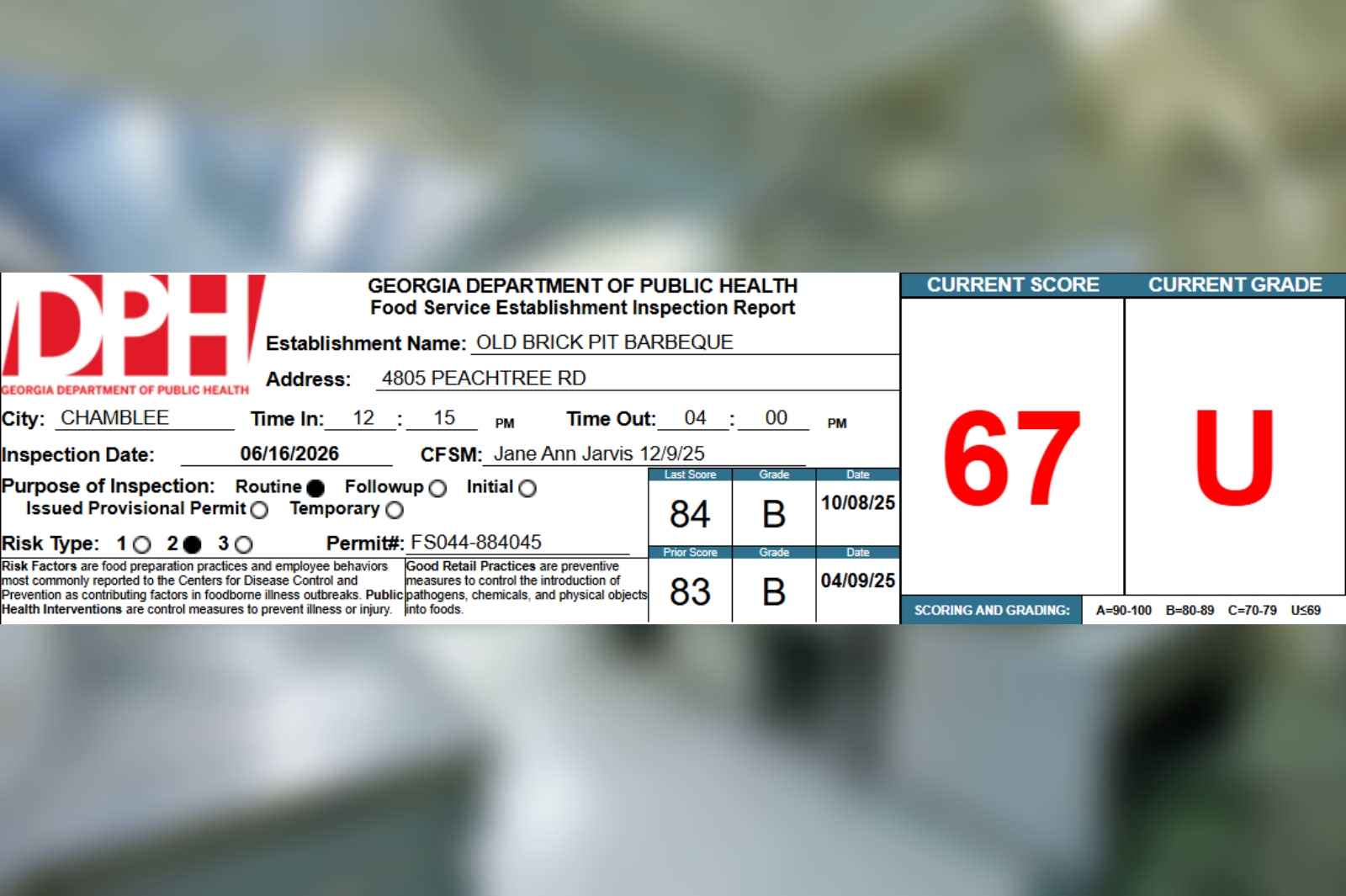
Old Brick Pit Barbeque, located at 4805 Peachtree Rd. Chamblee, GA 30341, received a score of 67 points out of a possible 100 points during their 06/16/2026 inspection by the Georgia Department of Public Health.
The violations noted by the inspector were:
Violation #1:
1-2B – certified food protection manager
511-6-1.03(3)(a) – food safety manager certification (pf)
Points: 4
Corrected during inspection?: No
Repeat: No
Inspector Notes: Observed the Certified Food Safety Manager certificate was expired at the time of inspection. During the inspection, PIC registered for an approved Food Safety Manager course. CA: 511-6-1.03(3)(a) – Food Safety Manager Certification (Pf) Food service establishments shall have in its employ a Certified Food Safety Manager (CFSM) as specified in paragraph (b) of this subsection to ensure food safety is being managed within the food service establishment during all hours of operation as specified within paragraph (d) of this subsection. Pf PIC was advised to complete the course and submit a copy of the updated certification to Ashley.Albert@dph.ga.gov upon completion.
Violation #2:
2-2B – proper eating, tasting, drinking, or tobacco use
511-6-1.03(5)(k)1&2 – eating, drinking, or using tobacco (c)
Points: 4
Corrected during inspection?: Yes
Repeat: No
Inspector Notes: Observed two vape devices stored on a food-contact surface in the outdoor BBQ pit area during the inspection. CA: (k) Hygienic Practices. 1. Employees shall not use any form of tobacco products, or electronic devices that simulate tobacco smoking, while engaged in food preparation or service, nor while in areas used for equipment or utensil washing and storage, food preparation or food storage. Employees shall only use tobacco products or electronic devices that simulate tobacco smoking in approved designated areas. 2. Employees shall consume food only in approved designated areas separate from food preparation and serving areas, equipment or utensil areas and food storage areas. However, drinking from a single service beverage cup with a secure lid and straw that is handled to prevent contamination of the employee’s hands, the container, exposed food, clean equipment, utensils and linens, unwrapped single-service and single-use articles will be allowed. COS: Vape devices were removed from the food-contact surface.
Violation #3:
2-2D – adequate handwashing facilities supplied & accessible
511-6-1.06(2)(o) – using a handwashing sink- operation & maintenance (pf)
Points: 4
Corrected during inspection?: Yes
Repeat: No
Inspector Notes: Observed the handwashing sink in the outdoor BBQ pit area being used to store a Brillo pad and soiled wiping cloths during the inspection. CA:(o) Using a Handwashing Sink. 1. A handwashing sink shall be maintained so that it is accessible at all times for employee use. Pf 2. A handwashing facility may not be used for purposes other than handwashing. Pf 3. An automatic handwashing facility shall be used in accordance with manufacturer’s instructions. Pf COS: Items were removed from the handwashing sink.
Violation #4:
6-1B – proper hot holding temperatures
511-6-1.04(6)(f) – time/temperature control for safety; hot holding (p)
Points: 9
Corrected during inspection?: No
Repeat: No
Inspector Notes: Observed cooked chicken (106F) and pork ribs (115F) in the warming cabinet, and cooked chicken (116F) in the two-drawer warmer, held below the required hot holding temperature of 135°F during the inspection. CA: (f) Time/Temperature Control for Safety Food, Hot and Cold Holding. Except during preparation, cooking, or cooling, or when time is used as the public health control, time/temperature control for safety food shall be maintained at 41°F (5°C) or below or 135°F (57°C) or above, except that roasts cooked to a temperature and for a time specified in subsection (5)(a)2 of this Rule and reheated using the same temperature and time conditions as cooking may be held at a temperature of 130°F (54°C) or above. P COS: Person in Charge reheated the affected food items to 165F and returned them to hot holding.
Violation #5:
8-2B – toxic substances properly identified, stored, used
511-6-1.07(6)(d) – restriction (pf)
Points: 4
Corrected during inspection?: Yes
Repeat: No
Inspector Notes: Observed a propane tank and WD-40 stored on a food-contact surface in the outdoor BBQ pit area during the inspection. CA:(d) Restriction. 1. Only those poisonous or toxic materials that are required for the operation and maintenance of the food service establishment, such as for the cleaning and sanitizing of equipment and utensils, and the control of insects and rodents shall be allowed in a food service establishment. Pf 2. The requirement in paragraph 1of this subsection does not apply to packaged poisonous or toxic materials that are for retail sale. COS: Items were removed from the food-contact surface and relocated to an approved storage area. Toxic materials and maintenance chemicals shall be stored away from food, equipment, utensils, linens, and food-contact surfaces to prevent contamination.
Violation #6:
11A – proper cooling methods used: adequate equipment for temperature control
511-6-1.04(6)(e) – cooling methods (pf, c)
Points: 3
Corrected during inspection?: Yes
Repeat: No
Inspector Notes: Observed coleslaw and collard greens that had been recently prepared and placed in cooling while tightly covered. Additionally, collard greens were observed cooling on the countertop at ambient temperature. CA: (e) Cooling Methods. 1. Cooling shall be accomplished in accordance with the time and temperature criteria specified under DPH Rule 511-6-1-.04(6)(d) by using one or more of the following methods depending on the type of food being cooled: (i) Placing the food in shallow pans; Pf (ii) Separating the food into smaller or thinner portions; Pf (iii) Using rapid cooling equipment; Pf (iv) Stirring the food in a container placed in an ice water bath; Pf (v) Using containers that facilitate heat transfer; Pf (vi) Adding ice as an ingredient; Pf or (vii) Other effective methods. Pf 2. When placed in cooling or cold holding equipment, food containers in which food is being cooled shall be: (i) Arranged in the equipment to provide maximum heat transfer through the container walls; and (ii) Loosely covered, or uncovered if protected from overhead contamination during the cooling period to facilitate heat transfer from the surface of the food. COS:PIC removed the tight-fitting lids and transferred the foods to shallow pans to facilitate rapid cooling.
Violation #7:
12B – personal cleanliness
511-6-1.03(5)(j) – hair restraints (c)
Points: 3
Corrected during inspection?: No
Repeat: Yes
Inspector Notes: Observed employees with hair longer than one half inch preparing and handling food without a hair restraint. CA: Employees preparing or handling food shall use effective and clean, disposable or easily cleanable nets or other hair restraints approved by the Health Authority, worn properly to restrain loose hair including beards and mustaches longer than one half inch. 2. This does not apply to employees such as counter staff who only serve beverages and wrapped or packaged foods, hostesses, and wait staff if they present a minimal risk of contaminating exposed food, clean utensils and linens and unwrapped single-service and single-use articles. Advised PIC that all kitchen staff have to wear approved hair restraints. Ponytails need to be restrained as well.
Violation #8:
15A – food and nonfood-contact surfaces cleanable, properly designed, constructed, and used
511-6-1.05(6)(a) – good repair & proper adjustment (c)
Points: 1
Corrected during inspection?: No
Repeat: No
Inspector Notes: Observed the ambient air temperature of the reach-in cooler in the main kitchen at 44F during the inspection, exceeding the required cold holding temperature of 41F or below. CA: (6) Maintenance and Operation. (a) Good Repair and Proper Adjustment. 1. Equipment shall be maintained in a state of repair and condition that meets the requirements specified under subsections (1) and (2)of this Rule. 2. Equipment components such as doors, seals, hinges, fasteners, and kick plates shall be kept intact, tight, and adjusted in accordance with manufacturer’s specifications. 3. Cutting or piercing parts of can openers shall be kept sharp to minimize the creation of metal fragments that can contaminate food when the container is opened. Advise PIC that all cold holding equipment shall be maintained in good repair and capable of maintaining foods at 41F or below.
Violation #9:
15C – nonfood-contact surfaces clean
511-6-1.05(7)(d) – nonfood-contact surfaces (c)
Points: 1
Corrected during inspection?: No
Repeat: No
Inspector Notes: Observed the cart used to transport food from the outdoor BBQ pit area to the main kitchen with rusted and chipping paint surfaces during the inspection. CA: (d) Nonfood-Contact Surfaces. Nonfood-contact surfaces of equipment shall be cleaned at a frequency necessary to preclude accumulation of soil residues. Advise PIC to repair or replace the rusted cart to provide a smooth, durable, non-absorbent, and easily cleanable surface suitable for food operations.
Violation #10:
17D – adequate ventilation and lighting; designated areas used
511-6-1.07(4)(b) – designated areas for employee activity, located to prevent contamination of food, equipment, utensils, linens, & single service articles (c)
Points: 1
Corrected during inspection?: No
Repeat: No
Inspector Notes: Observed multiple employee personal items, including beverage containers, keys, and cellular phones, stored on preptop and front service countertable during the inspection. CA:(b) Designated Areas for Employee Activity. 1. Areas designated for employees to eat, drink, use tobacco products and electronic devices shall be located so that food, equipment, linens, and single-service and single-use articles are protected from contamination. 2. Lockers or other suitable facilities shall be located in a designated room or area where contamination of food, equipment, utensils, linens and single-service and single-use articles cannot occur. PIC was advised that employees were advised to store all personal belongings in approved designated areas only.
Violation #11:
18 – insects, rodents, and animals not present
511-6-1.07(2)(m) – outer openings protected (c)
Points: 3
Corrected during inspection?: No
Repeat: No
Inspector Notes: Observed the outdoor BBQ pit area was not adequately protected against the entry of insects, rodents, and other pests during the inspection. If food prep is being done the area must be screened in CA: (m) Outer Openings, Protected. 1. Except as specified in paragraphs 2 through 5 of this subsection, outer openings of a food service establishment shall be protected against the entry of insects and rodents by: (i) Filling or closing holes and other gaps along floors, walls, and ceilings; (ii) Closed, tight-fitting windows; and (iii) Solid, self-closing, tight-fitting doors. 2. The requirements in paragraph 1 of this subsection does not apply if a food service establishment opens into a larger structure, such as a mall, airport, or office building, or into an attached structure, such as a porch, and the outer openings from the larger or attached structure are protected against the entry of insects and rodents. 3. Exterior doors used as exits need not be self-closing if they are: (i) Solid and tight-fitting; (ii) Designated for use only when an emergency exists, by the fire protection authority that has jurisdiction over the food establishment; and (iii) Limited-use so they are not used for entrance or exit from the building for purposes other than the designated emergency exit use. 4. Except as specified in paragraphs 2 and 5 of this subsection, if the windows or doors of a food service establishment, or of a larger structure within which a food service establishment is located, are kept open for ventilation or other purposes or a temporary food service establishment is not provided with windows and doors as specified under paragraph 1 of this subsection, the openings shall be protected against the entry of insects and rodents by: (i) 16 mesh to 1 inch (16 mesh to 25.4 mm) screens; (ii) Properly designed and installed air curtains to control flying insects; or (iii) Other effective means. 5. The requirement in paragraph 4 of this subsection does not apply if flying insects and other pests are absent due to the location of the establishment, the weather, or other limiting condition. Advise PIC to provide effective measures to protect the outdoor BBQ pit area from pest entry and harborage. All food preparation, storage, and service areas shall be maintained to prevent the presence of pests and potential contamination of food and food-contact surfaces.
Additional remarks:
Thermometers calibrated (on site facility 32F (Thermopop, thermapen, deltatrak)
Observed signed employee reporting agreement form and EPA registered disinfectant against norovirus
All frozen foods are frozen solid
Main Kitchen 3 comp sink: 100 ppm chlorine
Accompanied by: Grace Dalva
511-6-1-.10 Compliance Procedures: (o) (1) Voluntary Closure. A food service establishment that is graded as a “U” and does not earn at least a grade “C” within ten (10) days of receiving the “U” will be requested to voluntarily close until all violations are corrected and/or have enforcement action taken to suspend or revoke the food service permit.
511-6-1-.10 Compliance Procedures: (o) (2) Voluntary Closure. A food service establishment that is graded as a “U” on two consecutive routine inspections will be asked to voluntarily close until all violations are corrected and/or have enforcement action taken to suspend or revoke the food service permit.
Advisements:
Ensure all refrigerated ready-to-eat TCS foods are properly date marked and discarded within 7 days.
Post the most recent inspection report in a location visible to the public, including the drive-thru window area if applicable.
Discontinue lining shelves and equipment surfaces with aluminum foil. Surfaces must be smooth, durable, and easily cleanable.
Discontinue reusing single-use containers for food storage. Single-use articles are not designed for repeated use and shall be discarded after their intended use.
CLICK HERE to read the full report
