Get notified by email when this case is updated.
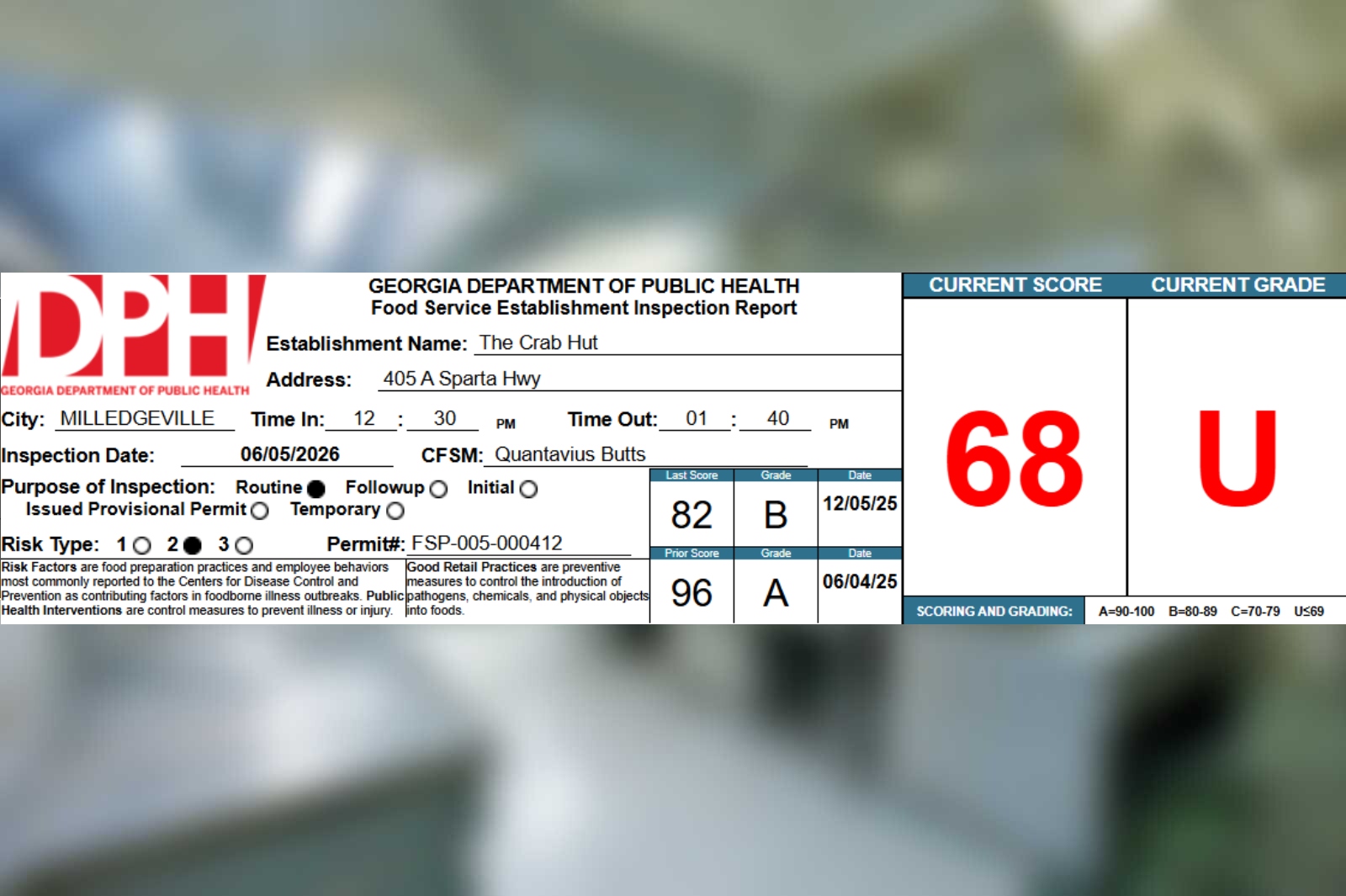
The Crab Hut, located at 405 A Sparta Hwy NE, Milledgeville, GA 31061, received a score of 68 points out of a possible 100 points during their 06/05/2026 inspection by the Georgia Department of Public Health.
The violations noted by the inspector were:
Violation #1:
1-2B – certified food protection manager
511-6-1.03(3)(c) – certification documentation (pf)
Points: 4
Corrected during inspection?: No
Repeat: Yes
Inspector Notes: Observed facility without CFSM being posted. 511-6-1.03(3)(c) – Certification Documentation (Pf) 1. The original CFSM certificate shall be posted in public view in each food service establishment. An additional copy shall be retained on file at the food service establishment at all times, and shall be made available for inspection by the Health Authority. 2. A CFSM certificate which has expired, been revoked or suspended shall not be posted in the food service establishment. 3. All licenses, certificates, diplomas, or other similar credentials issued or granted to an owner or operator who has successfully completed an approved or accredited food safety certification course and exam shall expire on the expiration date determined by the credentialing organization. Within ninety days of the expiration of the CFSM certificate, the CFSM shall enroll in an approved food safety training course, pass an approved exam and obtain a new certificate. 4. The certification is not transferable between persons. PIC was notified. Education was provided.
Violation #2:
2-2D – adequate handwashing facilities supplied & accessible
511-6-1.06(2)(o) – using a handwashing sink- operation & maintenance (pf)
Points: 4
Corrected during inspection?: No
Repeat: No
Inspector Notes: Observed handwashing sink broken in main kitchen. 511-6-1.06(2)(o) – Using a Handwashing Sink- Operation & maintenance (Pf) (o) Using a Handwashing Sink. 1. A handwashing sink shall be maintained so that it is accessible at all times for employee use. Pf 2. A handwashing facility may not be used for purposes other than handwashing. Pf 3. An automatic handwashing facility shall be used in accordance with manufacturer’s instructions. Pf PIC was notified. Education was provided.
Violation #3:
4-1A – food separated and protected
511-6-1.04(4)(c)1(i)(ii)(iii)(v)(vi)(vii)(viii) – packaged & unpackaged food separation, packaging, and segregation (p, c)
Points: 9
Corrected during inspection?: No
Repeat: No
Inspector Notes: Observed cooked potatoes stored under raw eggs in RIC. 511-6-1.04(4)(c)1(i)(ii)(iii)(v)(vi)(vii)(viii) – Packaged & Unpackaged Food Separation, Packaging, and Segregation (P, C) (c) Packaged and Unpackaged Food – Separation, Packaging, and Segregation. 1. Food shall be protected from cross contamination by: (i) Except as specified in paragraph (i)(IV) of this subsection, separating raw animal foods during storage, preparation, holding, and display from: (I) Raw ready-to-eat food including other raw animal food such as fish for sushi or molluscan shellfish, or other raw ready-to-eat food such as fruits and vegetables, P and (II) Cooked ready-to-eat food; and P (III) Fruits and vegetables before they are washed; P (IV) Frozen, commercially processed and packaged raw animal food may be stored or displayed with or above frozen, commercially processed and packaged, ready-to-eat food. (ii) Except when combined as ingredients, separating types of raw animal foods from each other such as beef, fish, lamb, pork, and poultry during storage, preparation, holding, and display by: (I) Using separate equipment for each type, P or (II) Arranging each type of food in equipment so that cross contamination of one type with another is prevented, P and (III) Preparing each type of food at different times or in separate areas; P (iii) Cleaning and sanitizing equipment and utensils; (v) Cleaning hermetically sealed containers of food of visible soil before opening; (vi) Protecting food containers that are received packaged together in a case or overwrap from cuts when the case or overwrap is opened; (vii) Storing damaged, spoiled, or recalled food being held in the food service establishment separate from food, equipment, utensils, linens and single-service and single-use articles; or (viii) Separating fruits and vegetables, before they are washed from ready-to-eat food. PIC was notified. Education was provided
Violation #4:
4-1A – food separated and protected
511-6-1.04(4)(c)1(i)(ii)(iii)(v)(vi)(vii)(viii) – packaged & unpackaged food separation, packaging, and segregation (p, c)
Points: 9
Corrected during inspection?: No
Repeat: No
Inspector Notes: Observed a bag of raw bacon stored above raw shrimp. 511-6-1.04(4)(c)1(i)(ii)(iii)(v)(vi)(vii)(viii) – Packaged & Unpackaged Food Separation, Packaging, and Segregation (P, C) (c) Packaged and Unpackaged Food – Separation, Packaging, and Segregation. 1. Food shall be protected from cross contamination by: (i) Except as specified in paragraph (i)(IV) of this subsection, separating raw animal foods during storage, preparation, holding, and display from: (I) Raw ready-to-eat food including other raw animal food such as fish for sushi or molluscan shellfish, or other raw ready-to-eat food such as fruits and vegetables, P and (II) Cooked ready-to-eat food; and P (III) Fruits and vegetables before they are washed; P (IV) Frozen, commercially processed and packaged raw animal food may be stored or displayed with or above frozen, commercially processed and packaged, ready-to-eat food. (ii) Except when combined as ingredients, separating types of raw animal foods from each other such as beef, fish, lamb, pork, and poultry during storage, preparation, holding, and display by: (I) Using separate equipment for each type, P or (II) Arranging each type of food in equipment so that cross contamination of one type with another is prevented, P and (III) Preparing each type of food at different times or in separate areas; P (iii) Cleaning and sanitizing equipment and utensils; (v) Cleaning hermetically sealed containers of food of visible soil before opening; (vi) Protecting food containers that are received packaged together in a case or overwrap from cuts when the case or overwrap is opened; (vii) Storing damaged, spoiled, or recalled food being held in the food service establishment separate from food, equipment, utensils, linens and single-service and single-use articles; or (viii) Separating fruits and vegetables, before they are washed from ready-to-eat food. PIC was notified. Education was provided.
Violation #5:
4-1A – food separated and protected
511-6-1.04(4)(c)1(i)(ii)(iii)(v)(vi)(vii)(viii) – packaged & unpackaged food separation, packaging, and segregation (p, c)
Points: 9
Corrected during inspection?: No
Repeat: No
Inspector Notes: Observed cooked vegetables being stored with raw fish. 511-6-1.04(4)(c)1(i)(ii)(iii)(v)(vi)(vii)(viii) – Packaged & Unpackaged Food Separation, Packaging, and Segregation (P, C) (c) Packaged and Unpackaged Food – Separation, Packaging, and Segregation. 1. Food shall be protected from cross contamination by: (i) Except as specified in paragraph (i)(IV) of this subsection, separating raw animal foods during storage, preparation, holding, and display from: (I) Raw ready-to-eat food including other raw animal food such as fish for sushi or molluscan shellfish, or other raw ready-to-eat food such as fruits and vegetables, P and (II) Cooked ready-to-eat food; and P (III) Fruits and vegetables before they are washed; P (IV) Frozen, commercially processed and packaged raw animal food may be stored or displayed with or above frozen, commercially processed and packaged, ready-to-eat food. (ii) Except when combined as ingredients, separating types of raw animal foods from each other such as beef, fish, lamb, pork, and poultry during storage, preparation, holding, and display by: (I) Using separate equipment for each type, P or (II) Arranging each type of food in equipment so that cross contamination of one type with another is prevented, P and (III) Preparing each type of food at different times or in separate areas; P (iii) Cleaning and sanitizing equipment and utensils; (v) Cleaning hermetically sealed containers of food of visible soil before opening; (vi) Protecting food containers that are received packaged together in a case or overwrap from cuts when the case or overwrap is opened; (vii) Storing damaged, spoiled, or recalled food being held in the food service establishment separate from food, equipment, utensils, linens and single-service and single-use articles; or (viii) Separating fruits and vegetables, before they are washed from ready-to-eat food. PIC was notified. Education was provided.
Violation #6:
6-2 – proper date marking and disposition
511-6-1.04(6)(g) – ready-to-eat time/temperature control for safety food, date marking (pf)
Points: 4
Corrected during inspection?: No
Repeat: No
Inspector Notes: Observed spinach dip, raw chicken, cooked vegetables, cooked beef, and cooked pasta in RIC with no date. 511-6-1.04(6)(g) – Ready-To-Eat Time/Temperature Control for Safety Food, Date Marking (Pf) (g) Ready-to-Eat Time/Temperature Control for Safety Food, Date Marking 1. Except when packaging food using a reduced oxygen packaging method, and except as specified in paragraphs 5 and 6 of this subsection, refrigerated, ready-to-eat, time/temperature control for safety food prepared and held in a food establishment for more than 24 hours shall be clearly marked to indicate the date or day by which the food shall be consumed on the premises, sold, or discarded, when held at a temperature of 41°F (5°C) or below for a maximum of 7 days. The day of preparation shall be counted as Day 1. Pf 2. Except as specified in paragraphs 5 through 7 of this subsection, refrigerated, ready-to-eat, time/temperature control for safety food prepared and packaged by a food processing plant shall be clearly marked, at the time the original container is opened in a food service establishment and if the food is held for more than 24 hours, to indicate the date or day by which the food shall be consumed on the premises, sold, or discarded, when held at a temperature of 41°F (5°C) or below for a maximum of 7 days after the original container is opened. The day the original container is opened in the food service establishment shall be counted as Day 1, except, the day or date marked by the food service establishment may not exceed a manufacturer’s use by date if the manufacturer determined the use-by date based on food safety; Pf 3. A refrigerated, ready-to-eat, time/temperature control for safety food ingredient or a portion of a refrigerated, ready-to-eat, time/temperature control for safety food that is subsequently combined with additional ingredients or portions of food shall retain the date marking of the earliest-prepared or first-prepared ingredient. Pf 4. A date marking system that meets the criteria stated in paragraphs 1 and 2 of this subsection may include: (i) Using a method approved by the Health Authority for refrigerated, ready-to-eat time / temperature control for safety food that is frequently rewrapped, such as lunchmeat or a roast, or for which date marking is impractical, such as soft serve mix or milk in a dispensing machine; (ii) Marking the date or day of preparation, with a procedure to discard the food on or before the last date or day by which the food must be consumed on the premises, sold, or discarded; (iii) Marking the date or day the original container is opened in a food service establishment, with a procedure to discard the food on or before the last date or day by which the food must be consumed on the premises, sold, or discarded; or (iv) Using calendar dates, days of the week, color-coded marks, or other effective marking methods, provided that the marking system is disclosed to the Health Authority upon request. 5. The requirements in paragraphs 1 and 2 of this subsection do not apply to individual meal portions served or repackaged for sale from a bulk container upon a consumer’s request. 6. The requirements in paragraphs 1 and 2 of this subsection do not apply to shellstock. 7. The requirement in paragraph 2 of this subsection does not apply to the following foods prepared and packaged by a food processing plant inspected by a Health Authority: (i) Deli salads, such as ham salad, seafood salad, chicken salad, egg salad, pasta salad, potato salad, and macaroni salad, manufactured in accordance with 21 CFR 117 Current good manufacturing practice in manufacturing, packing, or holding human food; (ii) Hard cheeses containing not more than 39% moisture as defined in 21 CFR 133 Cheeses and related cheese products, such as cheddar, gruyere, parmesan and reggiano, and romano; (iii) Semi-soft cheeses containing more than 39% moisture, but not more than 50% moisture, as defined in 21 CFR 133 Cheeses and related cheese products, such as blue, edam, gorgonzola, gouda, and monterey jack; (iv) Cultured dairy products as defined in 21 CFR 131 Milk and cream, such as yogurt, sour cream, and buttermilk; (v) Preserved fish products, such as pickled herring and dried or salted cod, and other acidified fish products defined in 21 CFR 114 Acidified foods; (vi) Shelf stable, dry fermented sausages, such as pepperoni and Genoa salami; and (vii) Shelf stable salt-cured products, such as prosciutto and Parma ham.
Violation #7:
8-2B – toxic substances properly identified, stored, used
511-6-1.07(6)(c) – storage, separation (p)
Points: 4
Corrected during inspection?: No
Repeat: No
Inspector Notes: Observed chemicals being stored on the sink filled with chicken. 511-6-1.07(6)(c) – Storage, Separation (P) (c) Storage, Separation. Poisonous or toxic materials shall be stored so they cannot contaminate food, equipment, utensils, linens, and single-service and single-use articles by: 1. Separating the poisonous or toxic materials by spacing or partitioning; P and 2. Locating the poisonous or toxic materials in an area that is not above food, equipment, utensils, linens, and single-service or single-use articles. This requirement does not apply to equipment and utensil cleaners and sanitizers that are stored in warewashing areas for availability and convenience if the materials are stored to prevent contamination of food, equipment, utensils, linens, and single-service and single-use articles. P PIC was notified. Education was provided.
Violation #8:
11C – approved thawing methods used
511-6-1.04(6)(c) – thawing (c)
Points: 3
Corrected during inspection?: No
Repeat: No
Inspector Notes: Observed chicken being thawed in sink without running water. 511-6-1.04(6)(c) – Thawing (C) (c) Thawing. Except as specified in paragraph 4 of this subsection, time/temperature control for safety food shall be thawed: 1. Under refrigeration that maintains the food temperature at 41°F (5°C) or less; PF or 2. Completely submerged under running water: (i) At a water temperature of 70°F (21°C) or below, PF (ii) With sufficient water velocity to agitate and float off loose particles in an overflow PF, and (iii) For a period of time that does not allow thawed portions of ready-to-eat food to rise above 41°F (5°C), or (iv) For a period of time that does not allow thawed portions of a raw animal food requiring cooking to be above 41°F (5°C), for more than 4 hours including: (I) The time the food is exposed to the running water and the time needed for preparation for cooking PF, or (II) The time it takes under refrigeration to lower the food temperature to 41°F (5°C) PF; 3. As part of a cooking process if the food that is frozen is: (i) Cooked as specified under subsections (5)(a)1 or 2 or (5)(b) or 5(e) of this Rule PF, or (ii) Thawed in a microwave oven and immediately transferred to conventional cooking equipment, with no interruption in the process PF; or 4. Using any procedure if a portion of frozen ready-to-eat food is thawed and prepared for immediate service in response to an individual consumer’s order. 5. Reduced oxygen packaged fish that bears a label indicating that it is to be kept frozen until time of use shall be removed from the reduced oxygen environment: (i) Prior to its thawing under refrigeration that maintains the food temperature at 41°F (5°C) or less; or (ii) Prior to, or immediately upon completion of its thawing, using procedures to completely submerge in running water as specified in paragraph 2 of this subsection. PIC was notified. Education was provided.
Violation #9:
13A – posted: permit/inspection/choking poster/handwashing
Points: 1
Corrected during inspection?: No
Repeat: Yes
Inspector Notes: Observed facility without inspection report posted. 511-6-1.02(1)(d) – Displaying of the Inspection Report (C) 1. The most current inspection report shall be prominently displayed in public view at all times, within fifteen feet of the front or primary public door and between five feet and seven feet from the floor and in an area where it can be read at a distance of one foot away. 2. Food service establishments with drive-thru windows will post the current inspection report, and also have the inspection report posted so that a minimum of the top one-third of a copy of the current inspection report is visible through each window allowing customers to easily read the score, date of inspection and establishment information. 3. At food service establishments with no primary or public door, the current inspection report shall be prominently displayed at all times where the documents can be read by the public from a distance of one foot away. If requirements of this paragraph are not possible because of physical restrictions, a location will be determined as approved by the Health Authority. 4. The most current inspection report for mobile food service units and extended food service units issued by the local Health Authority having jurisdiction for its inspections shall be prominently displayed in public view during all hours of operation. Such inspection reports shall be prominently displayed at the point of service where the documents can be read by the public from a distance of one foot away. 5. A food service establishment inspection report addendum need not be displayed, but shall be made available by the food service establishment to the public upon request. PIC was notified. Education was provided.
Additional remarks:
Discussed inspection report with the owner, Qwan Butts, he refused to sign the inspection report.
CLICK HERE to read the full report