Get notified by email when this case is updated.
Remove ads by Supporting Independent News
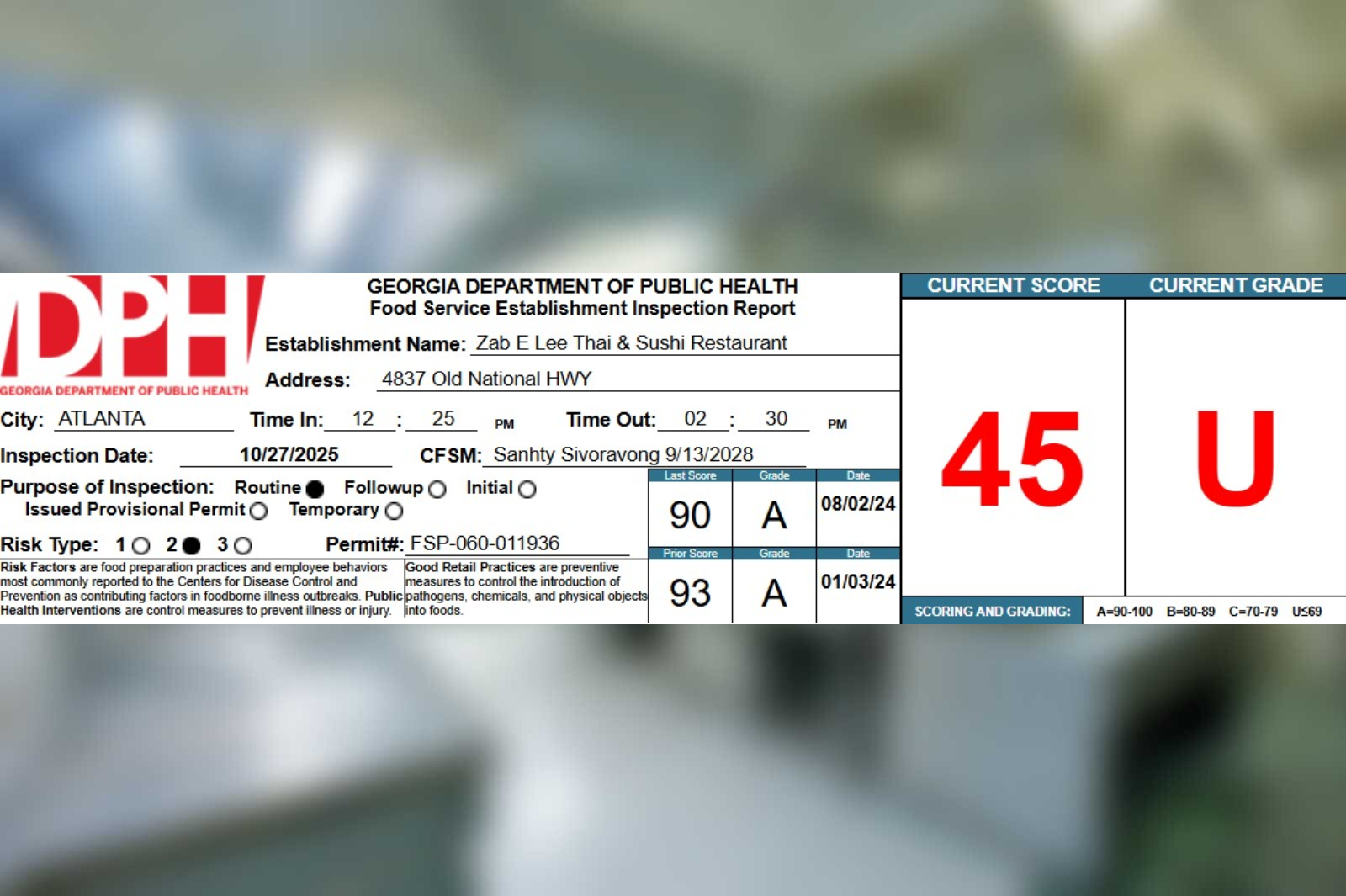
Zab E Lee Thai & Sushi Restaurant, located at 4837 Old National HWY in Atlanta, received a score of 45 points out of a possible 100 points during their 10/27/2025 inspection by the Georgia Department of Public Health.
The violations noted by the inspector were:
Violation #1:
1-2B – certified food protection manager
511-6-1-.03(3)(d) – certified food safety manager responsibility
Points: 4
Corrected during inspection?: No
Repeat: No
Inspector Notes: Certified Food Safety Manager does not demonstrate profienciecy in active mangerial control measures. Ceiling is leaking in kitchen/prep/cook areas and dry storage room. .CA: CFSM must be properly trained or retrained 511-6-1-.03(3)(d) – Certified Food Safety Manager Responsibility 1. The responsibility of the CFSM shall include the safety of food preparation and service by ensuring that all employees who handle, or have responsibility for handling, unpackaged foods of any kind, have sufficient knowledge of safe preparation and service of the food. The nature and extent of the knowledge that each employee is required to have may be tailored, as appropriate, to the employee’s duties related to food safety issues. 2. The CFSM shall: (i) Be the person-in-charge while on the premises of the food service establishment and shall designate someone else to be the person in charge when not on the premises; (ii) Supervise and instruct food service employees in the techniques of sanitary food handling and proper maintenance of the facility; (iii) Offer a training program for all food service employees to satisfy employee proficiency in their job responsibilities for food safety; (iv) Communicate with representatives of the Health Authority about the effectiveness of employee training programs; and (v) Assess training needs of the food service employees and request formal training as needed.
Violation #2:
2-1C – no bare hand contact with ready-to-eat foods or approved alternate method properly followed
511-6-1.04(4)(a)1,2,3,4(i) – preventing contamination from hands (p), (pf), (c)
Points: 9
Corrected during inspection?: No
Repeat: No
Inspector Notes: Observed cook touching ready to eat (vegetable) with bare hands when single-use gloves or utensils are required. It is after cooking the raw meats. COS: Cook discarded food. 511-6-1.04(4)(a)1,2,3,4(i) – Preventing Contamination from Hands (P), (Pf), (C) (4) Protection From Contamination After Receiving. (a) Preventing Contamination from Hands. 1. Food employees shall wash their hands as specified under DPH Rule 511-6-1-.03(5). 2. Except when washing fruits and vegetables or as specified under subsection (a)4, food employees shall not contact exposed, ready-to-eat food with their bare hands and shall use suitable utensils such as deli tissue, spatulas, tongs, single-use gloves, or dispensing equipment. P 3. Food employees shall minimize bare hand and arm contact with exposed food that is not in a ready- to-eat form. Pf 4. Paragraph (a)2. of this subsection does not apply to a food employee that contacts exposed, ready-to eat food with bare hands at the time the ready-to-eat food is being added as an ingredient to a food that: (i) contains a raw animal food and is to be cooked in the food service establishment to heat all parts of the food to at least the minimum time/temperatures specified in DPH Rule 511-6-1-.04(5)(a)1 and 2 and DPH Rule 511-6-1-.04(5)(b); P
Violation #3:
2-2B – proper eating, tasting, drinking, or tobacco use
511-6-1.03(5)(k)1&2 – eating, drinking, or using tobacco (c)
Points: 4
Corrected during inspection?: Yes
Repeat: No
Inspector Notes: Observed employees eating in a food preparation or other restricted area. COS: Employees removed their food from the prep table and placed in coolers.
Violation #4:
2-2D – adequate handwashing facilities supplied & accessible
511-6-1.06(2)(o) – using a handwashing sink- operation & maintenance (pf)
Points: 4
Corrected during inspection?: No
Repeat: No
Inspector Notes: Hand sink is not equipped to provide tempered water at a temperature of at least 100F through a mixing valve or combination faucet. Hot water temperature at hand sink is registering any 69 – 70 degrees. CA: Hot water temperature at all hand sink shall reach 85 degrees F. 511-6-1.06(2)(o) – Using a Handwashing Sink- Operation & maintenance (Pf) (o) Using a Handwashing Sink. 1. A handwashing sink shall be maintained so that it is accessible at all times for employee use. Pf 2. A handwashing facility may not be used for purposes other than handwashing. Pf 3. An automatic handwashing facility shall be used in accordance with manufacturer’s instructions. Pf
Violation #5:
4-2A – food stored covered
511-6-1.04(4)(c)1(iv) – packaged & unpackaged food, food stored covered(c)
Points: 4
Corrected during inspection?: No
Repeat: No
Inspector Notes: Observed several containers of food found stored in reach in coolers and reach in freezer uncovered and subject to contamination. CA: Must keep all foods covered inside the reach in coolers and freezers. 511-6-1.04(4)(c)1(iv) – Packaged & Unpackaged Food, food stored covered(C) (iv) Except as specified under paragraph 2. of this subsection and when cooling as specified in DPH Rule 511-6-1-.04(6)(e)2.(ii), storing the food in packages, covered containers, or wrappings, except for loosely covered or uncovered containers in which food is being cooled if protected from overhead contamination;
Violation #6:
4-2B – food-contact surfaces: cleaned & sanitized
511-6-1.05(6)(k) – manual warewashing, hot water sanitization temperatures(p)
Points: 4
Corrected during inspection?: No
Repeat: No
Inspector Notes: Observed employee washing Equipment and utensils but not sanitizing these Items. No hot water to sanitize the equipment nor utensils. CA: Must sanitize equipment and utensils after rinsing. 511-6-1.05(6)(k) – Manual Warewashing, Hot Water Sanitization Temperatures(P) (k) Manual Warewashing Equipment, Hot Water Sanitization Temperatures. If immersion in hot water is used for sanitizing in a manual operation, the temperature of the water shall be maintained at 171ºF (77ºC) or above. P
Violation #7:
4-2B – food-contact surfaces: cleaned & sanitized
511-6-1.05(7)(b) – food contact surfaces and utensils – cleaning frequency (p, c)
Points: 4
Corrected during inspection?: No
Repeat: No
Inspector Notes: Observed buildup of black and red slime in the interior of ice machine. CA: Discard all the ice from ice machine and clean and sanitize the inside of the unit. 511-6-1.05(7)(b) – Food Contact Surfaces and Utensils – Cleaning Frequency (P, C) (b) Equipment Food-Contact Surfaces and Utensils. 1. Equipment food-contact surfaces and utensils shall be cleaned: (i) Before each use with a different type of raw animal food such as beef, fish, lamb, pork, or poultry. It does not apply if the food-contact surface or utensil is in contact with a succession of different types of raw meat and raw poultry each requiring a higher cooking temperature as specified under DPH Rule 511-6-1.04(5)(a) than the previous type such as preparing raw pork followed by cutting raw poultry on the same cutting board; P (ii) Each time there is a change from working with raw foods to working with ready-to-eat foods; P (iii) Between uses with raw fruits and vegetables and with Time/Temperature Control for safety food; P (iv) Before using or storing a food temperature measuring device; P and (v) At any time during the operation when contamination may have occurred. P 2. Except as specified in paragraph 3 of this subsection, if used with time/temperature control for safety food, equipment food-contact surfaces and utensils shall be cleaned at least every 4 hours throughout the day. P 3. Surfaces of utensils and equipment contacting time/temperature control for safety food may be cleaned less frequently than every 4 hours if: (i) In storage, containers of time/temperature control for safety food and their contents are maintained at temperatures specified under DPH Rule 511-6-1-.04 and the containers are cleaned when they are empty; (ii) Utensils and equipment are used to prepare food in a refrigerated room or area that is maintained at one of the temperatures in the following chart and: (I) The utensils and equipment are cleaned at the frequency in the following chart that corresponds to the temperature:
Violation #8:
6-1A – proper cold holding temperatures
511-6-1.04(6)(f) – time/temperature control for safety; cold holding (p)
Points: 9
Corrected during inspection?: No
Repeat: No
Inspector Notes: Observed potentially hazardous food cold held at greater than 41 degrees Fahrenheit. CA: All cold held foods shall be held at 41 degrees F or colder. 511-6-1.04(6)(f) – Time/Temperature Control for Safety; Cold Holding (P) (f) Time/Temperature Control for Safety Food, Hot and Cold Holding. Except during preparation, cooking, or cooling, or when time is used as the public health control, time/temperature control for safety food shall be maintained at 41°F (5°C) or below or 135°F (57°C) or above, except that roasts cooked to a temperature and for a time specified in subsection (5)(a)2 of this Rule and reheated using the same temperature and time conditions as cooking may be held at a temperature of 130°F (54°C) or above. P
Violation #9:
6-2 – proper date marking and disposition
511-6-1.04(6)(g) – ready-to-eat time/temperature control for safety food, date marking (pf)
Points: 4
Corrected during inspection?: No
Repeat: No
Inspector Notes: Observed ready-to-eat, potentially hazardous food prepared on-site and frozen not properly date marked. CA: Foods held for more than 24 hours shall be properly labeled with prep date or discard date to ensure safe consumption.
Violation #10:
8-2B – toxic substances properly identified, stored, used
511-6-1.07(6)(c) – storage, separation (p)
Points: 4
Corrected during inspection?: No
Repeat: No
Inspector Notes: Observed medicine (Bayer pain reliever) present that is not necessary for the health of employees. Stored with food. CA: Shall store be divine necessary for employee away from food/prep areas. 511-6-1.07(6)(c) – Storage, Separation (P) (c) Storage, Separation. Poisonous or toxic materials shall be stored so they cannot contaminate food, equipment, utensils, linens, and single-service and single-use articles by: 1. Separating the poisonous or toxic materials by spacing or partitioning; P and 2. Locating the poisonous or toxic materials in an area that is not above food, equipment, utensils, linens, and single-service or single-use articles. This requirement does not apply to equipment and utensil cleaners and sanitizers that are stored in warewashing areas for availability and convenience if the materials are stored to prevent contamination of food, equipment, utensils, linens, and single-service and single-use articles. P
Violation #11:
10D – food properly labeled; original container
511-6-1.04(4)(d) – food storage containers identified with common name of food (c)
Points: 3
Corrected during inspection?: No
Repeat: No
Inspector Notes: Observed all Working containers of food removed from original container not identified by common name. CA: All foods not in original containers shall be labeled with the common name. 511-6-1.04(4)(d) – Food Storage Containers Identified with Common Name of Food (C) (d) Food Storage Containers, Identified with Common Name of Food. Except for containers holding food that can be readily and unmistakably recognized, such as dry pasta, working containers holding food or food ingredients that are removed from their original packages for use in the food establishment, such as cooking oils, flour, herbs, potato flakes, salt, spices, and sugar shall be clearly and legibly identified, in English, with the common name of the food.
Violation #12:
11C – approved thawing methods used
511-6-1.04(6)(c) – thawing (c)
Points: 3
Corrected during inspection?: No
Repeat: No
Inspector Notes: Observed potentially hazardous food thawed at room temperature. CA: Food shall be thawed under cool running water, reach in cooler or microwave. 511-6-1.04(6)(c) – Thawing (C) (c) Thawing. Except as specified in paragraph 4 of this subsection, time/temperature control for safety food shall be thawed: 1. Under refrigeration that maintains the food temperature at 41°F (5°C) or less; PF or 2. Completely submerged under running water: (i) At a water temperature of 70°F (21°C) or below, PF (ii) With sufficient water velocity to agitate and float off loose particles in an overflow PF, and (iii) For a period of time that does not allow thawed portions of ready-to-eat food to rise above 41°F (5°C), or (iv) For a period of time that does not allow thawed portions of a raw animal food requiring cooking to be above 41°F (5°C), for more than 4 hours including: (I) The time the food is exposed to the running water and the time needed for preparation for cooking PF, or (II) The time it takes under refrigeration to lower the food temperature to 41°F (5°C) PF; 3. As part of a cooking process if the food that is frozen is: (i) Cooked as specified under subsections (5)(a)1 or 2 or (5)(b) or 5(e) of this Rule PF, or (ii) Thawed in a microwave oven and immediately transferred to conventional cooking equipment, with no interruption in the process PF; or 4. Using any procedure if a portion of frozen ready-to-eat food is thawed and prepared for immediate service in response to an individual consumer’s order. 5. Reduced oxygen packaged fish that bears a label indicating that it is to be kept frozen until time of use shall be removed from the reduced oxygen environment: (i) Prior to its thawing under refrigeration that maintains the food temperature at 41°F (5°C) or less; or (ii) Prior to, or immediately upon completion of its thawing, using procedures to completely submerge in running water as specified in paragraph 2 of this subsection.
Violation #13:
12A – contamination prevented during food preparation, storage, display
511-6-1.04(4)(t) – food preparation (c)
Points: 3
Corrected during inspection?: No
Repeat: No
Inspector Notes: Unpackaged food (lettuce) was stored in direct contact with undrained ice. CA: Foods shall be properly stored. 511-6-1.04(4)(t) – Food Preparation (C) (t) Food Preparation. During preparation, unpackaged food shall be protected from environmental sources of contamination.
Violation #14:
12A – contamination prevented during food preparation, storage, display
511-6-1.04(4)(q) – food storage (c)
Points: 3
Corrected during inspection?: No
Repeat: No
Inspector Notes: Observed Food not stored in a clean/dry location that is not exposed to splash/dust. Ceiling is leaking all through kitchen/prep area on food and equipment/ CA: Must repair leaking ceiling. 511-6-1.04(4)(q) – Food Storage (C) (q) Food Storage. 1. Except as specified in paragraphs 2 and 3 of this subsection, food shall be protected from contamination by storing the food: (i) In a clean, dry location; (ii) Where it is not exposed to splash, dust, or other contamination; and (iii) At least 6 inches (15 cm) above the floor. 2. Food in packages and working containers may be stored less than 6 inches (15 cm) above the floor on case lot handling equipment if the equipment can be moved by hand or by conveniently available apparatuses such as hand trucks and forklifts. 3. Pressurized beverage containers, cased food in waterproof containers such as bottles or cans, and milk containers in plastic crates may be stored on a floor that is clean and not exposed to floor moisture.
Violation #15:
12A – contamination prevented during food preparation, storage, display
511-6-1.04(4)(q) – food storage (c)
Points: 3
Corrected during inspection?: No
Repeat: No
Inspector Notes: Observed food (onions) stored on floor inside dry storage room. CA: Store all food off floor 6 inches. 511-6-1.04(4)(q) – Food Storage (C) (q) Food Storage. 1. Except as specified in paragraphs 2 and 3 of this subsection, food shall be protected from contamination by storing the food: (i) In a clean, dry location; (ii) Where it is not exposed to splash, dust, or other contamination; and (iii) At least 6 inches (15 cm) above the floor. 2. Food in packages and working containers may be stored less than 6 inches (15 cm) above the floor on case lot handling equipment if the equipment can be moved by hand or by conveniently available apparatuses such as hand trucks and forklifts. 3. Pressurized beverage containers, cased food in waterproof containers such as bottles or cans, and milk containers in plastic crates may be stored on a floor that is clean and not exposed to floor moisture.
Violation #16:
12B – personal cleanliness
511-6-1.03(5)(j) – hair restraints (c)
Points: 3
Corrected during inspection?: No
Repeat: No
Inspector Notes: Observed employee with no hair restraint. CA: Employees/Cook must wear a hair restraint 511-6-1.03(5)(j) – Hair Restraints (C) (i) Hair Restraints. 1. Employees preparing or handling food shall use effective and clean, disposable or easily cleanable nets or other hair restraints approved by the Health Authority, worn properly to restrain loose hair including beards and mustaches longer than one half inch. 2. This does not apply to employees such as counter staff who only serve beverages and wrapped or packaged foods, hostesses, and wait staff if they present a minimal risk of contaminating exposed food, clean utensils and linens and unwrapped single-service and single-use articles.
Violation #17:
14A – in-use utensils: properly stored
511-6-1.04(4)(k) – in-use utensils, between-use storage (c)
Points: 1
Corrected during inspection?: No
Repeat: No
Inspector Notes: Observed in-use utensil stored in unclean water at or above 135 degrees Fahrenheit. CA: Store in use utensil in clean dry container or in water at 135 degrees F. 511-6-1.04(4)(k) – In-Use Utensils, Between-Use Storage (C) (k)Storage of In-Use Utensils. During pauses in food preparation or dispensing, food preparation and dispensing utensils shall be stored: 1.Except as specified under paragraph 2 of this subsection, in the food with their handles above the top of the food and the container; 2.In food that is not time/temperature control for safety food with their handles above the top of the food within containers or equipment that can be closed, such as bins of sugar, flour, or cinnamon; 3.On a clean portion of the food preparation table or cooking equipment only if the in-use utensil and the food-contact surface of the food preparation table or cooking equipment are cleaned and sanitized at a frequency specified under DPH Rule 511-6-1-.05(7)(b) and (8)(a); 4.In running water of sufficient velocity to flush particulates to the drain, if used with moist food such as ice cream or mashed potatoes; 5. In a clean, protected location if the utensils, such as ice scoops, are used only with a food that is not time/temperature control for safety food; or 6. In a container of water if the water is maintained at a temperature of at least 135°F (57°C) and the container is cleaned at a frequency specified under DPH Rule 511-6-1-.05(7)(b)3(vi).
Violation #18:
14C – single-use/single-service articles: properly stored, used
511-6-1.05(10)(f) – prohibitions; single service and single use articles (c)
Points: 1
Corrected during inspection?: No
Repeat: No
Inspector Notes: Observed Single use articles are being reused to store food. Old labels still on containers. CA: Discard all old garlic container and do not use to store other foods. 511-6-1.05(10)(f) – Prohibitions; Single Service and Single Use Articles (C) 1. Except as specified in paragraph 2. of this subsection, cleaned and sanitized equipment, utensils, laundered linens, and single-service.
Violation #19:
15C – nonfood-contact surfaces clean
511-6-1.05(7)(a)2,3 – equipment, food/nonfood-contact surfaces, and utensils, food-contact surfaces of cooking equipment & nonfood-contact surfaces free of accumulations (c)
Points: 1
Corrected during inspection?: No
Repeat: No
Inspector Notes: Observed soiled reach-in cooler gaskets and handles of all equipment CA: Clean equipment all equipment handles and gaskets. 511-6-1.05(7)(a)2,3 – Equipment, Food/Nonfood-Contact Surfaces, and Utensils, food-contact surfaces of cooking equipment & nonfood-contact surfaces free of accumulations (C) 2. The food-contact surfaces of cooking equipment and pans shall be kept free of encrusted grease deposits and other soil accumulations. 3. Nonfood-contact surfaces of equipment shall be kept free of an accumulation of dust, dirt, food residue, and other debris.
Violation #20:
16A – hot and cold water available; adequate pressure
511-6-1.06(1)(g),(h) – water supply, capacity; pressure (pf)
Points: 2
Corrected during inspection?: No
Repeat: No
Inspector Notes: Observed Hot water supply not maintained during peak periods at non of the sinks. Hot water temperature reaching at 69 -70 degrees F. CA: Must provide hot water at all sinks including dish machine. 511-6-1.06(1)(g),(h) – Water Supply, Capacity; Pressure (Pf) (g) Capacity. 1. The water source and system shall be of sufficient capacity to meet the peak water demands of the food service establishment. Pf 2. Hot water generation and distribution systems shall be sufficient to meet the peak hot water demands throughout the food service establishment. Pf (h) Pressure. Water under pressure shall be provided to all fixtures, equipment, and nonfood equipment that are required to use water except that water supplied as specified under subsection (1)(k)1 and 2 to a temporary food service operation or in response to a temporary interruption of a water supply need not be under pressure. Pf
Violation #21:
16B – plumbing installed; proper backflow devices
511-6-1.06(2)(r) – system maintained in good repair (p, c)
Points: 2
Corrected during inspection?: No
Repeat: No
Inspector Notes: Observed leaking pipe at hot water handles at the 3 compartment sink and at the water handles at the hand sink at bar in dining area. CA: Repair all leaking water handles of sinks. 511-6-1.06(2)(r) – System Maintained in Good Repair (P, C) (r) System Maintained in Good Repair. A plumbing system shall be repaired according to law; P and maintained in good repair.
Violation #22:
17A – toilet facilities: properly constructed, supplied, cleaned
511-6-1.07(2)(l) – toilet rooms, enclosed (c)
Points: 1
Corrected during inspection?: No
Repeat: No
Inspector Notes: Observed women’s Bathroom door not enclosed with tight-fitting, self-closing doors. CA: Women restroom door must be self closing.
Violation #23:
17C – physical facilities installed, maintained, and clean
511-6-1.07(5)(a),(b) – good repair, physical facilities maintained; cleaning, frequency & restrictions, cleaned often enough to keep them clean (c)
Points: 1
Corrected during inspection?: No
Repeat: No
Inspector Notes: Observed ceiling in disrepair. And clean air vents on ceiling. Repair detached ceiling vent cover. Violation Code Reference 511-6-1.07(5)(a),(b) – Good Repair, physical facilities maintained; Cleaning, Frequency & Restrictions, cleaned often enough to keep them clean (C) (5) Maintenance and Operation. (a) Good Repair. All physical facilities shall be maintained in good repair. (b) Cleaning, Frequency and Restrictions. 1. The physical facilities shall be cleaned as often as necessary to keep them clean and by methods that prevent contamination of food products. 2. Except for cleaning that is necessary due to a spill or other accident, cleaning shall be done during periods when the least amount of food is exposed, such as after closing. 3. If present, playground equipment and associated areas shall be maintained in a clean and sanitary condition. In addition, a cleaning and sanitizing plan along with cleaning and sanitizing records for playground equipment and associated areas shall be maintained within the food service establishment for review upon request by the Health Authority. Further, such cleaning and sanitizing plan for employees to follow in the event of encountering vomitus or fecal matter shall be included and submitted at the time of permit application as specified in DPH Rule 511-6-1-.02(1)(c)
Violation #24:
18 – insects, rodents, and animals not present
511-6-1.07(5)(l) – removing dead or trapped birds, insects, rodents, and other pest (c)
Points: 3
Corrected during inspection?: No
Repeat: No
Inspector Notes: Observed a lot of dead roaches on premises and inside reach in freezers in dry storage area. CA: Clean and Sanitize inside cold holding units
Violation #25:
18 – insects, rodents, and animals not present
511-6-1.07(5)(l) – removing dead or trapped birds, insects, rodents, and other pest (c)
Points: 3
Corrected during inspection?: Yes
Repeat: No
Inspector Notes: Observed a lot of dead roaches on premises and inside reach in freezers in dry storage area. CA: Clean and Sanitize inside cold holding units 511-6-1.07(5)(l) – Removing Dead or Trapped Birds, Insects, Rodents, and Other Pest (C) (l) Removing Dead or Trapped Birds, Insects, Rodents, and Other Pests. Dead or trapped birds, insects, rodents, and other pests shall be removed from control devices and the premises at a frequency that prevents their accumulation, decomposition, or the attraction of pests.
Violation #26:
18 – insects, rodents, and animals not present
511-6-1.07(5)(l) – removing dead or trapped birds, insects, rodents, and other pest (c)
Points: 3
Corrected during inspection?: No
Repeat: No
Inspector Notes: Observed the presence of insects, rodents, or other pests. COS: Employee removed dead mouse. 511-6-1.07(5)(l) – Removing Dead or Trapped Birds, Insects, Rodents, and Other Pest (C) (l) Removing Dead or Trapped Birds, Insects, Rodents, and Other Pests. Dead or trapped birds, insects, rodents, and other pests shall be removed from control devices and the premises at a frequency that prevents their accumulation, decomposition, or the attraction of pests.
Violation #27:
18 – insects, rodents, and animals not present
511-6-1.07(2)(m) – outer openings protected (c)
Points: 3
Corrected during inspection?: No
Repeat: No
Inspector Notes: Outer openings not protected and vermin and/or environmental cross-contamination present. CA: Seal bottom of rear door inside dry storage room. 511-6-1.07(2)(m) – Outer Openings Protected (C) (m) Outer Openings, Protected. 1. Except as specified in paragraphs 2 through 5 of this subsection, outer openings of a food service establishment shall be protected against the entry of insects and rodents by: (i) Filling or closing holes and other gaps along floors, walls, and ceilings; (ii) Closed, tight-fitting windows; and (iii) Solid, self-closing, tight-fitting doors. 2. The requirements in paragraph 1 of this subsection does not apply if a food service establishment opens into a larger structure, such as a mall, airport, or office building, or into an attached structure, such as a porch, and the outer openings from the larger or attached structure are protected against the entry of insects and rodents. 3. Exterior doors used as exits need not be self-closing if they are: (i) Solid and tight-fitting; (ii) Designated for use only when an emergency exists, by the fire protection authority that has jurisdiction over the food establishment; and (iii) Limited-use so they are not used for entrance or exit from the building for purposes other than the designated emergency exit use. 4. Except as specified in paragraphs 2 and 5 of this subsection, if the windows or doors of a food service establishment, or of a larger structure within which a food service establishment is located, are kept open for ventilation or other purposes or a temporary food service establishment is not provided with windows and doors as specified under paragraph 1 of this subsection, the openings shall be protected against the entry of insects and rodents by: (i) 16 mesh to 1 inch (16 mesh to 25.4 mm) screens; (ii) Properly designed and installed air curtains to control flying insects; or (iii) Other effective means. 5. The requirement in paragraph 4 of this subsection does not apply if flying insects and other pests are absent due to the location of the establishment, the weather, or other limiting condition.
Additional remarks:
This establishment will voluntary close due to not hot water and leaking ceiling inside the main kitchen/prep area and dry storage area.
CLICK HERE to read the full report
Remove ads by Supporting Independent News
Get notified by email when this case is updated.