You're not signed in. Sign in to remove ads.

Sign in
Dark
Light
July 31, 2026
July 31, 2026

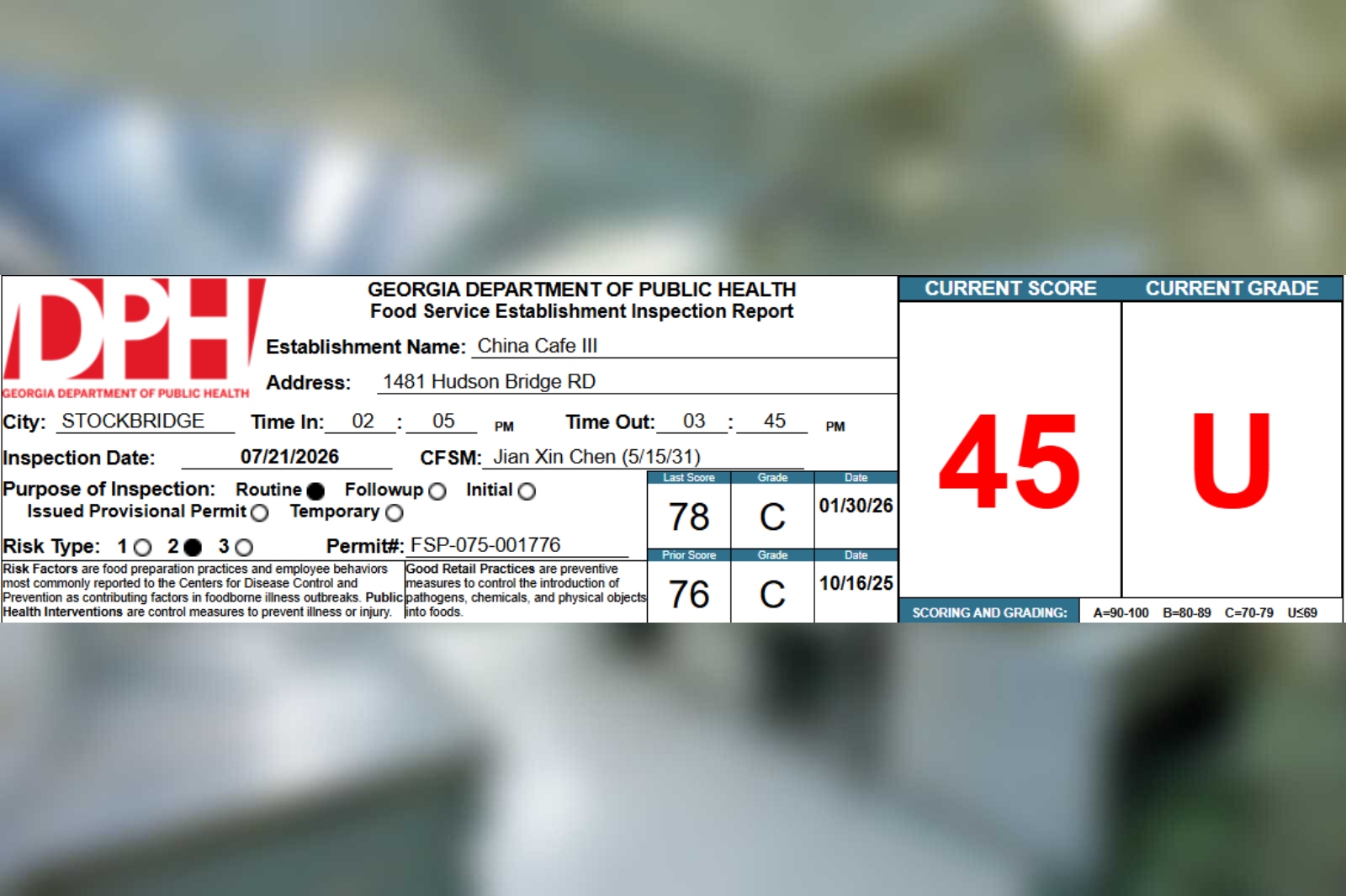
China Cafe III in Stockbridge receives a 45% on their recent health inspection

Follow China Cafe III in Stockbridge receives a 45% on their recent health inspection

Get notified by email when this case is updated.

China Cafe III, located at 1481 Hudson Bridge Rd Ste i, Stockbridge, GA 30281, received a score of 45 points out of a possible 100 points during their 07/21/2026 inspection by the Georgia Department of Public Health.

The violations noted by the inspector were:

Violation #1:
2-1C – no bare hand contact with ready-to-eat foods or approved alternate method properly followed
511-6-1.04(4)(a)1,2,3,4(i) – preventing contamination from hands (p), (pf), (c)
Points: 9
Corrected during inspection?: Yes
Repeat: No
Inspector Notes: Observed bare-hand contact with ready-to eat food item (sweet and sour chicken). PIC discarded of item. 511-6-1.04(4)(a)1,2,3,4(i) – Preventing Contamination from Hands (P), (Pf), (C) (4) Protection From Contamination After Receiving. (a) Preventing Contamination from Hands. 1. Food employees shall wash their hands as specified under DPH Rule 511-6-1-.03(5). 2. Except when washing fruits and vegetables or as specified under subsection (a)4, food employees shall not contact exposed, ready-to-eat food with their bare hands and shall use suitable utensils such as deli tissue, spatulas, tongs, single-use gloves, or dispensing equipment. P 3. Food employees shall minimize bare hand and arm contact with exposed food that is not in a ready- to-eat form. Pf 4. Paragraph (a)2. of this subsection does not apply to a food employee that contacts exposed, ready-to eat food with bare hands at the time the ready-to-eat food is being added as an ingredient to a food that: (i) contains a raw animal food and is to be cooked in the food service establishment to heat all parts of the food to at least the minimum time/temperatures specified in DPH Rule 511-6-1-.04(5)(a)1 and 2 and DPH Rule 511-6-1-.04(5)(b); P

Violation #2:
2-2B – proper eating, tasting, drinking, or tobacco use
511-6-1.03(5)(k)1&2 – eating, drinking, or using tobacco (c)
Points: 4
Corrected during inspection?: No
Repeat: Yes
Inspector Notes: Observed employee water bottle stored next to single use cups at front service area. 511-6-1.03(5)(k)1&2 – Eating, Drinking, or Using Tobacco (C) (k) Hygienic Practices. 1. Employees shall not use any form of tobacco products, or electronic devices that simulate tobacco smoking, while engaged in food preparation or service, nor while in areas used for equipment or utensil washing and storage, food preparation or food storage. Employees shall only use tobacco products or electronic devices that simulate tobacco smoking in approved designated areas. 2. Employees shall consume food only in approved designated areas separate from food preparation and serving areas, equipment or utensil areas and food storage areas. However, drinking from a single service beverage cup with a secure lid and straw that is handled to prevent contamination of the employee’s hands, the container, exposed food, clean equipment, utensils and linens, unwrapped single-service and single-use articles will be allowed.

Violation #3:
2-2D – adequate handwashing facilities supplied & accessible
511-6-1.07(3)(b) – hand drying provision (pf)
Points: 4
Corrected during inspection?: Yes
Repeat: No
Inspector Notes: Observed no hand drying provision at handwashing sink in main kitchen. PIC provided paper towels. 511-6-1.07(3)(b) – Hand Drying Provision (Pf) (b) Hand Drying Provision. Each handwashing sink or group of adjacent handwashing sinks shall be provided with: 1. Individual, disposable towels; Pf 2. A continuous towel system that supplies the user with a clean towel; Pf 3. A heated-air hand drying device; Pf or 4. A hand drying device that employs an air-knife system that delivers high velocity, pressurized air at ambient temperatures.Pf

Violation #4:
4-1A – food separated and protected
511-6-1.04(4)(c)1(i)(ii)(iii)(v)(vi)(vii)(viii) – packaged & unpackaged food separation, packaging, and segregation (p, c)
Points: 9
Corrected during inspection?: No
Repeat: No
Inspector Notes: Observed raw chicken stored next to pooled eggs and adjacent to sauces in walk-in cooler. Also observed raw chicken stored next to the cooked sweet and sour chicken and cherries in prep top cooler. 511-6-1.04(4)(c)1(i)(ii)(iii)(v)(vi)(vii)(viii) – Packaged & Unpackaged Food Separation, Packaging, and Segregation (P, C) (c) Packaged and Unpackaged Food – Separation, Packaging, and Segregation. 1. Food shall be protected from cross contamination by: (i) Except as specified in paragraph (i)(IV) of this subsection, separating raw animal foods during storage, preparation, holding, and display from: (I) Raw ready-to-eat food including other raw animal food such as fish for sushi or molluscan shellfish, or other raw ready-to-eat food such as fruits and vegetables, P and (II) Cooked ready-to-eat food; and P (III) Fruits and vegetables before they are washed; P (IV) Frozen, commercially processed and packaged raw animal food may be stored or displayed with or above frozen, commercially processed and packaged, ready-to-eat food. (ii) Except when combined as ingredients, separating types of raw animal foods from each other such as beef, fish, lamb, pork, and poultry during storage, preparation, holding, and display by: (I) Using separate equipment for each type, P or (II) Arranging each type of food in equipment so that cross contamination of one type with another is prevented, P and (III) Preparing each type of food at different times or in separate areas; P (iii) Cleaning and sanitizing equipment and utensils; (v) Cleaning hermetically sealed containers of food of visible soil before opening; (vi) Protecting food containers that are received packaged together in a case or overwrap from cuts when the case or overwrap is opened; (vii) Storing damaged, spoiled, or recalled food being held in the food service establishment separate from food, equipment, utensils, linens and single-service and single-use articles; or (viii) Separating fruits and vegetables, before they are washed from ready-to-eat food.

Violation #5:
6-1A – proper cold holding temperatures
511-6-1.04(6)(f) – time/temperature control for safety; cold holding (p)
Points: 9
Corrected during inspection?: No
Repeat: No
Inspector Notes: Observed beef and chicken stored in prep top cooler and ribs in reach-in cooler above 41F. 511-6-1.04(6)(f) – Time/Temperature Control for Safety; Cold Holding (P) (f) Time/Temperature Control for Safety Food, Hot and Cold Holding. Except during preparation, cooking, or cooling, or when time is used as the public health control, time/temperature control for safety food shall be maintained at 41°F (5°C) or below or 135°F (57°C) or above, except that roasts cooked to a temperature and for a time specified in subsection (5)(a)2 of this Rule and reheated using the same temperature and time conditions as cooking may be held at a temperature of 130°F (54°C) or above. P

Violation #6:
6-1B – proper hot holding temperatures
511-6-1.04(6)(f) – time/temperature control for safety; hot holding (p)
Points: 9
Corrected during inspection?: Yes
Repeat: No
Inspector Notes: Observed chicken wings stored below 135F. PIC discarded of items. 511-6-1.04(6)(f) – Time/Temperature Control for Safety; Hot Holding (P) (f) Time/Temperature Control for Safety Food, Hot and Cold Holding. Except during preparation, cooking, or cooling, or when time is used as the public health control, time/temperature control for safety food shall be maintained at 41°F (5°C) or below or 135°F (57°C) or above, except that roasts cooked to a temperature and for a time specified in subsection (5)(a)2 of this Rule and reheated using the same temperature and time conditions as cooking may be held at a temperature of 130°F (54°C) or above. P

Violation #7:
6-1C – proper cooling time and temperature
511-6-1.04(6)(d) – cooling (p)
Points: 9
Corrected during inspection?: Yes
Repeat: No
Inspector Notes: Observed cooked chicken, made at approximately 10 AM, not properly cooled in walk-in cooler. PIC discarded of items. 511-6-1.04(6)(d) – Cooling (P) (d) Cooling. 1. Cooked time/temperature control for safety food shall be cooled: (i) Within 2 hours from 135°F (57°C) to 70°F (21°C); P and (ii) Within a total of 6 hours from 135°F (57°C) to 41°F (5°C) or less. P 2. Time/temperature control for safety food shall be cooled within 4 hours to 41°F (5°C) or less if prepared from ingredients at ambient temperature, such as reconstituted foods and canned tuna. P 3. Except as specified under paragraph 4 of this subsection, a time/temperature control for safety food received in compliance with laws allowing a temperature above 41°F (5°C) during shipment from the supplier shall be cooled within 4 hours to 41°F (5°C). P 4. Raw eggs shall be received and immediately placed in refrigerated equipment that maintains an ambient air temperature of 41°F (5°C) or less. P

Violation #8:
6-2 – proper date marking and disposition
511-6-1.04(6)(g) – ready-to-eat time/temperature control for safety food, date marking (pf)
Points: 4
Corrected during inspection?: No
Repeat: No
Inspector Notes: Observed TCS food items in walk-in, reach-in freezer and reach-in coolers without proper date marking. 511-6-1.04(6)(g) – Ready-To-Eat Time/Temperature Control for Safety Food, Date Marking (Pf) (g) Ready-to-Eat Time/Temperature Control for Safety Food, Date Marking

Violation #9:
8-2B – toxic substances properly identified, stored, used
511-6-1.07(6)(b) – working containers, common name (pf)
Points: 4
Corrected during inspection?: No
Repeat: No
Inspector Notes: Observed degreaser and bleach bottles with no labeling. 511-6-1.07(6)(b) – Working Containers, Common Name (Pf) (b) Working Containers, Common Name. Working containers used for storing poisonous or toxic materials such as cleaners and sanitizers taken from bulk supplies shall be clearly and individually identified with the common name of the material. Pf

Violation #10:
11D – thermometers provided and accurate
511-6-1.05(2)(x) – tmd, located in refrigerators/ hot holding (pf, c)
Points: 3
Corrected during inspection?: No
Repeat: No
Inspector Notes: Observed no thermometer in reach-in cooler. 511-6-1.05(2)(x) – TMD, Located in Refrigerators/ Hot Holding (Pf, C) (x) Temperature Measuring Devices. 1. In a mechanically refrigerated or hot food storage unit, the sensor of a temperature measuring device shall be located to measure the air temperature in the warmest part of a mechanically refrigerated unit and in the coolest part of a hot food storage unit. 2. Except as specified in paragraph 3 of this subsection, cold or hot holding equipment used for time/temperature control for safety food shall be designed to include and shall be equipped with at least one integral or permanently affixed temperature measuring device that is located to allow easy viewing of the device’s temperature display. 3. The requirement in paragraph 2 of this subsection does not apply to equipment for which the placement of a temperature measuring device is not a practical means for measuring the ambient air surrounding the food because of the design, type, and use of the equipment such as insulated food transport containers and salad bars. 4. Temperature measuring devices shall be designed to be easily readable. 5. Food temperature measuring devices and water temperature measuring devices on warewashing machines shall have a numerical scale, printed record, or digital readout in increments no greater than 1ºC or 2ºF in the intended range of use. Pf

Violation #11:
12A – contamination prevented during food preparation, storage, display
511-6-1.04(4)(q) – food storage (c)
Points: 3
Corrected during inspection?: Yes
Repeat: No
Inspector Notes: Observed dirty rag covering cooked chicken wings stored on top of warmer. PIC discarded of food item. Also observed rice noodles uncovered on counter. 511-6-1.04(4)(q) – Food Storage (C) (q) Food Storage. 1. Except as specified in paragraphs 2 and 3 of this subsection, food shall be protected from contamination by storing the food: (i) In a clean, dry location; (ii) Where it is not exposed to splash, dust, or other contamination; and (iii) At least 6 inches (15 cm) above the floor. 2. Food in packages and working containers may be stored less than 6 inches (15 cm) above the floor on case lot handling equipment if the equipment can be moved by hand or by conveniently available apparatuses such as hand trucks and forklifts. 3. Pressurized beverage containers, cased food in waterproof containers such as bottles or cans, and milk containers in plastic crates may be stored on a floor that is clean and not exposed to floor moisture

Violation #12:
12C – wiping cloths: properly used and stored
511-6-1.04(4)(m) – wiping cloths, use limitation (c)
Points: 3
Corrected during inspection?: Yes
Repeat: No
Inspector Notes: Observed no wiping clothes in chlorine sanitizer solution prepared to properly clean and sanitize food contact surfaces. PIC made sanitizer solution. 511-6-1.04(4)(m) – Wiping Cloths, Use Limitation (C) (m) Wiping Cloths, Use Limitation. 1. Cloths in-use for wiping food spills from tableware and carry-out containers that occur as food is being served shall be: (i) Maintained dry; and (ii) Used for no other purpose. 2. Cloths in-use for wiping counters and other equipment surfaces shall be: (i) Held between uses in a chemical sanitizer solution at a concentration specified under DPH Rule 511-6-1-.05(6)(n); and (ii) Laundered daily. 3. Cloths in-use for wiping surfaces in contact with raw animal foods shall be kept separate from cloths used for other purposes. 4. Dry wiping cloths and the chemical sanitizing solutions in which wet wiping cloths are held between uses shall be free of food debris and visible soil. 5. Containers of chemical sanitizing solutions in which wet wiping cloths are held between uses shall be stored off the floor and used in a manner that prevents contamination of food, equipment, utensils, linens, single-service, or single-use articles. 6. Single-use disposable sanitizer wipes shall be used in accordance with EPA-approved manufacturer’s label use instructions.

Violation #13:
13A – posted: permit/inspection/choking poster/handwashing
511-6-1.02(1)(d) – displaying of the inspection report (c)
Points: 1
Corrected during inspection?: No
Repeat: Yes
Inspector Notes: Observed inspection report not properly posted. 511-6-1.02(1)(d) – Displaying of the Inspection Report (C) 1. The most current inspection report shall be prominently displayed in public view at all times, within fifteen feet of the front or primary public door and between five feet and seven feet from the floor and in an area where it can be read at a distance of one foot away. 2. Food service establishments with drive-thru windows will post the current inspection report, and also have the inspection report posted so that a minimum of the top one-third of a copy of the current inspection report is visible through each window allowing customers to easily read the score, date of inspection and establishment information. 3. At food service establishments with no primary or public door, the current inspection report shall be prominently displayed at all times where the documents can be read by the public from a distance of one foot away. If requirements of this paragraph are not possible because of physical restrictions, a location will be determined as approved by the Health Authority. 4. The most current inspection report for mobile food service units and extended food service units issued by the local Health Authority having jurisdiction for its inspections shall be prominently displayed in public view during all hours of operation. Such inspection reports shall be prominently displayed at the point of service where the documents can be read by the public from a distance of one foot away. 5. A food service establishment inspection report addendum need not be displayed, but shall be made available by the food service establishment to the public upon request.

Violation #14:
14A – in-use utensils: properly stored
511-6-1.04(4)(k) – in-use utensils, between-use storage (c)
Points: 1
Corrected during inspection?: Yes
Repeat: Yes
Inspector Notes: Observed rice spoon stored in stagnant water. PIC removed water from container. Also observed tongs improperly stored in food prep area and spoon improperly stored in sugar. 511-6-1.04(4)(k) – In-Use Utensils, Between-Use Storage (C) (k)Storage of In-Use Utensils. During pauses in food preparation or dispensing, food preparation and dispensing utensils shall be stored: 1.Except as specified under paragraph 2 of this subsection, in the food with their handles above the top of the food and the container; 2.In food that is not time/temperature control for safety food with their handles above the top of the food within containers or equipment that can be closed, such as bins of sugar, flour, or cinnamon; 3.On a clean portion of the food preparation table or cooking equipment only if the in-use utensil and the food-contact surface of the food preparation table or cooking equipment are cleaned and sanitized at a frequency specified under DPH Rule 511-6-1-.05(7)(b) and (8)(a); 4.In running water of sufficient velocity to flush particulates to the drain, if used with moist food such as ice cream or mashed potatoes; 5. In a clean, protected location if the utensils, such as ice scoops, are used only with a food that is not time/temperature control for safety food; or 6. In a container of water if the water is maintained at a temperature of at least 135°F (57°C) and the container is cleaned at a frequency specified under DPH Rule 511-6-1-.05(7)(b)3(vi).

Violation #15:
14C – single-use/single-service articles: properly stored, used
511-6-1.05(10)(e)1&3 – single-service/single-use items stored 6″ off floor in clean, dry location (c)
Points: 1
Corrected during inspection?: No
Repeat: No
Inspector Notes: Observed single-use items stored directly on floor. 511-6-1.05(10)(e)1&3 – Single-Service/Single-Use items stored 6″ off floor in clean, dry location (C) (e) Equipment, Utensils, Linens, and Single-Service and Single-Use Articles. 1. Except as specified in paragraph 4 of this subsection, cleaned equipment and utensils, laundered linens, and single-service and single-use articles shall be stored: (i) In a clean, dry location; (ii) Where they are not exposed to splash, dust, or other contamination; and (iii) At least 6 inches (15 centimeters) above the floor. 3. Single-service and single-use articles shall be stored as specified under paragraph 1 of this subsection and shall be kept in the original protective package or stored by using other means that afford protection from contamination until used.

Violation #16:
17A – toilet facilities: properly constructed, supplied, cleaned
511-6-1.07(2)(l) – toilet rooms, enclosed (c)
Points: 1
Corrected during inspection?: No
Repeat: No
Inspector Notes: Observed restroom doors without self closure mechanism. 511-6-1.07(2)(l) – Toilet Rooms, Enclosed (C) (l) Toilet Rooms, Enclosed. Except where a toilet room is located outside a food service establishment and does not open directly into the food service establishment, such as a toilet room that is provided by the management of a shopping mall, a toilet room located on the premises shall be completely enclosed and provided with a tight-fitting and self-closing door.

Violation #17:
17B – garbage/refuse properly disposed; facilities maintained
511-6-1.06(5)(o),(p) – using drain plugs; maintaining refuse areas (c)
Points: 1
Corrected during inspection?: No
Repeat: No
Inspector Notes: Observed excessive garbage trash accumulation around outside dumpster. 511-6-1.06(5)(o),(p) – Using Drain Plugs; Maintaining Refuse Areas (C) (o) Using Drain Plugs. Drains in receptacles and waste handling units for refuse, recyclables, and returnables shall have drain plugs in place. (p) Maintaining Refuse Areas and Enclosures. A storage area and enclosure for refuse, recyclables, or returnables shall be maintained free of unnecessary items and clean.

Violation #18:
17D – adequate ventilation and lighting; designated areas used
511-6-1.07(4)(b) – designated areas for employee activity, located to prevent contamination of food, equipment, utensils, linens, & single service articles (c)
Points: 1
Corrected during inspection?: No
Repeat: No
Inspector Notes: Observed employee phone and drinks improperly stored. 511-6-1.07(4)(b) – Designated Areas for Employee Activity, located to prevent contamination of food, equipment, utensils, linens, & single service articles (C) (b) Designated Areas for Employee Activity. 1. Areas designated for employees to eat, drink, use tobacco products and electronic devices shall be located so that food, equipment, linens, and single-service and single-use articles are protected from contamination. 2. Lockers or other suitable facilities shall be located in a designated room or area where contamination of food, equipment, utensils, linens and single-service and single-use articles cannot occur.

Violation #19:
18 – insects, rodents, and animals not present
511-6-1.07(2)(m) – outer openings protected (c)
Points: 3
Corrected during inspection?: No
Repeat: No
Inspector Notes: Observed back screen door damaged and not tightly fitted. 511-6-1.07(2)(m) – Outer Openings Protected (C) (m) Outer Openings, Protected. 1. Except as specified in paragraphs 2 through 5 of this subsection, outer openings of a food service establishment shall be protected against the entry of insects and rodents by: (i) Filling or closing holes and other gaps along floors, walls, and ceilings; (ii) Closed, tight-fitting windows; and (iii) Solid, self-closing, tight-fitting doors. 2. The requirements in paragraph 1 of this subsection does not apply if a food service establishment opens into a larger structure, such as a mall, airport, or office building, or into an attached structure, such as a porch, and the outer openings from the larger or attached structure are protected against the entry of insects and rodents. 3. Exterior doors used as exits need not be self-closing if they are: (i) Solid and tight-fitting; (ii) Designated for use only when an emergency exists, by the fire protection authority that has jurisdiction over the food establishment; and (iii) Limited-use so they are not used for entrance or exit from the building for purposes other than the designated emergency exit use. 4. Except as specified in paragraphs 2 and 5 of this subsection, if the windows or doors of a food service establishment, or of a larger structure within which a food service establishment is located, are kept open for ventilation or other purposes or a temporary food service establishment is not provided with windows and doors as specified under paragraph 1 of this subsection, the openings shall be protected against the entry of insects and rodents by: (i) 16 mesh to 1 inch (16 mesh to 25.4 mm) screens; (ii) Properly designed and installed air curtains to control flying insects; or (iii) Other effective means. 5. The requirement in paragraph 4 of this subsection does not apply if flying insects and other pests are absent due to the location of the establishment, the weather, or other limiting condition.

Additional remarks:
Inspection was conducted with EHS IV Robert Lewis. The state audit and false inspections were discussed with the PIC.

CLICK HERE to read the full report