Get notified by email when this case is updated.
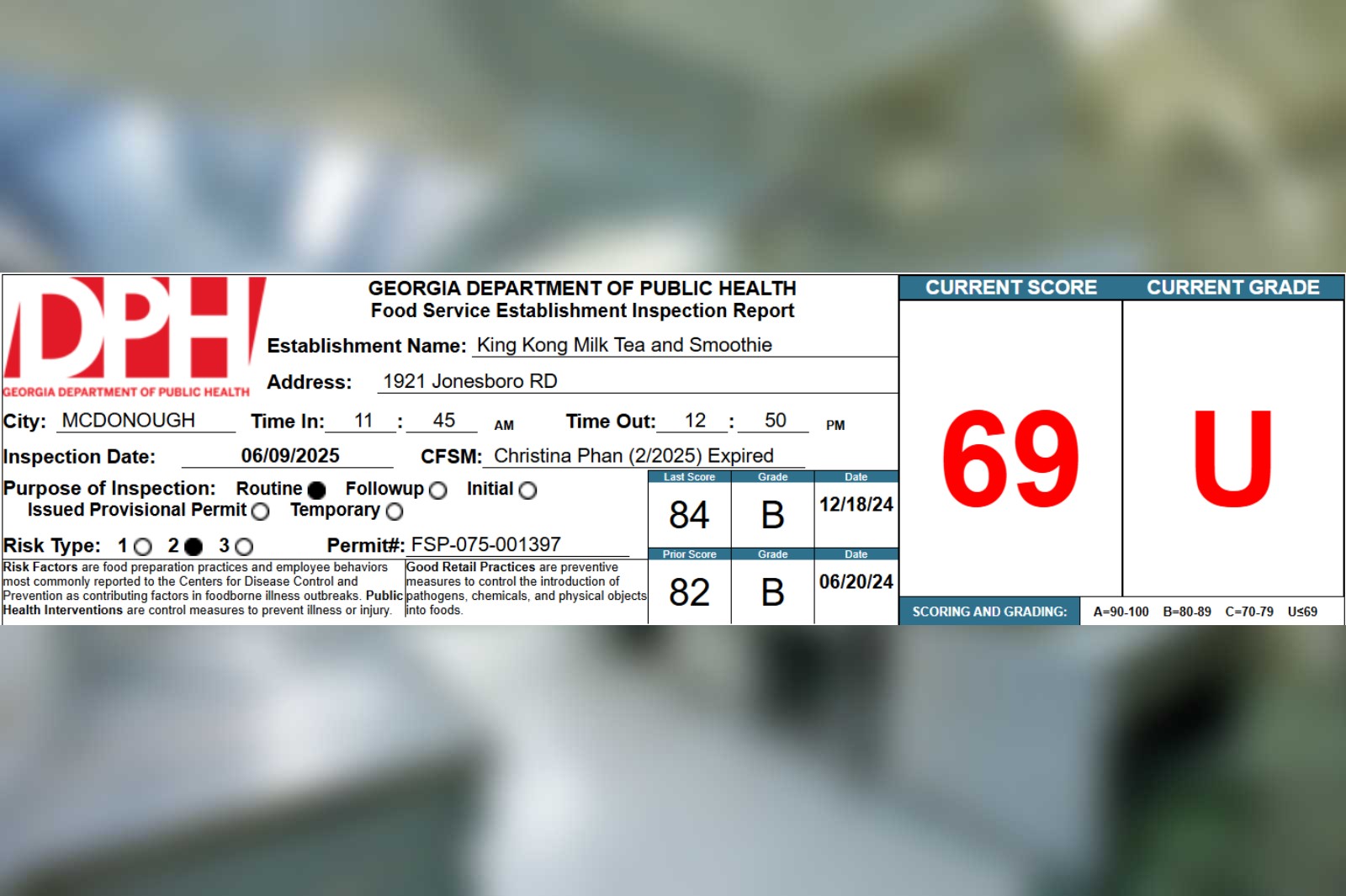
King Kong Milk Tea and Smoothie, located at 1921 Jonesboro Rd in McDonough, received a score of 69 points out of a possible 100 points during their 06/09/2025 inspection by the Georgia Department of Public Health.
The violations noted by the inspector were:
Violation #1:
1-2B – certified food protection manager
511-6-1.03(3)(c) – certification documentation (pf)
Points: 4
Corrected during inspection?: No
Repeat: No
Inspector Notes: Observed expired food safety manager certifications. 511-6-1.03(3)(c) – Certification Documentation (Pf) 1. The original CFSM certificate shall be posted in public view in each food service establishment. An additional copy shall be retained on file at the food service establishment at all times, and shall be made available for inspection by the Health Authority. 2. A CFSM certificate which has expired, been revoked or suspended shall not be posted in the food service establishment. 3. All licenses, certificates, diplomas, or other similar credentials issued or granted to an owner or operator who has successfully completed an approved or accredited food safety certification course and exam shall expire on the expiration date determined by the credentialing organization. Within ninety days of the expiration of the CFSM certificate, the CFSM shall enroll in an approved food safety training course, pass an approved exam and obtain a new certificate. 4. The certification is not transferable between persons.
Violation #2:
4-2B – food-contact surfaces: cleaned & sanitized
511-6-1.05(7)(b) – food contact surfaces and utensils – cleaning frequency (p, c)
Points: 4
Corrected during inspection?: No
Repeat: No
Inspector Notes: Observed black and pink accumulation on deflector of ice machine, and black accumulation in interior of front service ice machine. 511-6-1.05(7)(b) – Food Contact Surfaces and Utensils – Cleaning Frequency (P, C) (b) Equipment Food-Contact Surfaces and Utensils. 1. Equipment food-contact surfaces and utensils shall be cleaned: (i) Before each use with a different type of raw animal food such as beef, fish, lamb, pork, or poultry. It does not apply if the food-contact surface or utensil is in contact with a succession of different types of raw meat and raw poultry each requiring a higher cooking temperature as specified under DPH Rule 511-6-1.04(5)(a) than the previous type such as preparing raw pork followed by cutting raw poultry on the same cutting board; P (ii) Each time there is a change from working with raw foods to working with ready-to-eat foods; P (iii) Between uses with raw fruits and vegetables and with Time/Temperature Control for safety food; P (iv) Before using or storing a food temperature measuring device; P and (v) At any time during the operation when contamination may have occurred. P 2. Except as specified in paragraph 3 of this subsection, if used with time/temperature control for safety food, equipment food-contact surfaces and utensils shall be cleaned at least every 4 hours throughout the day. P 3. Surfaces of utensils and equipment contacting time/temperature control for safety food may be cleaned less frequently than every 4 hours if: (i) In storage, containers of time/temperature control for safety food and their contents are maintained at temperatures specified under DPH Rule 511-6-1-.04 and the containers are cleaned when they are empty; (ii) Utensils and equipment are used to prepare food in a refrigerated room or area that is maintained at one of the temperatures in the following chart and: (I) The utensils and equipment are cleaned at the frequency in the following chart that corresponds to the temperature: Temperature Cleaning Frequency 41ºF (5.0ºC) or less 24 hours >41ºF – 45ºF (>5.0ºC – 7.2ºC) 20 hours >45ºF – 50ºF (>7.2ºC – 10.0ºC) 16 hours >50ºF – 55ºF (>10.0ºC – 12.8ºC) 10 hours and (II) The cleaning frequency based on the ambient temperature of the refrigerated room or area is documented in the food service establishment. (iii) Temperature measuring devices are maintained in contact with food, such as when left in a container of deli food or in a roast, held at temperatures specified under DPH Rule 511-6-1- .04; (iv) Equipment is used for storage of packaged or unpackaged food, such as a reach-in refrigerator, and the equipment is cleaned at a frequency necessary to preclude accumulation of soil residues; (v) The cleaning schedule is approved based on consideration of: (I) Characteristics of the equipment and its use, (II) The type of food involved, (III) The amount of food residue accumulation, and (IV) The temperature at which the food is maintained during the operation and the potential for the rapid and progressive multiplication of pathogenic or toxigenic microorganisms that are capable of causing foodborne disease; or (vi) In-use utensils are intermittently stored in a container of water in which the water is maintained at 135ºF (57ºC) or more and the utensils and container are cleaned at least every 24 hours or at a frequency necessary to preclude accumulation of soil residues. 4. Dining counters and table-tops shall be cleaned and sanitized routinely after removing all soiled tableware and food trays shall be cleaned and sanitized after each use by one of the following methods: (i) A two step method in which one cloth, rinsed in sanitizing solution is used to clean food debris from the surface and a second cloth in separate sanitizing solution is used to rinse; (ii) Sanitizing solution is sprayed onto the surface and the surface is then wiped clean with a disposable towel; (iii) If used for cleaning and sanitizing, single-use disposable sanitizer wipes shall be used in accordance with EPA-registered label use instructions; or (iv) Other methods approved by the Health Authority. (v) Food trays may be cleaned and sanitized the same as table ware. 5. Except when dry cleaning methods are used as specified under subsection (7)(e) of this Rule, surfaces of utensils and equipment contacting food that is not time/temperature control for safety food shall be cleaned: (i) At any time when contamination may have occurred; (ii) At least every 24 hours for iced tea dispensers including nozzles and consumer self-service utensils such as tongs, scoops, or ladles; (iii) Before restocking consumer self-service equipment and utensils such as condiment dispensers and display containers; and (iv) In equipment such as ice bins and beverage dispensing nozzles and enclosed components of equipment such as ice makers, cooking oil storage tanks and distribution lines, beverage and syrup dispensing lines or tubes, coffee bean grinders, and water vending equipment: (I) At a frequency specified by the manufacturer; or (II) Absent manufacturer specifications, at a frequency necessary to preclude accumulation of soil or mold.
Violation #3:
4-2B – food-contact surfaces: cleaned & sanitized
511-6-1.05(7)(b) – food contact surfaces and utensils – cleaning frequency (p, c)
Points: 4
Corrected during inspection?: No
Repeat: Yes
Inspector Notes: Observed black and pink accumulation on deflector of ice machine, and black accumulation in interior of front service ice machine. 511-6-1.05(7)(b) – Food Contact Surfaces and Utensils – Cleaning Frequency (P, C) (b) Equipment Food-Contact Surfaces and Utensils. 1. Equipment food-contact surfaces and utensils shall be cleaned: (i) Before each use with a different type of raw animal food such as beef, fish, lamb, pork, or poultry. It does not apply if the food-contact surface or utensil is in contact with a succession of different types of raw meat and raw poultry each requiring a higher cooking temperature as specified under DPH Rule 511-6-1.04(5)(a) than the previous type such as preparing raw pork followed by cutting raw poultry on the same cutting board; P (ii) Each time there is a change from working with raw foods to working with ready-to-eat foods; P (iii) Between uses with raw fruits and vegetables and with Time/Temperature Control for safety food; P (iv) Before using or storing a food temperature measuring device; P and (v) At any time during the operation when contamination may have occurred. P 2. Except as specified in paragraph 3 of this subsection, if used with time/temperature control for safety food, equipment food-contact surfaces and utensils shall be cleaned at least every 4 hours throughout the day. P 3. Surfaces of utensils and equipment contacting time/temperature control for safety food may be cleaned less frequently than every 4 hours if: (i) In storage, containers of time/temperature control for safety food and their contents are maintained at temperatures specified under DPH Rule 511-6-1-.04 and the containers are cleaned when they are empty; (ii) Utensils and equipment are used to prepare food in a refrigerated room or area that is maintained at one of the temperatures in the following chart and: (I) The utensils and equipment are cleaned at the frequency in the following chart that corresponds to the temperature: Temperature Cleaning Frequency 41ºF (5.0ºC) or less 24 hours >41ºF – 45ºF (>5.0ºC – 7.2ºC) 20 hours >45ºF – 50ºF (>7.2ºC – 10.0ºC) 16 hours >50ºF – 55ºF (>10.0ºC – 12.8ºC) 10 hours and (II) The cleaning frequency based on the ambient temperature of the refrigerated room or area is documented in the food service establishment. (iii) Temperature measuring devices are maintained in contact with food, such as when left in a container of deli food or in a roast, held at temperatures specified under DPH Rule 511-6-1- .04; (iv) Equipment is used for storage of packaged or unpackaged food, such as a reach-in refrigerator, and the equipment is cleaned at a frequency necessary to preclude accumulation of soil residues; (v) The cleaning schedule is approved based on consideration of: (I) Characteristics of the equipment and its use, (II) The type of food involved, (III) The amount of food residue accumulation, and (IV) The temperature at which the food is maintained during the operation and the potential for the rapid and progressive multiplication of pathogenic or toxigenic microorganisms that are capable of causing foodborne disease; or (vi) In-use utensils are intermittently stored in a container of water in which the water is maintained at 135ºF (57ºC) or more and the utensils and container are cleaned at least every 24 hours or at a frequency necessary to preclude accumulation of soil residues. 4. Dining counters and table-tops shall be cleaned and sanitized routinely after removing all soiled tableware and food trays shall be cleaned and sanitized after each use by one of the following methods: (i) A two step method in which one cloth, rinsed in sanitizing solution is used to clean food debris from the surface and a second cloth in separate sanitizing solution is used to rinse; (ii) Sanitizing solution is sprayed onto the surface and the surface is then wiped clean with a disposable towel; (iii) If used for cleaning and sanitizing, single-use disposable sanitizer wipes shall be used in accordance with EPA-registered label use instructions; or (iv) Other methods approved by the Health Authority. (v) Food trays may be cleaned and sanitized the same as table ware. 5. Except when dry cleaning methods are used as specified under subsection (7)(e) of this Rule, surfaces of utensils and equipment contacting food that is not time/temperature control for safety food shall be cleaned: (i) At any time when contamination may have occurred; (ii) At least every 24 hours for iced tea dispensers including nozzles and consumer self-service utensils such as tongs, scoops, or ladles; (iii) Before restocking consumer self-service equipment and utensils such as condiment dispensers and display containers; and (iv) In equipment such as ice bins and beverage dispensing nozzles and enclosed components of equipment such as ice makers, cooking oil storage tanks and distribution lines, beverage and syrup dispensing lines or tubes, coffee bean grinders, and water vending equipment: (I) At a frequency specified by the manufacturer; or (II) Absent manufacturer specifications, at a frequency necessary to preclude accumulation of soil or mold.
Violation #4:
6-1A – proper cold holding temperatures
511-6-1.04(6)(f) – time/temperature control for safety; cold holding (p)
Points: 9
Corrected during inspection?: No
Repeat: No
Inspector Notes: Observed waffle mix containing dairy at a temperature above 41F. PIC was advised to discard item.Violation Code Reference 511-6-1.04(6)(f) – Time/Temperature Control for Safety; Cold Holding (P) (f) Time/Temperature Control for Safety Food, Hot and Cold Holding. Except during preparation, cooking, or cooling, or when time is used as the public health control, time/temperature control for safety food shall be maintained at 41°F (5°C) or below or 135°F (57°C) or above, except that roasts cooked to a temperature and for a time specified in subsection (5)(a)2 of this Rule and reheated using the same temperature and time conditions as cooking may be held at a temperature of 130°F (54°C) or above. P
Violation #5:
12A – contamination prevented during food preparation, storage, display
511-6-1.04(4)(q) – food storage (c)
Points: 3
Corrected during inspection?: No
Repeat: No
Inspector Notes: Observed powder mix stored directly on the floor in dry storage room.511-6-1.04(4)(q) – Food Storage (C) (q) Food Storage. 1. Except as specified in paragraphs 2 and 3 of this subsection, food shall be protected from contamination by storing the food: (i) In a clean, dry location; (ii) Where it is not exposed to splash, dust, or other contamination; and (iii) At least 6 inches (15 cm) above the floor. 2. Food in packages and working containers may be stored less than 6 inches (15 cm) above the floor on case lot handling equipment if the equipment can be moved by hand or by conveniently available apparatuses such as hand trucks and forklifts. 3. Pressurized beverage containers, cased food in waterproof containers such as bottles or cans, and milk containers in plastic crates may be stored on a floor that is clean and not exposed to floor moisture.
Violation #6:
14C – single-use/single-service articles: properly stored, used
511-6-1.05(10)(e)1&3 – single-service/single-use items stored 6″ off floor in clean, dry location (c)
Points: 1
Corrected during inspection?: No
Repeat: Yes
Inspector Notes: Observed single-service cups stored directly on the floor in the dry storage area. 511-6-1.05(10)(e)1&3 – Single-Service/Single-Use items stored 6″ off floor in clean, dry location (C) (e) Equipment, Utensils, Linens, and Single-Service and Single-Use Articles. 1. Except as specified in paragraph 4 of this subsection, cleaned equipment and utensils, laundered linens, and single-service and single-use articles shall be stored: (i) In a clean, dry location; (ii) Where they are not exposed to splash, dust, or other contamination; and (iii) At least 6 inches (15 centimeters) above the floor. 3. Single-service and single-use articles shall be stored as specified under paragraph 1 of this subsection and shall be kept in the original protective package or stored by using other means that afford protection from contamination until used.
Violation #7:
15B – warewashing facilities: installed, maintained, used; test strips
511-6-1.05(6)(p) – warewashing equipment, determining chemical sanitizer concentration (pf)
Points: 1
Corrected during inspection?: No
Repeat: Yes
Inspector Notes: Observed no accurate test strips provided in the establishment to test chlorine sanitizer solution. 511-6-1.05(6)(p) – Warewashing Equipment, Determining Chemical Sanitizer Concentration (Pf) (p) Warewashing Equipment, Determining Chemical Sanitizer Concentration. Concentration of the sanitizing solution shall be accurately determined by using a test kit or other device. Pf.
Violation #8:
15C – nonfood-contact surfaces clean
511-6-1.05(7)(a)2,3 – equipment, food/nonfood-contact surfaces, and utensils, food-contact surfaces of cooking equipment & nonfood-contact surfaces free of accumulations (c)
Points: 1
Corrected during inspection?: No
Repeat: No
Inspector Notes: Observed interior of washing/dump sink with black accumulation and excessive water accumulation in the reach-in cooler under the prep-top cooler. Also observed excessive grease accumulation on the table adjacent to the grills. 511-6-1.05(7)(a)2,3 – Equipment, Food/Nonfood-Contact Surfaces, and Utensils, food-contact surfaces of cooking equipment & nonfood-contact surfaces free of accumulations (C) 2. The food-contact surfaces of cooking equipment and pans shall be kept free of encrusted grease deposits and other soil accumulations. 3. Nonfood-contact surfaces of equipment shall be kept free of an accumulation of dust, dirt, food residue, and other debris.
Violation #9:
17B – garbage/refuse properly disposed; facilities maintained
511-6-1.06(5)(o),(p) – using drain plugs; maintaining refuse areas (c)
Points: 1
Corrected during inspection?: No
Repeat: No
Inspector Notes: Observed trash accumulation around outside dumpsters. 511-6-1.06(5)(o),(p) – Using Drain Plugs; Maintaining Refuse Areas (C) (o) Using Drain Plugs. Drains in receptacles and waste handling units for refuse, recyclables, and returnables shall have drain plugs in place. (p) Maintaining Refuse Areas and Enclosures. A storage area and enclosure for refuse, recyclables, or returnables shall be maintained free of unnecessary items and clean.
Violation #10:
17C – physical facilities installed, maintained, and clean
511-6-1.07(5)(a),(b) – good repair, physical facilities maintained; cleaning, frequency & restrictions, cleaned often enough to keep them clean (c)
Points: 1
Corrected during inspection?: No
Repeat: No
Inspector Notes: Observed the floors under the fryer with excessive grease accumulation.
Violation #11:
18 – insects, rodents, and animals not present
511-6-1.07(5)(l) – removing dead or trapped birds, insects, rodents, and other pest (c)
Points: 3
Corrected during inspection?: No
Repeat: Yes
Inspector Notes: Observed dead insects in dry food storage area and excessive dead insects in traps at the back door and in the dry storage area. Also observed spider webs in storage area near back door. 511-6-1.07(5)(l) – Removing Dead or Trapped Birds, Insects, Rodents, and Other Pest (C) (l) Removing Dead or Trapped Birds, Insects, Rodents, and Other Pests. Dead or trapped birds, insects, rodents, and other pests shall be removed from control devices and the premises at a frequency that prevents their accumulation, decomposition, or the attraction of pests.
Additional remarks:
Please provide updated food safety manager documentation to rachel.williams@dph.ga.gov. Follow-up inspection required within 10 days. Before re-inspection can occur a fee must be provided to the Henry County Environmental Health Department.
CLICK HERE to read the full report
Get notified by email when this case is updated.
